TRANSMISSION // 2611.31745v1
How Two Mesons Reveal Their Inner Structure
Source published
Tensor-network calculations in the massive Schwinger model find distinct momentum patterns for vector and scalar mesons, shaped by charge conjugation. The study also maps where its results remain uncertain.
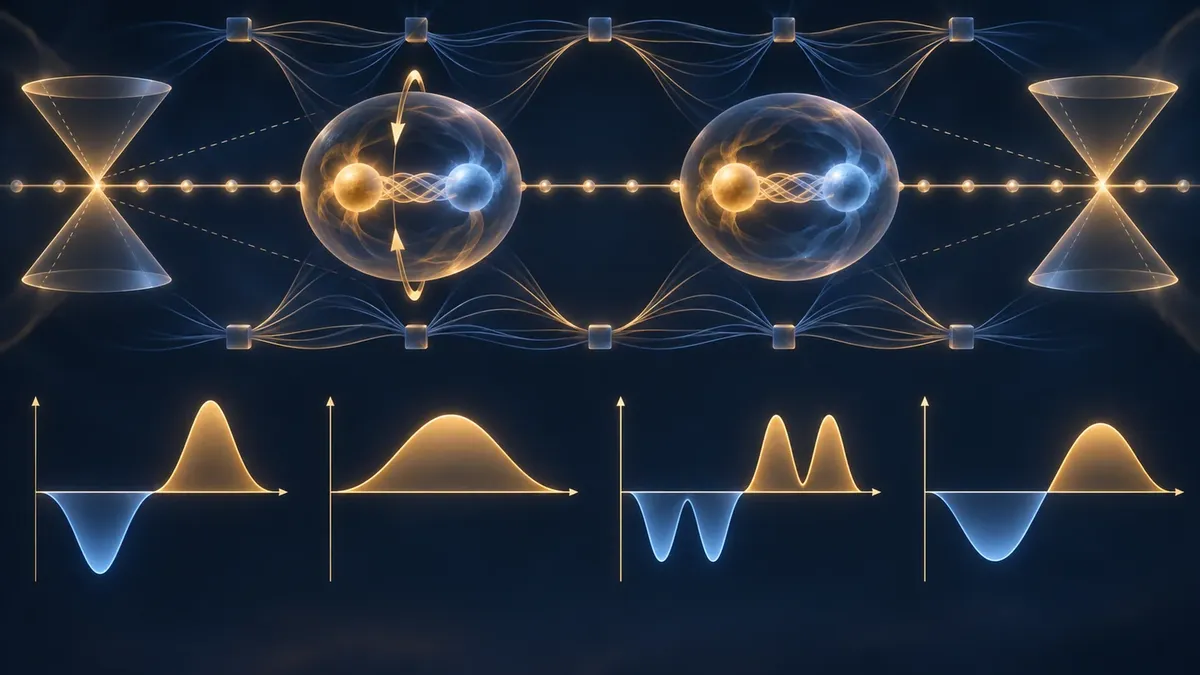
A meson’s constituents are bound together by fields that make its internal structure difficult to calculate directly. A tensor-network study uses a one-dimensional gauge theory to calculate two kinds of light-cone distributions for vector and scalar mesons—and finds sharply different patterns linked to each meson’s charge-conjugation symmetry.
Understanding how a meson’s constituents share its momentum is a central problem in particle physics. Two useful descriptions are the parton distribution function (PDF), which tracks the momentum carried by constituents, and the light-cone distribution amplitude (LCDA), which describes the meson’s quark–antiquark component. Both are defined by correlations at lightlike separations. Those real-time correlations are not directly accessible with standard Euclidean-time lattice calculations.
Juan Hormaza and Wenyang Qian investigate whether tensor-network methods can calculate these distributions directly in a simpler gauge theory: the massive Schwinger model, or quantum electrodynamics in one space and one time dimension. The model shares features such as confinement and bound states with more complicated theories, but it is much more tractable. It is a testing ground, not a substitute for calculations of real-world hadrons in quantum chromodynamics.
Preparing mesons and following real-time correlations
The researchers put the model on a spatial lattice using the Kogut–Susskind Hamiltonian formulation. They eliminate the gauge field using Gauss’s law, then represent the vacuum and meson states as matrix product states, a type of tensor network suited to one-dimensional systems. They identify the vector and scalar mesons by their approximate charge-conjugation properties and momentum. The scalar is an excited state, so distinguishing it from other states in the finite system requires particular care.
To calculate the distributions, the team evaluates gauge-invariant correlations along a discretized light-cone path. They approximate the path with alternating real-time evolution and spatial transport, and use time-evolving block decimation to evolve the states. Fourier transforms of the resulting correlations yield the PDFs and LCDAs.
The calculations cover four fermion masses, on a finite lattice with open boundaries. The authors check convergence against choices such as tensor-network bond dimension and electric-flux cutoff, and compare results at several lattice spacings while holding physical volume fixed. These checks test numerical control, but do not remove all finite-size or lattice effects.
Symmetry leaves different fingerprints
The vector meson’s PDF has a peak at positive momentum fraction and an opposite-sign mirror peak at negative momentum fraction, reflecting the antiquark convention used for the PDF. Its LCDA, by contrast, is symmetric about equal sharing of momentum between the two constituents.
The scalar meson looks different: its PDF has two peaks with a dip between them, while its LCDA is antisymmetric and crosses zero at equal momentum sharing. These shapes follow from charge conjugation, a symmetry that exchanges particles and antiparticles. For the scalar meson, that symmetry requires the LCDA to change sign when the two momentum fractions are exchanged. Its integral—the zeroth moment—therefore vanishes, so the researchers normalize it using the first moment instead.
The team also compares decay constants calculated from local matrix elements with values obtained from LCDA moments. The two approaches agree well at the larger masses studied; at the lightest mass, the agreement is poorer, especially for the scalar. The decay constants approach predictions from a nonrelativistic model as the fermion mass increases, but the authors report substantial disagreement with that model at the lightest mass. This is a regime-dependent comparison, not evidence that the approximation works throughout the model.
For the relatively large masses investigated, the PDFs broadly follow the normalized squared LCDAs. In this one-dimensional setting, that similarity is expected for a meson dominated by a single fermion–antifermion pair, or valence component. It suggests that this component dominates in the studied regime, but does not prove that other components are absent.
Where the result is less certain
The scalar meson is more affected by the calculation’s limitations. Open boundaries and the lattice discretization break charge conjugation slightly, and this affects the excited scalar state. Its PDF also retains a nonzero dip at equal momentum sharing, where the valence-only squared LCDA would vanish. The authors say this could reflect contributions beyond the valence component, finite-volume effects, or lattice artifacts; their calculations do not separate these explanations. They specifically call for more systematic studies of volume and correlator range.
The findings are numerical results for a low-dimensional model and selected masses, not predictions for the full structure of ordinary mesons. The paper is an arXiv preprint, and its claims should be read as research in progress rather than as established consensus. Its contribution is methodological as well as physical: it demonstrates a direct real-time tensor-network route to PDFs and LCDAs for both ground and excited states in this model.
- tensor networks
- Schwinger model
- meson structure
- parton distribution functions
- light-cone distribution amplitudes
- lattice gauge theory
Related reading
Automatically matched by shared topic keywords. These links do not imply that the sources agree or establish a consensus.
A quantum processor watches electric strings spread
Source published
Shared keywords: lattice gauge theory
How a tiny gauge-theory ladder approaches thermal equilibrium
Source published
Shared keywords: lattice gauge theory
How many electric-field levels does a quantum simulation need?
Source published
Shared keywords: lattice gauge theory
Cold atoms stage meson–baryon conversion
Source published
Shared keywords: lattice gauge theory
A broader message-passing method for tensor networks
Source published
Shared keywords: tensor networks