TRANSMISSION // 2611.31736v1
Why a simulator that gets history right can fail a what-if
Source published
A program can match past records yet mishandle a new change. Researchers test Vouch, a tool that checks each what-if answer against targeted rules.
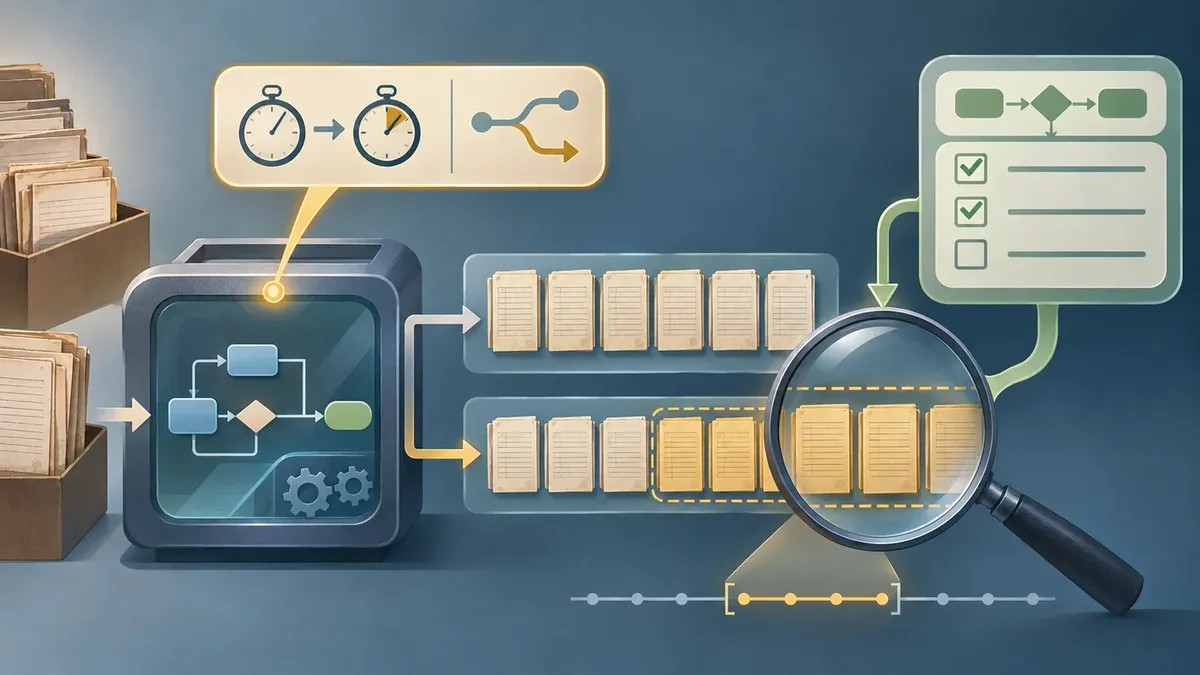
A simulator that reproduces yesterday’s records may still get a hypothetical wrong. A preprint introduces Vouch, a system that tests whether generated simulators handle the particular change a question asks about.
A program can appear reliable because it reproduces recorded events exactly. But that does not prove it will handle a situation the records never contained. If every loan applicant in the history took one day to fill out a form, for instance, a simulator that hard-codes “one day” can match every past case—and still give a wrong answer when asked what happens if someone takes one second.
That gap is the focus of a preprint on Vouch, a library designed to assess individual answers from simulators written by large language models (LLMs). Rather than certify or reject a program once and for all, Vouch asks whether it passed checks relevant to the specific change in a what-if question.
Checking the change, not just the history
A typical history check compares a program’s output with recorded outcomes. It can reveal errors on past cases, but not necessarily a faulty assumption that history never tested. A what-if question poses a different challenge: change a duration, remove a worker, alter a route, or revise a policy, then predict the result.
For each question, Vouch turns the requested change into a structured description and checks it against the process document and records. It then runs the program on the queried run’s unchanged inputs and requires it to reproduce that run’s recorded outcomes exactly. Finally, it runs targeted tests based on the requested change. For example, if an input is altered, the program should respond when that input is used; if a worker is unavailable, that worker should not start tasks during the specified period. Some tests use the question’s own change, while others make a small related change to check a rule.
These are “metamorphic” tests: instead of checking an output against a known answer, they check relationships that should hold between outputs when inputs change. The tests are built from the process rules and records, not from reference answers. Vouch does not calculate the what-if answer itself. It releases the simulator’s answer only when the request is valid, the history check passes, and relevant tests provide evidence without a failure. If testing is impossible, it may abstain. It also records test failures so that later questions involving the same kind of change can be declined.
What the study found
The researchers evaluated 86 generated programs from three program-generation platforms and five language models, spanning manufacturing, IT operations, and loan and pharmacy workflows. The test set included 9,792 program–question pairs. Comparisons included platform acceptance checks, history checks, other rule-based tests, LLM judges, and an agent allowed to run the program. Independently checked reference simulators supplied the answers used to assess correctness.
In the main results for programs built by Claude Haiku and Sonnet, platform checks allowed 277 wrong answers through. A history check alone left 207; Vouch left five while releasing answers for 80.1% of program–question pairs. Much of the improvement came from one platform, where targeted tests caught programs that mishandled changed routing probabilities. At equal coverage, Vouch also accepted fewer wrong answers than the tested Claude Haiku LLM judges.
There was a trade-off: Vouch declined some correct answers, too. It rejected 430 correct answers in this group, including cases where a test failure applied more broadly than the particular question. Results also varied by setting. Where programs made no errors, or the history check already caught them, Vouch added little. For programs built by the tested open-weight models, Vouch released 4.2% of program–question pairs; the paper reports that these programs mostly failed the history check.
In a separate policy-variant set covering 31 Claude-built workflow programs, the researchers added a worker to a pool. Every program in that set failed the history check, and Vouch released no answers. That cautious result also shows a limitation: the tool did not establish which answers remained useful after a policy change.
What “trusted” means—and does not mean
Vouch’s label is not a guarantee that an answer is correct. A program can pass the tests and still contain a flaw the tests do not target. The authors describe the tests as evidence about specified changes, not proof of general correctness. On average, Vouch used about 1.5 additional program runs per question and made no extra model calls beyond the question-interpretation step shared by the judges.
The evaluation has boundaries. The workflow data came from published simulation models, and their random values were recorded; real organizations generally do not know those values in advance. Questions were generated from templates, which may be easier to interpret than questions people write. Claude models helped develop the reference engine and checker, and were also used to build and judge programs. Separate checks and reproductions reduce, but do not eliminate, the risk that a shared misunderstanding of the rules went unnoticed.
This is an arXiv preprint, not evidence of deployment in live business processes or proof that the approach catches every important simulator fault. Its contribution is narrower: it demonstrates why matching history is not enough for a what-if answer, and explores a way to test generated programs against the particular change being asked about.
- LLM-generated simulators
- what-if questions
- software testing
- metamorphic testing
- simulation assurance
- Vouch
Reviewed cross-references
These connections were reviewed by a model, not independently fact-checked by a human. Similarity does not imply agreement; consult the original papers and the evidence below.
When a Power-Grid AI Changes Its Answer
Shared method: Both studies use metamorphic testing to check relationships between outputs on related inputs without relying on a unique reference answer for each test. Vouch tests whether generated workflow simulators correctly handle a requested intervention; Peng and Nair test whether AC-OPF surrogates behave consistently under specified equivalent encodings. The shared method does not make their systems, test relations, or findings directly comparable.
Model review: · openai-codex/gpt-6-luna
Evidence and provenance
Selected excerpts, not complete papers. PDF extraction can omit figures or damage equations, tables and reading order; sources may be preprints.
2611.31736v1 — Original paper
Excerpt reference:
static/papers/2611.31736v1.md:220-285
Basis: Paper text
Source SHA-256:ff0f4be851c0d85cbb19c93f521af501af355a25ba361c44860247faa5934e022611.13566v1 — Original paper
Excerpt reference:
static/papers/2611.13566v1.md:13-69
Basis: Paper text
Source SHA-256:5c44acea201d831baff8808f2d631970f102d8c0c0b2fe2371267a93d6f9ba24
Related reading
Automatically matched by shared topic keywords. These links do not imply that the sources agree or establish a consensus.
When a Power-Grid AI Changes Its Answer
Source published
Shared keywords: metamorphic testing
Same problem, different answer: testing AI solvers for hidden inconsistencies
Source published
Shared keywords: metamorphic testing
What Coding Agents Can—and Can’t—Do With Tests
Source published
Shared keywords: software testing
DynaFix gives AI code repairs a closer look at execution
Source published
Shared keywords: software testing
Why Passing Tests May Not Prove an AI Patch Is Correct
Source published
Shared keywords: software testing