TRANSMISSION // 2611.31720v1
How EventSSM estimates depth from event-camera data
Source published
EventSSM keeps a spatial memory of timestamped camera events to estimate depth. On one outdoor benchmark it improved several error measures, with important limits.
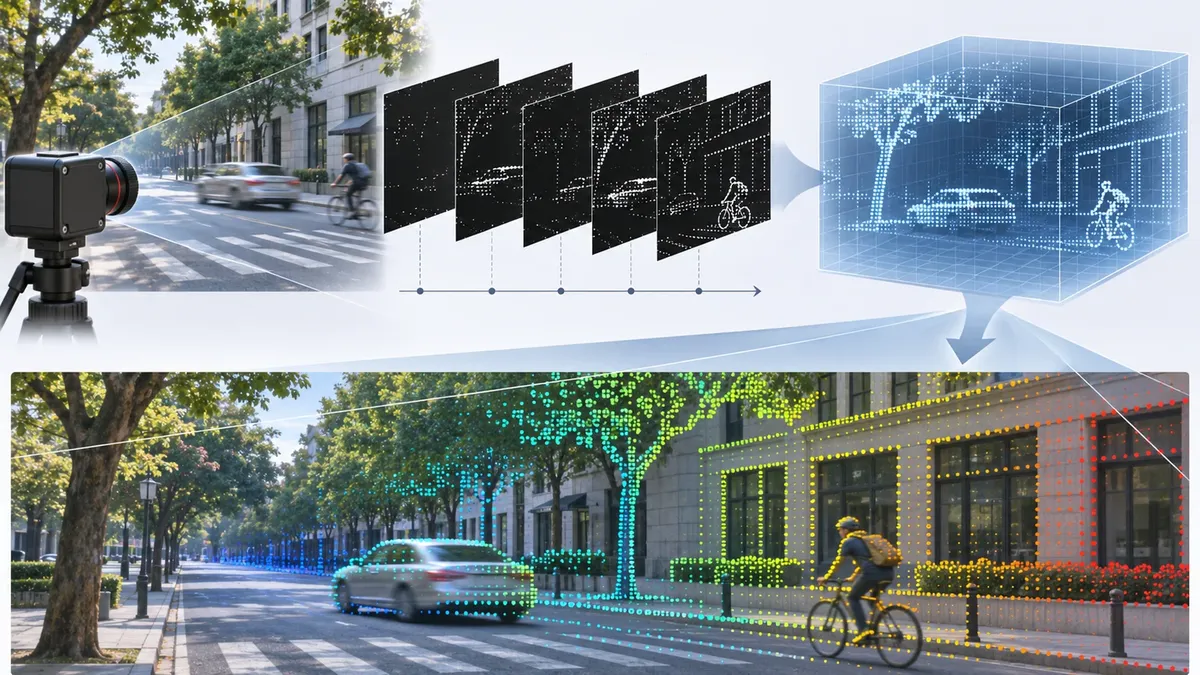
Event cameras record changes in brightness as they happen, rather than taking conventional images at fixed intervals. EventSSM is designed to use that fine-grained timing to estimate metric depth—the distance to visible surfaces—while learning from depth labels available only at selected reference times.
The challenge of depth between frames
An event camera does not produce a regular stream of photographs. It reports individual brightness changes, each with a location, timestamp and polarity indicating whether brightness rose or fell. Those events can arrive at very different rates across the image. They also do not directly say how far away a surface is: depth has to be inferred from patterns and context.
That creates a mismatch for training. Depth labels are often available at occasional image timestamps, while events happen between them. Grouping events into frame-like grids makes them easier for conventional vision systems to process, but can blur their timing. The researchers behind EventSSM ask whether a model can retain that timing while still learning from sparse, frame-time depth labels.
A memory updated in chronological packets
EventSSM processes events in chronological packets. Each packet updates a spatial memory: a learned map of features across the image. The model transports that memory across image locations, lets it fade according to elapsed time, and injects new information where events are observed. It then uses the local memory around each event to estimate that event’s depth.
The model is causal at packet boundaries: a packet’s prediction can use events within that packet, but not events from later packets. Its output is attached to events, rather than being a full depth map predicted directly at every image pixel.
To connect these event-time estimates to the training labels, the researchers use calibrated camera poses to move predicted depths into the viewpoint of a reference image. A differentiable renderer combines the transported samples into a depth image, which can be compared with the available reference depth during training. This geometric step assumes the scene points being tracked remain stationary; independently moving objects can break that assumption.
The evaluation used the MVSEC outdoor recordings. The team trained on outdoor Day 2, selected checkpoints using Day 1, and evaluated on the outdoor night sequences, with Day 1 also reported. They compared EventSSM with four event-depth methods at matched reference times and scoring locations. They also tested design choices, including the memory update, image-feature initialization and packet subdivision. The trained model uses events and its recurrent memory at inference; synchronized intensity images are used only to initialize its features during training.
Stronger results on several error measures
Across the four reported sequences, EventSSM had the lowest absolute-relative error, squared-relative error, root-mean-square error and mean absolute error among the compared methods. Those measures capture different aspects of depth mismatch, including relative error and error in metres. The result was not a clean sweep of every metric: other methods did better on some of the stricter threshold-accuracy measures, and ScaleEvent had lower mean absolute error within the nearest 10 metres on the three night sequences.
The ablations suggest that some choices matter more than others in this setup. Image-feature initialization reduced the reported depth error in its comparison, while replacing elapsed-time-based memory retention with a fixed per-update form increased error. Other component changes produced smaller or mixed differences. More packet subdivisions did not reliably improve accuracy, so the authors chose six packets as a practical balance between more frequent outputs and update cost.
The paper reports a packet inference time of 5.58 milliseconds on an NVIDIA GeForce RTX 2080 Ti. That is a hardware-specific measurement, not a general guarantee of real-time performance. EventSSM also makes more predictions per interval than the baseline systems, so its latency per call should not be mistaken for a lower total computation cost over the same sensor time.
What the results do—and do not—show
These findings are promising but tied to a particular evaluation. The benchmark covers outdoor MVSEC sequences, and the reported comparisons use selected windows, event samples and shared scoring masks. The authors note that the scored pixels cover only a portion of eligible reference-depth pixels in the packet-count ablation. Regions with complex independent object motion were cropped because camera-motion-based transport does not model those objects correctly. The method’s assumptions therefore matter for scenes with moving subjects, occlusions or different camera and sensor conditions.
The authors also report that omitting target-time warping did not materially change accuracy over the short intervals tested. That is a reminder that a sophisticated component need not show a measurable benefit in every setting; it does not establish that timing-aware geometry is unnecessary in longer or more dynamic intervals.
EventSSM is presented in an arXiv preprint, which may not have undergone peer review. The paper describes comparisons and ablations, but independent replication and testing beyond this benchmark would help establish how broadly the results apply. For now, it offers evidence that a persistent, time-aware spatial memory can be useful for event-associated depth estimation—not that the approach has solved depth perception across real-world conditions.
- event cameras
- depth estimation
- computer vision
- asynchronous vision
- state-space models
- MVSEC
Reviewed cross-references
These connections were reviewed by a model, not independently fact-checked by a human. Similarity does not imply agreement; consult the original papers and the evidence below.
How Event Cameras Learn Depth Without Dense Labels
Shared method: Both methods geometrically transport event-associated depth to a target time and use differentiable rendering. Their supervision differs: EventSSM uses calibrated poses and reference-depth labels, while the other paper estimates motion and learns from event alignment without dense depth labels; this is a shared rendering approach, not evidence of comparable performance.
Model review: · openai-codex/gpt-6-luna
Evidence and provenance
Selected excerpts, not complete papers. PDF extraction can omit figures or damage equations, tables and reading order; sources may be preprints.
2611.31720v1 — Original paper
Excerpt reference:
static/papers/2611.31720v1.md:122-166
Basis: Paper text
Source SHA-256:f9f9db126aaf179d4dea9ddcdb0256af8ce1c3576bb7175163a70b88da766a552611.27509v1 — Original paper
Excerpt reference:
static/papers/2611.27509v1.md:112-180
Basis: Paper text
Source SHA-256:3c375fdd2e6f83936afc99b8f07eeef77224ed07ec2efe1d68a1831eb2601deb
Related reading
Automatically matched by shared topic keywords. These links do not imply that the sources agree or establish a consensus.
How Event Cameras Learn Depth Without Dense Labels
Source published
Shared keywords: computer vision, depth estimation, event cameras
Teaching AI to Generate Event-Camera Signals
Source published
Shared keywords: computer vision, event cameras
How event polarity may help detect tiny drones
Source published
Shared keywords: computer vision, event cameras
How an event camera can help track a spacecraft
Source published
Shared keywords: computer vision, event cameras
ADEPT lets a depth model help tune its camera
Source published
Shared keywords: computer vision