TRANSMISSION // 2611.31705v1
A robot model that predicts the moving target—not the whole world
Source published
FoveaWAM predicts a moving object’s pose precisely, nearby motion coarsely, and acts quickly. Tests report gains in simulation and on a real robot, with important limits.
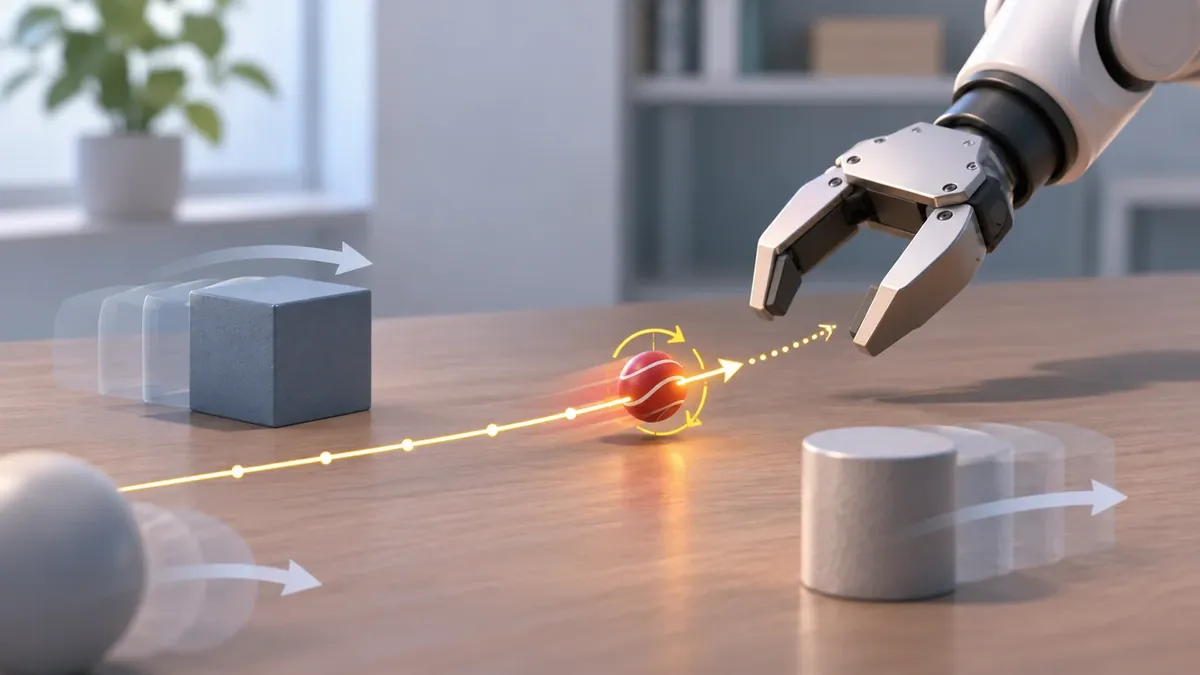
When a robot reaches for a moving object, the scene changes while the robot’s policy is calculating. FoveaWAM tackles that timing problem by spending prediction effort where contact depends on it: the target’s future pose.
A robot reaching for a moving object needs to know not only where that object is now, but where it will be when the robot’s action takes effect. Yet prediction itself takes time: while a policy computes, the target keeps moving. Predicting every detail of a scene may be costly, while focusing only on the target can miss obstacles or nearby motion that affect contact.
FoveaWAM, a world–action model described in an arXiv preprint, explores a middle ground. Its central idea is to assign different prediction detail to different parts of the scene. The target receives a precise forecast of its position and orientation; surrounding motion receives a coarser description; and static geometry is taken from the current camera frame rather than forecast. The model also generates robot actions.
Different roles, different forecasts
The authors represent the target’s motion as a trajectory in metric 3D space, including its orientation. In robotics, this kind of position-and-orientation representation is called an SE(3) trajectory. The surrounding scene is represented by sparse 3D flow: estimates of how selected points move. For context such as obstacles, the model’s aim is to capture enough motion to assess clearance or changes that influence the target, rather than reconstruct every detail with equal precision.
As input, FoveaWAM uses one RGB-D frame—a color image paired with depth—and a short history of the target’s poses and the robot’s state. The paper describes eight target-pose samples covering the previous 350 milliseconds. The authors argue that this history supplies motion information, such as velocity, that a single image cannot provide. During training, the model is supervised to predict future target poses and scene flow. At deployment, it skips those prediction-output heads; the training is intended to shape the internal representation used to choose actions.
That design addresses a practical trade-off: a forecast can be useful but arrive too late. On one NVIDIA RTX 5090, the paper reports a 15.1-millisecond 95th-percentile time-to-action for FoveaWAM. This is a reported hardware-specific measurement, not a guarantee of speed on other systems.
Testing with the clock running
The authors introduce OnTimeBench, a simulated benchmark of 14 dynamic-manipulation tasks. These include grasping moving objects, placing items into moving receptacles, catching rolling or sliding objects, and guiding a wand past a rotating wire. Crucially, the simulated scene continues to advance while a policy computes. Each method is evaluated using its own measured latency, so a slower prediction can leave less time to act on the observation.
On this benchmark, FoveaWAM reached 82.1% task-balanced success at its native latency. The authors report this as 20.8 percentage points above the strongest baseline, PUMA, at 61.4%. When the simulator was paused during inference, FoveaWAM still led the comparison, though the score and the meaning of the test changed: pausing removes the delay’s effect on the moving scene.
The paper also reports tests on DOMINO, a separate benchmark whose evaluator pauses physics during inference. FoveaWAM scored 46.8% success there, 19.9 percentage points above the strongest baseline reported by the authors. In six real-robot tasks using a Flexiv arm, the model achieved 48.3% average success over 20 trials per task and the highest success rate among the tested methods on each task. These results are promising, but they come from specific tasks, equipment, training data, and comparison setups—not a general demonstration that the approach will work equally well in other environments.
What remains uncertain
The authors’ own stated limitation is important: FoveaWAM currently assumes a rigid target whose pose can be tracked online. Articulated or deformable targets are left for future work. Real-robot results also depend on a target-tracking system, so the reported policy timing should not be confused with the full perception-and-control pipeline in every deployment.
OnTimeBench helps expose the effect of inference time, but it is a constructed simulation benchmark, and its test scenes are sampled from task-specific ranges. Real-world performance across broader settings remains an open question. The real-robot evaluation is useful evidence, but six tasks and 20 trials per task are limited grounds for broad conclusions.
Finally, this is a version-one arXiv preprint, not evidence of peer review. The paper’s claims and reported comparisons should be read as the authors’ results pending further scrutiny and independent replication. Its most useful contribution may be the question it makes concrete: in a changing scene, what needs a precise forecast, and what can be represented more cheaply?
- robotics
- robot manipulation
- world-action models
- dynamic manipulation
- robot learning
- 3D motion prediction
Reviewed cross-references
These connections were reviewed by a model, not independently fact-checked by a human. Similarity does not imply agreement; consult the original papers and the evidence below.
WorldFlow predicts motion in both pixels and 3D
Supporting evidence: Both papers report that explicit 3D motion predictions can support manipulation: FoveaWAM predicts a target pose trajectory and reports gains on dynamic tasks, while WorldFlow predicts queried-point trajectories and reports higher execution success than its comparator in 36 real-robot trials. These are distinct systems and evaluations, so they support only this broad, bounded connection—not a direct comparison of methods or results.
Model review: · openai-codex/gpt-6-luna
Evidence and provenance
Selected excerpts, not complete papers. PDF extraction can omit figures or damage equations, tables and reading order; sources may be preprints.
2611.31705v1 — Original paper
Excerpt reference:
static/papers/2611.31705v1.md:165-228
Basis: Paper text
Source SHA-256:a9521ba07cda9a78571adb8e0a5318cc490a07e6eddd42f1464b173977c3871c2611.31705v1 — Original paper
Excerpt reference:
static/papers/2611.31705v1.md:1154-1219
Basis: Paper text
Source SHA-256:a9521ba07cda9a78571adb8e0a5318cc490a07e6eddd42f1464b173977c3871c2610.39278v3 — Original paper
Excerpt reference:
static/papers/2610.39278v3.md:823-891
Basis: Paper text
Source SHA-256:4cce00abe647e8bfcd55fd3e7f9611ef349a0c318741a343b7a2c01f0e6669e8
Related reading
Automatically matched by shared topic keywords. These links do not imply that the sources agree or establish a consensus.
Teaching a robot model to predict what its actions will change
Source published
Shared keywords: robot learning, robot manipulation, world action models
Can a Robot Learn a New Task by Watching One Video?
Source published
Shared keywords: robot learning, robot manipulation, world action models
DexWAC: Teaching robots to act, predict and evaluate
Source published
Shared keywords: robot learning, robot manipulation, world action models
Can a general AI model control a robot arm?
Source published
Shared keywords: robot learning, robot manipulation
How MAWAM imagines teamwork for robots
Source published
Shared keywords: robot manipulation, world action models