TRANSMISSION // 2611.31684v1
How CROSS-Calib repairs ultrasound signals before imaging
Source published
CROSS-Calib uses other ultrasound channels to correct persistent amplitude and phase errors, then selectively repairs local interference while retaining usable measurements.
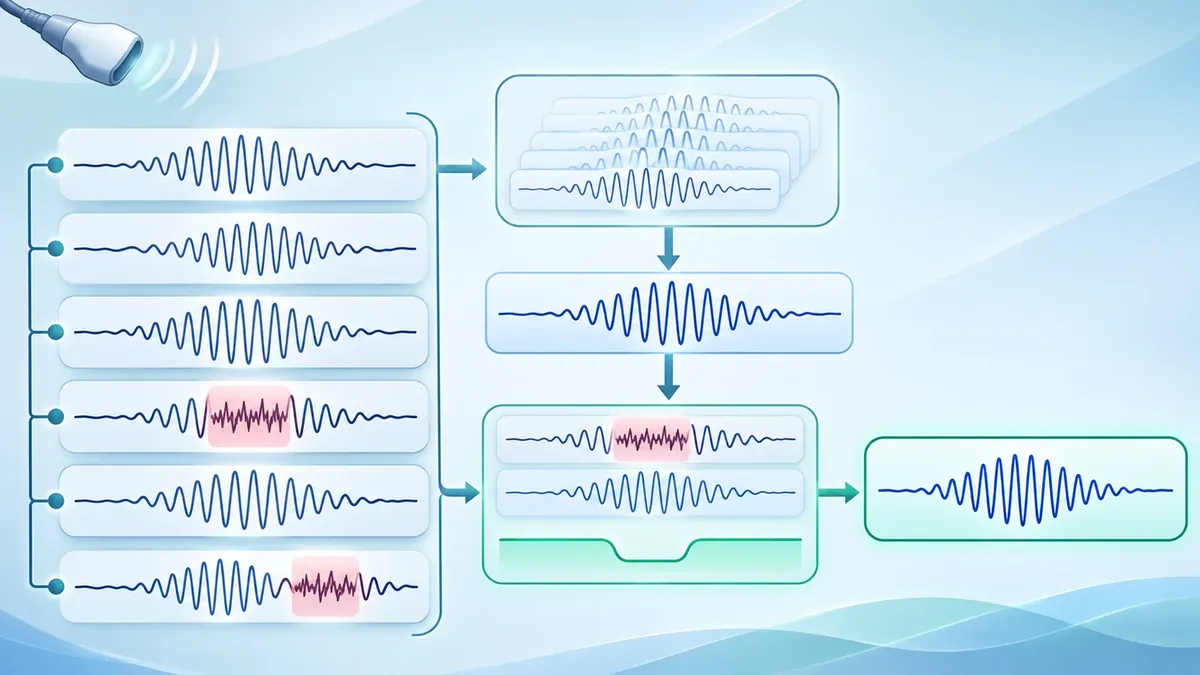
Ultrasound images combine echoes recorded across many receiver channels. If a channel’s response is altered or a brief burst of interference contaminates its signal, image quality can suffer. CROSS-Calib aims to correct and repair these signals before image formation, while preserving measurements that appear reliable.
Ultrasound scanners form images by combining echoes recorded across multiple channels. For that combination to work well, the signals need consistent amplitude and phase. A channel with an altered response can affect the result, while a burst of interference may contaminate only a short segment. Replacing an entire channel to address a brief disturbance could also discard useful measurements.
A paper by Tongxiao Hu and Junyu Zhou introduces CROSS-Calib, a method designed to handle both problems before image formation. It uses predictions from other channels as references, corrects persistent amplitude and phase errors, and then makes a local choice about whether to retain a corrected measurement or rely more on a prediction.
Predictions, calibration and a local choice
The method works with complex IQ signals, which retain amplitude and phase information. It divides receiver channels into four interleaved groups. In turn, each group is withheld while a neural network predicts its echoes from the others. The predictions are then stitched together to form a reference for each channel.
CROSS-Calib estimates a complex gain for each channel—a correction for amplitude and phase deviations modeled as constant across an acquisition. After applying that correction, a learned gate examines local features, including agreement between measured and predicted waveforms and signal strength relative to nearby regions. The gate determines how much to blend the corrected measurement with the predicted reference. For a channel with missing echoes, the method uses the reference directly.
This separation matters because persistent gain errors and brief bursts are different problems. A channel-wide correction cannot remove a local burst, while replacing every sample could discard valid echoes. The gate is designed to make the choice sample by sample.
Tests with injected faults
The researchers evaluated CROSS-Calib using acquired data from the EPFL ultrafast ultrasound dataset. They used 13,976 acquisitions from six volunteers for training, 1,825 acquisitions from V4 for validation and model selection, and 1,605 acquisitions from V8 for in-vivo testing. A further 1,013 acquisitions from phantom 054GS were used for phantom tests.
The researchers added controlled faults to the recorded signals: channel-wide amplitude and phase changes, short segments of strong additive noise, or channels with echoes removed. They tested both “heavy” and more severe “extreme” versions. Since the original signals were available, the damaged inputs could be compared with clean counterparts. The authors also compared CROSS-Calib with several reconstruction methods, using signal-error measures and image-quality measures after delay-and-sum beamforming, a standard way of combining echoes.
In the in-vivo tests, CROSS-Calib had the highest reported structural similarity scores among the compared methods for the tested gain-error and burst conditions. The advantage varied with the fault: under heavy burst interference, one baseline was already close on this image metric, while the difference was larger under extreme burst. In phantom tests, the method recovered cyst contrast, and wire-target echo widths were close to those in the clean reference. An ablation study, which held the reference and gain-estimation components fixed, also found better burst-repair scores with the learned gate than with simpler output rules.
What the results do—and don’t—show
These findings suggest that channel calibration followed by selective, local repair can help under the disturbances tested. They do not establish that CROSS-Calib improves diagnosis or patient outcomes. The evaluation used controlled faults added to recorded data; it does not establish performance across naturally occurring equipment failures or the full range of clinical interference. The in-vivo test set was V8, and the phantom evaluation used acquisitions from phantom 054GS. How well the method works with other scanners, settings and patient populations remains uncertain.
The results also depend on reference predictions being useful. If other channels cannot reliably predict a channel’s signal, the gate may have a harder choice. The paper’s experiments do not determine how the approach behaves under every possible corruption or acquisition condition.
CROSS-Calib is described in an arXiv preprint, which may not have undergone peer review. The findings are best understood as an early technical evaluation, not evidence that the method is ready for clinical use.
- ultrasound imaging
- signal reconstruction
- channel calibration
- medical AI
- interference repair
Related reading
Automatically matched by shared topic keywords. These links do not imply that the sources agree or establish a consensus.
A broader test for medical AI recommendations
Source published
Shared keywords: medical ai
MedicalRSI aims to help medical AI learn from mistakes
Source published
Shared keywords: medical ai
A medical AI scales up, but vision remains a challenge
Source published
Shared keywords: medical ai
Why Medical AI Agents Underuse Their Own Instructions
Source published
Shared keywords: medical ai
Where medical AI fairness gaps may arise
Source published
Shared keywords: medical ai