TRANSMISSION // 2611.31668v1
When translation erases what a user actually said
Source published
A study finds that multilingual AI summaries can blur whether a grammatical detail came from the user or was required by the target language. A writing-and-reading convention plus a pre-deletion check improved recall and F1 in controlled tests, though the evidence comes from synthetic scenarios and a limited set of models.
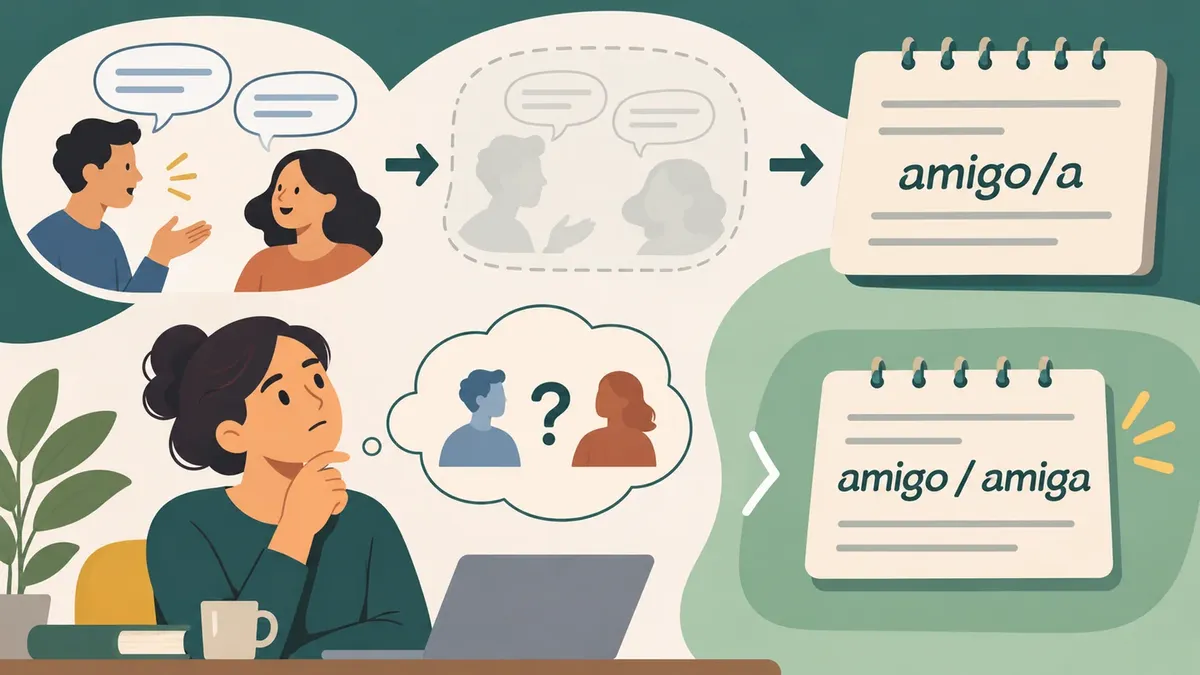
When an AI assistant shortens a conversation, can its next answer distinguish a fact the user supplied from a detail grammar forced into the summary? Researchers tested this problem in multilingual notes, where context loss can make the difference hard to recover. Their proposed repair records uncertainty in the note and checks unsupported forms before the original message is discarded.
An AI assistant may turn an earlier conversation into a short note, then discard the original messages to save space. But a translation can contain details that the user never stated. Spanish, for example, marks gender on some adjectives: “agotado” and “agotada” differ, even if the English source simply said, “I was exhausted.” Once the original message is gone, a later assistant may not know whether the form reflects the user’s words or a grammatical choice made during translation.
That uncertainty creates two opposing risks. Treating the form as a confirmed fact can lead the assistant to assert something the user never said. Treating it as merely grammatical can make the assistant forget a detail the user explicitly provided. A rule that always trusts the form risks unsupported assertions; a rule that always discounts it loses stated information.
In Provenance Loss and Repair in Multilingual Compaction, Ian Miao, Fangrui Zhu and Bowen Jiang investigate this problem and test a repair. The paper is a preprint; its findings come from controlled experiments, not deployed assistants.
Testing what survives a summary
The researchers built 300 pairs of fictional support or scheduling messages. In each pair, one message left an attribute unspecified and its twin stated it explicitly—for example, a pronoun, whether a sibling was older or younger, or whether a grandmother was maternal or paternal. The team examined adjective gender in Spanish, French, Italian and Portuguese, as well as Mandarin terms for sibling age and family lineage.
A model first translated each message into a note. In the main test, the original message was then removed, and a model had to answer a question about the attribute or write a short handover for another agent. The authors also tested longer conversations, repeated summaries, note retrieval and later user updates. They evaluated five open-weight models: three Qwen3.5 sizes and two Gemma-4 sizes.
The main combined measure was F1, which balances precision—how often an asserted attribute was correct—with recall—how often a stated attribute was recovered. The researchers also examined those measures separately, since a system can avoid unsupported claims by being cautious while still failing to retain useful facts.
A convention, with a check before deletion
The proposed repair combines a writing-and-reading convention with verification before the original message is deleted. Under the convention, a writer uses paired forms such as “agotado/a” when the source leaves the attribute open. A reader instructed to follow the convention treats paired forms as unstated and remaining single forms as supported facts. The notation works as intended only if writers and readers follow those rules.
The verification step is more specific than a direct check of meaning. For an unqualified single form, the method compares the note’s likelihood with that of a version using the opposite form. It makes this comparison both with the original message body and with that body replaced by a placeholder, retaining the ticket ID and sender name. The difference is used to estimate whether the body itself favors the form; if the score falls below a threshold, the note is rewritten with a paired form. This is “training-free”: it changes prompts and checks notes rather than training model weights.
In the main question-answering test, removing the source reduced recall for stated attributes from 90% to 34%. Across the five models, the full repair increased F1 by 9–53 percentage points for question answering and 12–40 percentage points for agent handovers. The convention drove nearly all of the improvement for most models; verification helped especially with the smallest model, whose writers more often left unsupported single forms. The full method raised F1 in most tested multi-turn, retrieval and update settings, but not every model-setting combination improved.
What the evidence does—and does not—show
The study isolates a specific failure mechanism: a grammatical form in a translated note can conceal whether the user supplied its meaning. It does not show that all multilingual summaries fail this way, or that the proposed method is ready for every language or identity. The benchmark was synthetically created, relied mainly on explicit attribute cues, and covered a limited set of grammatical categories. The authors tested two model families, up to 31 billion parameters, rather than proprietary or larger systems.
The paired forms also encode a binary distinction. The paper notes that representing a stated non-binary identity remains an open question. More broadly, these are controlled tests of note writing and later recall, not evidence about outcomes in real customer-support workflows.
The preprint therefore supports a focused design lesson, not a universal solution: when compression removes the source, a note may need to record whether a detail was actually supplied by the user. Further evaluation across languages, settings and systems would help establish how widely this repair applies.
- multilingual AI
- context compaction
- AI memory
- language models
- data provenance
- hallucination
Reviewed cross-references
These connections were reviewed by a model, not independently fact-checked by a human. Similarity does not imply agreement; consult the original papers and the evidence below.
When AI Agents Summarize, Their Rules Can Disappear
Supporting evidence: The findings support the bounded point that compaction can discard information relevant to later behavior: Jiang et al. report reduced recall of user-stated attributes after source eviction, while Salle et al. report that summaries drop task rules and some user constraints. The studies use different tasks and measures, so they do not establish a common rate or mechanism; these are reported findings from preprints, not evidence of a general effect across settings.
Model review: · openai-codex/gpt-6-luna
Evidence and provenance
Selected excerpts, not complete papers. PDF extraction can omit figures or damage equations, tables and reading order; sources may be preprints.
2611.31668v1 — Original paper
Excerpt reference:
static/papers/2611.31668v1.md:13-102
Basis: Paper text
Source SHA-256:fa5636e6cbbcdc76f89b6f1466ca7a1aaae8a9d0841ad55e2146ca5fca030b512611.31668v1 — Original paper
Excerpt reference:
static/papers/2611.31668v1.md:150-213
Basis: Paper text
Source SHA-256:fa5636e6cbbcdc76f89b6f1466ca7a1aaae8a9d0841ad55e2146ca5fca030b512610.31778v2 — Original paper
Excerpt reference:
static/papers/2610.31778v2.md:653-697
Basis: Paper text
Source SHA-256:9eb347a9f5e74a1280e03e29adda1c1b655acec7e161c7ab67c65d5b2428c987
Related reading
Automatically matched by shared topic keywords. These links do not imply that the sources agree or establish a consensus.
When an AI agent’s summary can rewrite what the user authorized
Source published
Shared keywords: context compaction, data provenance
A receipt-checking layer for AI agents
Source published
Shared keywords: data provenance
Why AI Agents Can Misuse Retrieved Memories
Source published
Shared keywords: ai memory, language models
Teaching AI Agents What to Keep in a Summary
Source published
Shared keywords: context compaction, language models
When AI Agents Summarize, Their Rules Can Disappear
Source published
Shared keywords: context compaction, language models