TRANSMISSION // 2611.31654v1
Pooling AI demand may recover stranded compute value
Source published
A model suggests that pooling diverse AI inference demand could improve accelerator utilization, but its financial estimates rely on scenario assumptions rather than live-facility measurements.
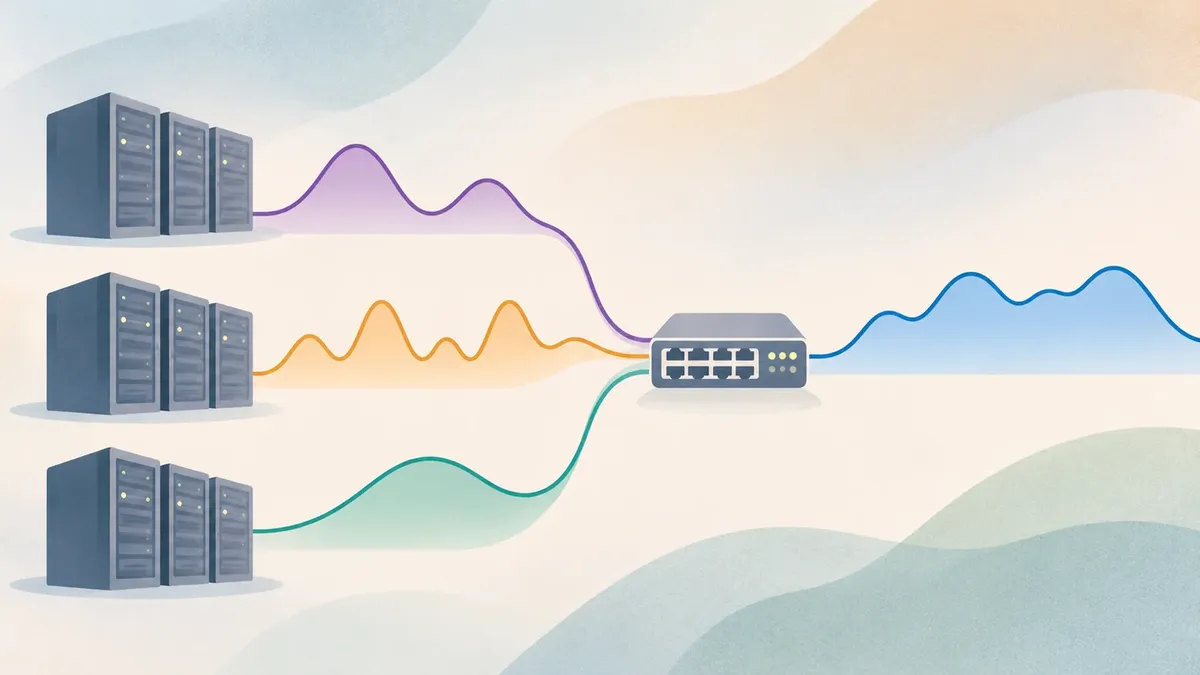
AI data centers are often discussed in terms of electricity. This preprint argues that, in one modeled deployment, a larger economic issue is costly accelerator capacity that sits idle or must be held in reserve. It explores whether aggregating demand from tenants with different usage patterns could reduce those losses.
The question: what leaves inference capacity unused?
AI inference—the computing used to generate responses to prompts—relies on costly accelerators. A data center’s theoretical throughput may exceed the output it can reliably deliver and bill for. Some capacity sits idle between requests; some is kept in reserve so the service can handle bursts and meet latency commitments.
Sam Kingsley’s preprint asks how much of this gap might be reduced by combining demand from different tenants, and whether the potential value is large relative to the cost of interconnection. The analysis concerns infrastructure economics. It does not claim that pooling makes individual GPUs faster or reduces the electricity needed for each response.
How the analysis works
The paper models a representative, carrier-neutral colocation deployment and treats interconnection as a possible way to aggregate demand. It compares “nameplate” throughput—the theoretical capacity—with goodput: output remaining after modeled losses for scheduling utilization, burst reserve, fragmentation and low-batch operation, maintenance, service-level misses, and quality rejection. Quality acceptance is one factor in this accounting; the paper does not establish a broader measure of usefulness.
The author treats idle capacity and burst reserve as losses that could partly diversify across tenants. If one tenant’s demand is quiet while another’s is busy, their combined demand might be less uneven. The model varies tenant count and demand correlation: the more tenant demand moves together, the less smoothing the model allows.
The headline figures are scenario calculations, not measurements from an operating facility. The reference case uses numerous assumptions, including accelerator and facility costs, token price, utilization, reserve, and service targets. The paper specifically flags its accelerator-rack capital estimate as unsourced and says it should be replaced with a real vendor price. That assumption matters because capital recovery dominates the modeled cost stack.
What the model finds
In the reference scenario, capital recovery represents 87.3% of fully loaded cost per token, while electricity represents 3.7%. The model puts service-level-qualified goodput at 59.6% of nameplate throughput. Of the 40.4 percentage-point gap, it attributes 15.0 points to idle capacity and 10.2 to burst reserve, together totaling 25.2 points.
In a modeled case with eight tenants and moderately correlated demand, goodput rises from 59.6% to 66.9% of nameplate. At the assumed token price, the paper values that increase at about $0.75 million per year per megawatt of IT capacity. This is not a measured saving. The comparison is with an illustrative annual interconnection-spend range, estimated using assumed counts of cross-connects and high-capacity virtual ports and prevailing list rates. The paper reports that the modeled recovery is several times that estimated spend in this scenario.
Within the paper’s assumed demand and correlation model, adding tenants brings diminishing additional gains, while more correlated demand reduces the modeled benefit. The relevant factor is therefore not simply tenant count but how their demand patterns differ.
The author argues that a neutral colocation and interconnection provider could help bring diverse demand sources together. But the paper does not demonstrate that network links alone provide the coordination, capacity sharing, or service-level safeguards required to pool workloads. Its proposal is that interconnection could serve as part of such an aggregation mechanism, not proof that this operational model is already working.
What remains uncertain
This is a model-based economic analysis, not a live deployment trial. Its estimates depend on assumed costs, token prices, service requirements, tenant demand patterns, and the feasibility of sharing capacity while meeting service commitments. The comparison can turn unfavorable in the model when demand is highly correlated and interconnection spending is high. Results should therefore be read as conditional on the scenario, not as a general forecast for data centers.
The analysis does not establish that every facility could achieve the modeled goodput increase, that tenants would agree to share capacity, or that providers could capture the estimated value. The paper leaves potential commercial consequences—such as repricing or new products—as judgments rather than findings.
The source is a single-author arXiv preprint. The supplied evidence does not establish peer-reviewed validation. Its calculations are best understood as a framework to test against real deployment data, not a guaranteed financial return.
- AI inference
- data centers
- GPU utilization
- demand aggregation
- colocation
- interconnection
- preprint
Reviewed cross-references
These connections were reviewed by a model, not independently fact-checked by a human. Similarity does not imply agreement; consult the original papers and the evidence below.
Matching AI accelerators to workloads could ease data-center grid constraints
Supporting evidence: Both papers model operational choices that affect the economics of AI compute: Kingsley estimates that pooling demand across eight tenants raises goodput by 7.3 percentage points in a reference deployment, while Lyu et al. report 6.5% lower daily cost from jointly sizing heterogeneous accelerators and scheduling workloads in a representative two-site case. These are compatible examples of modeled infrastructure design affecting cost or capacity use, not independent validation of the pooling estimate; the mechanisms, assumptions, and outcomes differ.
Model review: · openai-codex/gpt-6-luna
Evidence and provenance
Selected excerpts, not complete papers. PDF extraction can omit figures or damage equations, tables and reading order; sources may be preprints.
2611.31654v1 — Original paper
Excerpt reference:
static/papers/2611.31654v1.md:13-43
Basis: Paper text
Source SHA-256:f02bda301e53a69bacafce9cbe1e2bcf060e4414de94b5bc3f766c1358d940072611.27576v1 — Original paper
Excerpt reference:
static/papers/2611.27576v1.md:13-66
Basis: Paper text
Source SHA-256:5d0c0be7d3a4283380f1084d3941ac9572f7d6b6d5bc44e25fa395ebdee68433
Related reading
Automatically matched by shared topic keywords. These links do not imply that the sources agree or establish a consensus.
Flexible Data Centers May Need Near-Total Grid Cutoffs, Even When Annual Curtailment Is Tiny
Source published
Shared keywords: data centers
Reddit debates reveal what lies behind data center opposition
Source published
Shared keywords: data centers
DICE reports faster AI decoding in tested setups
Source published
Shared keywords: ai inference
AdaOffload adapts CPU and GPU workloads to run large AI models
Source published
Shared keywords: ai inference
AVERT targets average compute for each request
Source published
Shared keywords: ai inference