TRANSMISSION // 2611.31653v1
AI assembles physical mechanisms from equations
Source published
An equation-native AI system combines parts of scientific mechanisms across fields, with mismatches expressed as equations for missing terms.
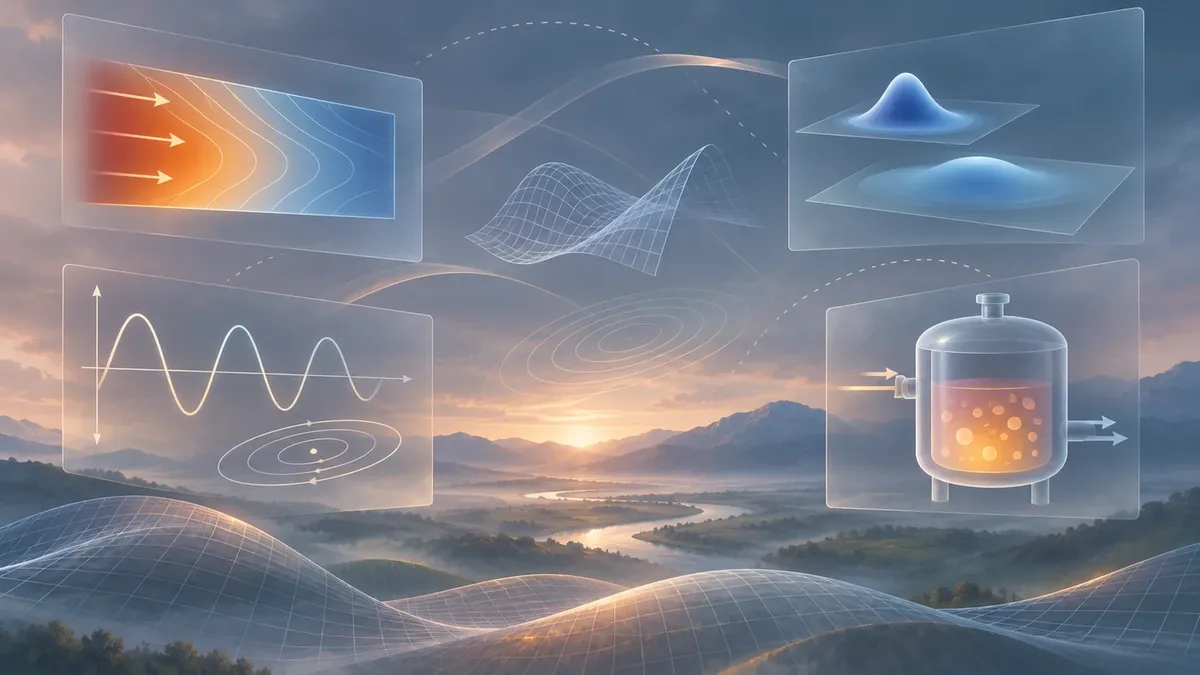
Heat flow, molecular diffusion and Brownian motion can share mathematical patterns. A new arXiv preprint describes an AI system that reads equations and constructs mechanisms by combining their parts.
A mathematical pattern can appear in different scientific settings. Heat spreading through a solid, molecular diffusion and the motion of a Brownian particle, for example, can be described by related equations. But a physical mechanism is rarely captured by one equation alone: its operation, boundaries, parameters and other details may be set out at different stages of a derivation.
In an arXiv preprint, Vladimir A. Baulin, Austin Cook and Shagor Rahman describe an equation-native system that reads equations from 2.5 million arXiv manuscripts. The authors say it can construct mechanisms through deterministic calculation. The abstract does not explain the system’s full processing steps, so the precise meaning and scope of “reads” cannot be assessed from the available evidence here.
The system’s constructor can detach, transfer, unfold, compose and join parts of equations, including parts drawn from different disciplines. When a combination fails to fit, the authors say the failure can be expressed as an equation for a missing term. This makes the mismatch explicit; the abstract does not say that supplying such a term would by itself make the mechanism work.
The authors describe three constructed mechanisms. In one, a threshold reactor becomes a memory that a weak signal can write. In another, an oscillator becomes a switch through two changes that each fail on their own. A third uses a rhythm to regulate a chemical amount. The abstract says each construction has conditions for an experimental test; it does not report that these mechanisms have been experimentally demonstrated.
The available source for this account is the paper’s abstract, rather than its full text. It does not provide details needed here to assess the system’s implementation or how the examples were derived and checked. The abstract also does not report performance benchmarks or comparisons with other methods; their presence or absence in the full paper cannot be established from the abstract alone.
The work describes a way to assemble mechanisms from equations and to express some failed combinations as missing-term equations. How well that approach works, and how broadly its examples hold up, cannot be judged from the abstract alone. The paper is an arXiv preprint; the supplied information does not establish whether it has been peer reviewed.
- artificial intelligence
- equation-based reasoning
- physical mechanisms
- scientific discovery
- arXiv preprint
Related reading
Automatically matched by shared topic keywords. These links do not imply that the sources agree or establish a consensus.
Can AI help science think across disciplines?
Source published
Shared keywords: scientific discovery
Why rare training facts may help AI make discoveries
Source published
Shared keywords: scientific discovery
Why AI discovery agents should compare competing explanations
Source published
Shared keywords: arxiv preprint, scientific discovery
AI Explanations May Work Better When They Match How Scientists Judge Evidence
Source published
Shared keywords: scientific discovery
Can a computer model knowledge we cannot quite explain?
Source published
Shared keywords: artificial intelligence