TRANSMISSION // 2611.31643v1
A seven-hour spin—and a phase curve with caveats—for comet 1998 SH2
Source published
Five nights of telescope observations reveal the weakly active near-Earth comet’s rotation period, while showing why its surface-brightness changes remain difficult to pin down.
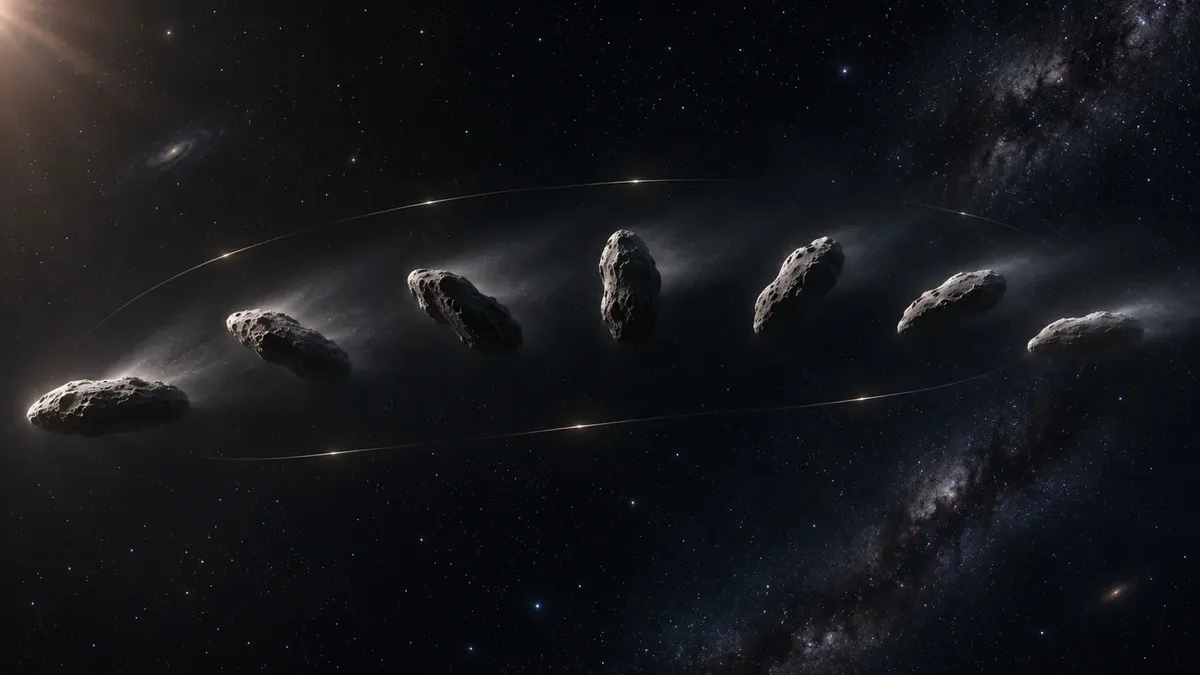
Near-Earth object 1998 SH2 is a faintly active comet, but its spin had not been measured. New observations estimate a rotation period of about seven hours and suggest an elongated nucleus. The same data provide a less certain result: the comet’s changing brightness cannot cleanly distinguish surface reflection from changing activity.
Near-Earth object (875163) 1998 SH2 sits in the fuzzy territory between asteroids and comets. Its path through space shows a small acceleration that earlier researchers judged too large to explain through sunlight alone, and previous imaging revealed a faint dust tail. These clues point to weak cometary activity. But how quickly does it rotate, and can observations from one stretch of its orbit reveal how its surface brightens and dims as viewing geometry changes?
A study by Javier Licandro, Miguel R. Alarcón and Miquel Serra-Ricart addresses both questions using observations from September 2025. The work is available as an arXiv preprint, so its findings should be treated as research that may not yet have undergone peer review.
A rotation hidden among aliases
The team used the TTT2 telescope at Spain’s Teide Observatory to observe the object on five nights. They collected 2,392 calibrated brightness measurements through a broad visible-light filter. As the object rotates, different portions of its surface come into view, causing its measured brightness to vary. Repeating patterns in that variation can reveal the rotation period.
The task was complicated by gaps between nights. Standard period-search methods initially favored different possible periods—about 9.1 and 14.1 hours—because nightly sampling can create false alternatives known as aliases. Rather than choosing the strongest peak in a periodogram, the researchers focused on two nights with continuous observations lasting long enough to track the object through much of a rotation. Of the candidate periods, about 6.97 hours best matched the brightness changes within those nights.
Combining that result with all five nights, the authors report a synodic rotation period of 6.970 ± 0.020 hours. “Synodic” means the period as seen from Earth; the authors do not determine the object’s spin direction or pole. They also estimate a double-peaked light curve with a peak-to-peak brightness range of roughly 0.18 magnitudes. Such a pattern is consistent with an elongated body rotating, although brightness alone does not provide a complete shape model. Assuming a triaxial body whose brightness follows its cross-section and an equatorial viewing aspect, the measured variation implies a lower bound of about 1.18 for the body’s long-to-short axis ratio. This is an inference under those assumptions, not a direct measurement of projected axes; the authors note that the true elongation could be greater.
The period also helps make sense of earlier radar observations. Radar measurements alone had suggested a short-period limit under an assumption of a spherical body. Using the new period, the authors find the radar result is consistent with an elongated nucleus. This is a consistency argument, not a direct radar reconstruction of the object’s shape: the viewing geometry is unknown, and radar breadth and thermal diameter measure different things.
What the brightness trend cannot tell us
The observations also tracked the comet across solar phase angles—the angles formed by the Sun, object and observer—from about 3.7 to 9.3 degrees. As that angle changed, the object’s measured brightness changed too. Astronomers use a phase curve to describe this relationship, but the standard IAU curve models could not be meaningfully constrained by this narrow range of observations. Their fitted parameters became unphysical, a sign that the data do not pin them down. In particular, the observations do not cover the very small angles needed to test for a possible opposition brightness surge.
A simpler, straight-line fit describes the observed trend: 0.074 ± 0.005 magnitudes per degree. But this is an apparent slope, not a secure measurement of the bare nucleus’s surface. The object was weakly active, and activity may have increased during the observing run. Dust or gas around a comet can add light; if that contribution changes over time, it can mimic or steepen a brightness trend.
There is a further complication: phase angle and observing date were almost perfectly linked in this data set. The comet was seen at different phase angles on different nights, so a change in surface brightness with angle cannot be cleanly separated from a change in activity over time. The authors therefore treat the measured slope as an upper limit on the intrinsic surface slope. Stacks of observations from the first and last nights showed no resolved tail or coma, but that non-detection does not rule out weak activity below the images’ sensitivity.
Assuming that comet nuclei like this show little or no opposition surge, the authors extrapolate the linear fit to estimate a provisional absolute brightness of about 20.9–21.0 in the study’s Luminance filter. That estimate depends on the assumption and retains possible contamination from weak activity; it is not a definitive intrinsic brightness.
The central result is firmer than the phase-curve interpretation: the observations support a rotation period near seven hours, while a single apparition leaves the surface’s true brightness behavior uncertain. Observations at lower phase angles, or during a demonstrably quiet period, could help separate light reflected by the nucleus from light associated with activity.
- 1998 SH2
- near-Earth comet
- comet rotation
- photometry
- phase curve
- cometary activity