TRANSMISSION // 2611.31641v1
How E2SIM Simulates Human Activity Over Time
Source published
E2SIM connects simulated actors’ changing goals and knowledge to a shared world. In one 60-day test, it produced fewer near-duplicate actions and more evaluator-judged meaningful event threads than four prompting baselines, but this does not show fidelity to real people.
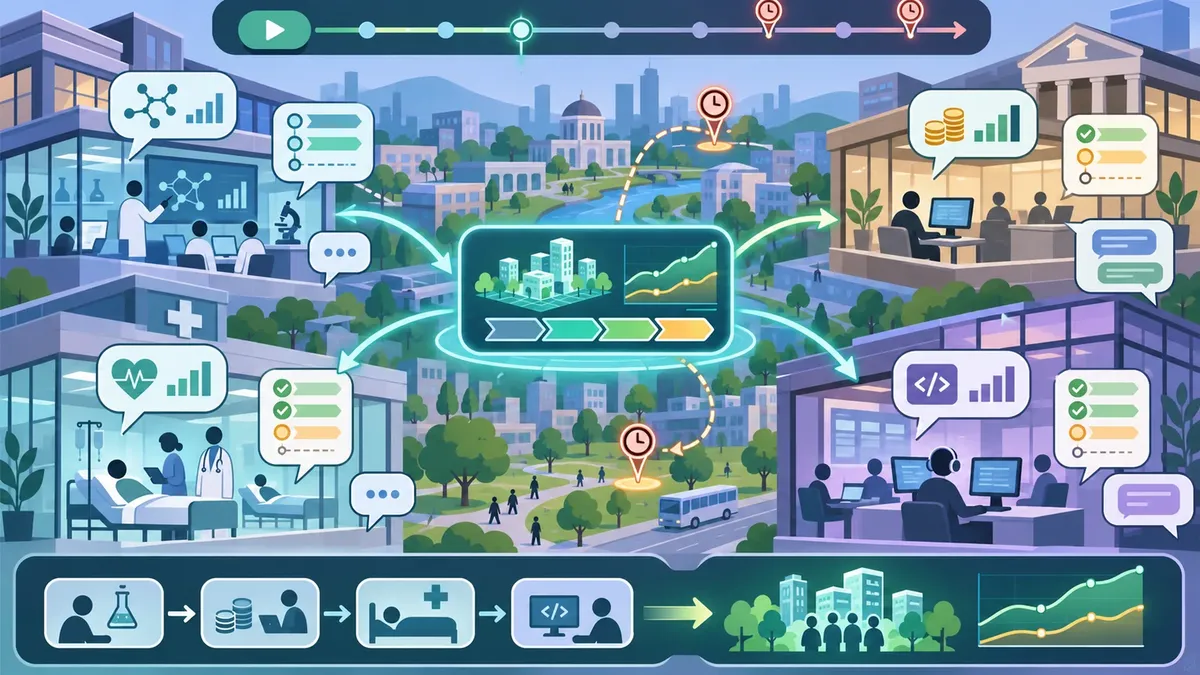
Long-running AI assistants must account for how earlier events change people’s plans and knowledge. E2SIM is a framework for simulating those changes alongside a shared environment. Its initial test found less repetition and more meaningful event threads by an automated evaluator, but measured coherence within a simulation—not resemblance to real human behavior.
A plan can change because of something that happened days earlier: a failed experiment, a delayed reply, or a new opportunity. For AI systems intended to support people over time, the challenge is not just retaining past interactions. Later actions must reflect earlier events as goals and knowledge evolve.
A paper introducing E2SIM (Everyday Simulation with Evolving States) asks how to generate long-running simulated activity across work and daily life. It represents actors alongside the shared world they inhabit. The authors argue that trajectories should develop coherently rather than repeat routines or rush through unresolved events.
A world that records consequences
Each simulated actor has stable attributes, such as background and habits, as well as changing goals, plans, interests, and knowledge. At each time step, actors use their state and observations to choose goals and generate possible action paths with different outcomes. The system samples one path uniformly, then a judge determines whether the proposed action can occur fully, partly, or not at all. The resulting outcome can change the shared world, update plans, or schedule delayed events. For example, an agreement to travel the following week can produce a scheduled follow-up.
Actors do not automatically know everything that happens. Information updates an actor’s state when it becomes visible—for instance, through a message or an observed change to a shared document. Collaborators can therefore have different information and respond differently to the same world.
The framework also introduces external events and lets actors propose new longer-term goals. The authors say they used random selection among candidate paths because preliminary runs tended to favor positive outcomes, which could make long projects finish unrealistically quickly. Together, these choices create a feedback loop: actions change the world, and observed changes shape later actions.
What the test found
The researchers generated 60-day trajectories for ten actors in one scenario spanning four connected settings: a university lab, a lending company, a hospital ward, and a software studio. They compared E2SIM with four approaches that used language-model prompts to generate actions more directly. Each method was run once, using the same generation model.
The evaluation covered changes in actor states, event progression, collaboration, and repetition. Many scores came from a language-model judge assessing evidence in simulated histories. The researchers also tested its discrimination using original and deliberately corrupted collaboration episodes, including cases involving forgotten commitments or violated dependencies. This tests whether the judge scores the original above the altered version; it does not show that its judgments agree with people.
In this comparison, E2SIM produced more extracted event threads judged meaningful by the evaluator and fewer near-duplicate actions than the four prompting baselines. It had 21.4 meaningful threads per 1,000 actor-slots, compared with 3.9 to 10.3 for the baselines. Its near-duplicate rate was 22.3%, versus 60.5% to 73.5%. Other measures were mixed: the Direct baseline scored higher on individual dynamic consistency and collaboration plausibility, and three baselines had lower spillover rates. The results are not a win across every measure.
The paper also reports component tests: from the day-60 state, the researchers continued the full system and separate versions without particular components for 14 days. In that continuation, removing random outcome selection increased exact repetition. Removing new-goal creation was associated with more actor-slots lacking an active project and shorter event threads. These results describe those runs, not how reliably the effects would recur across independent simulations.
What remains uncertain
Coherence inside a simulated world is not the same as fidelity to real people. The authors say their measures assess consistency and development within the simulation—not accuracy in representing human behavior or effectiveness in downstream assistant tasks. The study used synthetic trajectories and did not involve human subjects or private personal data.
The main comparison used one scenario and one run per method, so it cannot estimate variability across repeated simulations. Event-thread counts also rely on an automated process that extracts and groups actions. Evaluator scores cover only cases judged eligible, and those subsets differ between methods. The authors note that event density has no universal target and should be considered alongside other measures.
E2SIM is a proposed simulation and evaluation framework, with initial evidence that connecting actor states to a changing shared world can reduce repetition and sustain event threads in one test. Whether its trajectories resemble real human behavior, or help train and evaluate deployed assistants, remains unanswered. The source is an arXiv preprint; its reported findings should be read as provisional research rather than established evidence.
- E2SIM
- AI agents
- simulated behavior
- longitudinal simulation
- language models
- AI evaluation
Related reading
Automatically matched by shared topic keywords. These links do not imply that the sources agree or establish a consensus.
Can AI Build and Improve Business Agents?
Source published
Shared keywords: ai agents, ai evaluation
Why AI-Agent Interventions Help—or Fail
Source published
Shared keywords: ai agents, ai evaluation, language models
A broader checklist for judging whether AI can be trusted
Source published
Shared keywords: ai agents, ai evaluation
When More AI Agents Mean More Escalation
Source published
Shared keywords: ai agents, ai evaluation
AI agents can make the deliverable and still miss the rules
Source published
Shared keywords: ai agents, ai evaluation