TRANSMISSION // 2611.31635v1
When quantum walks agree—and when they don’t
Source published
On increasingly large hypercubes, time-averaged quantum walks can settle into different patterns depending on how the walk is defined. A mathematical study finds one shared limit and two important mismatches.
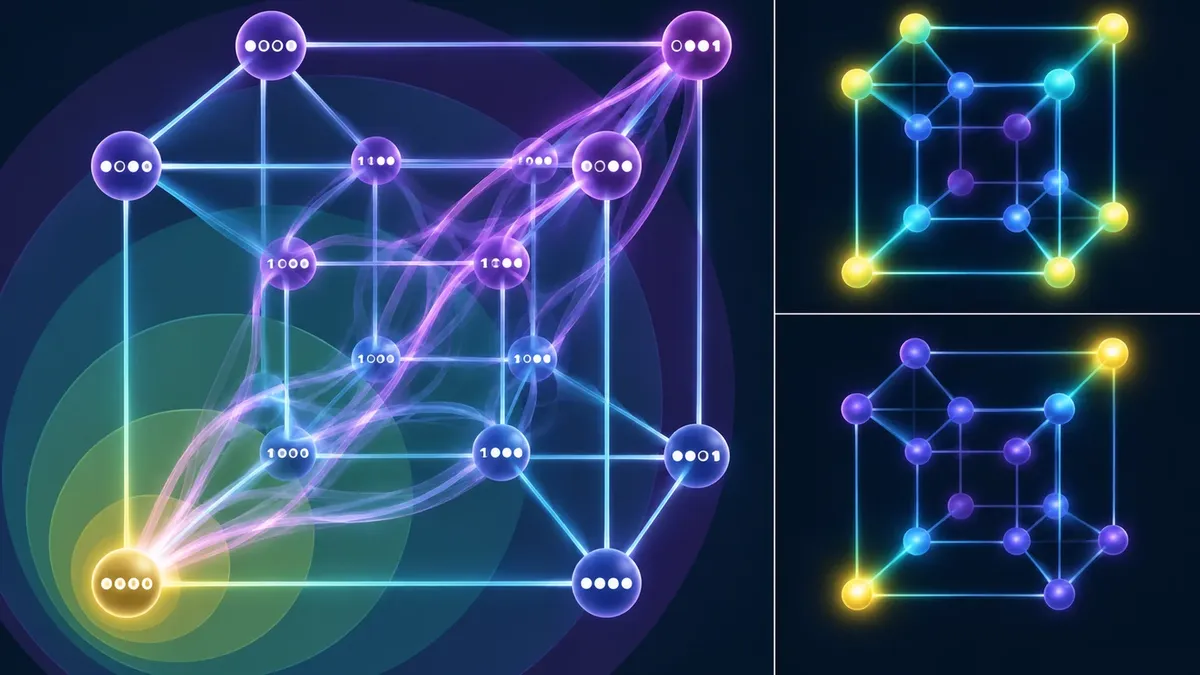
Quantum walks are unitary models associated with classical random walks, but continuous-time and discrete-time versions can behave differently. A mathematical study of walks on hypercubes asks whether their long-run, time-averaged distance patterns converge to the same distribution as the network grows.
A hypercube is a network whose vertices are bit strings. In a three-dimensional example, each vertex is a corner of a cube, and an edge joins strings that differ in one bit. This paper considers a broader family of walks whose transition rules depend on Hamming distance—the number of bit positions in which two strings differ. It tracks the walker’s distance from its starting point.
The question is what happens to that distance when researchers average the walker’s position over a very long time and then let the hypercube’s dimension grow. The authors compare continuous-time quantum walks with a discrete-time version known as Szegedy’s walk. Both are associated with classical random walks, but they use different quantum evolution rules, so their long-run patterns need not match.
Turning a large network into a distance problem
The analysis uses the hypercube’s symmetry. Because the walks treat vertices alike when their Hamming distances match, the authors can study distance classes rather than every vertex separately. They use the Hamming scheme, a mathematical framework for this symmetry, and Krawtchouk polynomials to express features of the walks.
For each fixed dimension, the authors first take the infinite-time average of the probability distribution. They then study the limit as the dimension grows, dividing the distance from the starting point by the dimension. This order matters: the results concern time averaging first, followed by the large-dimension limit. They are not simply limits of walks over time on an infinite graph.
For continuous-time walks, the paper proves a general result: if the eigenvalues associated with the underlying symmetric random walk are all distinct, the time-averaged Hamming distance follows a discrete arcsine distribution. After distance is rescaled by the dimension, this approaches an arcsine distribution on the interval from zero to one. It assigns more probability near the ends of that interval than near its middle.
The discrete-time results vary across three examples. For the simple random walk, the rescaled time-averaged distance approaches the same arcsine distribution as in continuous time. For a walk with binomially weighted transitions, the discrete-time limit is an equal mixture of two distributions: an arcsine law over the full interval and another whose range is shifted and rescaled according to the model’s parameter. For the independent random walk, the limit instead has two point masses, each with probability one-half: one at zero and one at one-half.
A match in one case, not a general rule
The continuous- and discrete-time limits agree for the simple random walk but differ in the other two examples. In the independent random-walk case, the eigenvalues are repeated, so the paper’s general continuous-time theorem, which assumes distinct eigenvalues, does not apply. The authors separately report that the continuous-time limit is concentrated at zero, unlike the discrete-time limit.
The paper contrasts these findings with earlier work on path graphs, where the two models’ limits coincide under specified conditions. The hypercube examples show that agreement does not automatically carry over to another network family. The authors also explain why a spectral gap—the separation between certain eigenvalues—is not enough to determine whether the limits match: their examples include a closing gap with agreement and persistent gaps with disagreement.
These are mathematical results for specified models, not evidence that one kind of quantum walk is universally more useful or that quantum computers gain an advantage from them. The paper leaves open the broader problem of finding necessary and sufficient conditions for the two kinds of walks to have the same scaling limit. The conclusions are tied to the walk constructions, starting state, time-averaging procedure and, for the general continuous-time result, the distinct-eigenvalue assumption.
The source is version 1 of an arXiv preprint by Yusuke Ide, Norio Konno and Shuhei Mano. It provides mathematical statements and derivations, but the source information available here does not establish whether this version has been peer reviewed. The findings should be understood as the authors’ claims in a preprint, not as independently confirmed consensus.
- quantum walks
- hypercube
- arcsine distribution
- Hamming distance
- Krawtchouk polynomials
- scaling limits
Reviewed cross-references
These connections were reviewed by a model, not independently fact-checked by a human. Similarity does not imply agreement; consult the original papers and the evidence below.
Quantum walks rank nodes in a small grid model
Shared method: Both studies use continuous-time quantum-walk evolution on graphs: Ide, Konno and Mano analyze time-averaged Hamming-distance distributions on hypercubes, while Jayakody and colleagues condition walk evolution on power-grid outage configurations to define a node-ranking measure. The graph-walk method connects them, but their models, observables and aims differ; this is not evidence that their results support or conflict with each other.
Model review: · openai-codex/gpt-6-luna
Evidence and provenance
Selected excerpts, not complete papers. PDF extraction can omit figures or damage equations, tables and reading order; sources may be preprints.
2611.31635v1 — Original paper
Excerpt reference:
static/papers/2611.31635v1.md:37-97
Basis: Paper text
Source SHA-256:53bb4ee52985866feebbc97ba5cfcf641bfd6960e5c2bfd4ca5e38bfca1bd7ce2611.29648v1 — Original paper
Excerpt reference:
static/papers/2611.29648v1.md:16-68
Basis: Paper text
Source SHA-256:1228ad78489de97b0a659f245cdfeb7589ba6ba1ba22655a96db1b8a1093809a
Related reading
Automatically matched by shared topic keywords. These links do not imply that the sources agree or establish a consensus.
Quantum walks rank nodes in a small grid model
Source published
Shared keywords: quantum walks
Reading a quantum network depends on how you look
Source published
Shared keywords: quantum walks
A tunable middle ground for quantum spatial search
Source published
Shared keywords: quantum walks
How energy levels set the limits of quantum thermometers
Source published
Shared keywords: quantum walks
Which branching trees can perfectly transfer a quantum state?
Source published
Shared keywords: quantum walks