TRANSMISSION // 2611.31631v1
Adaptive ghost orbitals extend simulations of electron dynamics
Source published
An adaptive Gutzwiller method adds auxiliary orbitals as correlations grow, matching available DMFT benchmarks and extending strong-coupling simulations to longer times.
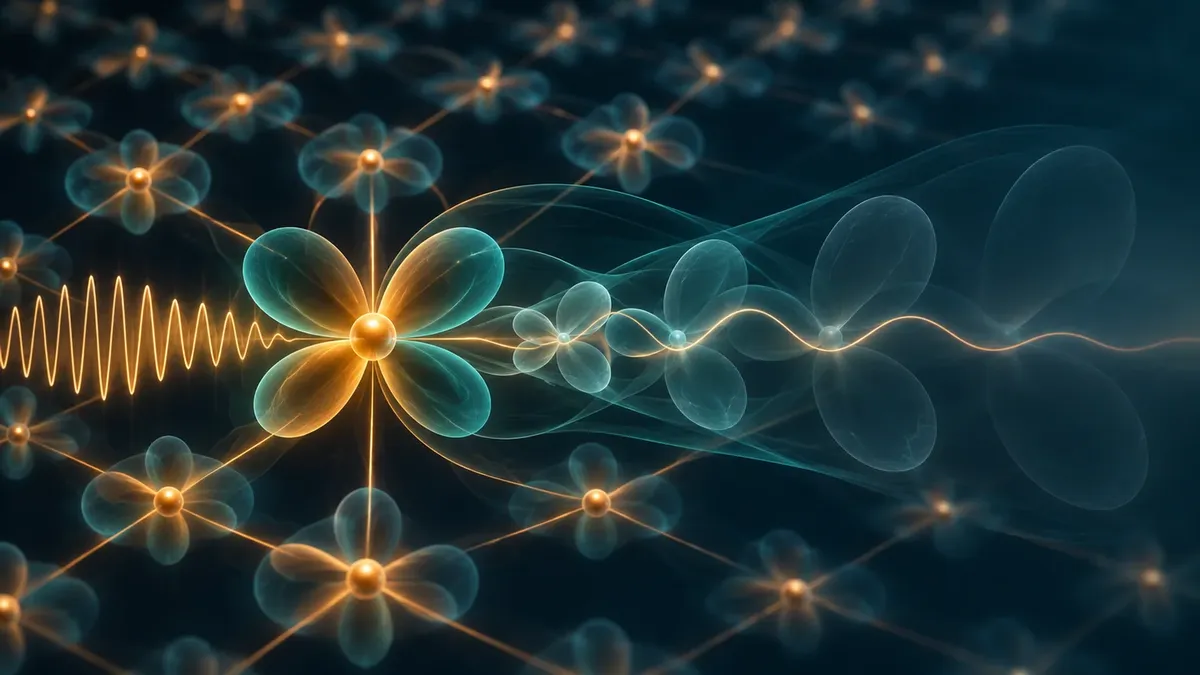
How can researchers track interacting electrons after a sudden change for longer than existing reference calculations allow? A new preprint tests an adaptive simulation method that adds computational degrees of freedom as the evolving system needs them.
Why follow electrons after a sudden change?
Electrons in a strongly interacting material do not always behave like independent particles. After a sudden change in their interactions—a protocol called a quench—their collective state can evolve through regimes that are difficult to calculate. Exact numerical methods often become impractical at long times, while approximate methods may lack a reliable way to tell when their answers are converged.
Yong-Xin Yao’s preprint studies this problem using the half-filled Hubbard model on an infinite-coordination Bethe lattice. In the model, electrons begin in a noninteracting Fermi sea, and an interaction is switched on suddenly. The study asks whether a time-dependent ghost Gutzwiller approximation can follow this evolution across weak, intermediate and strong interactions, while estimating when its results are trustworthy.
Adding orbitals as needed
The method, called adaptive td-gGA, extends the Gutzwiller approximation with auxiliary orbitals known as “ghost” orbitals. These are not extra physical atoms. They enlarge the mathematical description so it can represent correlations that the simpler approximation misses.
Rather than choose a large number of ghost orbitals at the start, the calculation begins with the smallest set that describes the initial state. It monitors the occupation of the outermost ghost pair and adds another pair when that occupation passes a threshold. In this way, the simulation spends more effort as the evolving correlations demand it. Comparing runs with different maximum numbers of orbitals provides a convergence check; the method also estimates from a run when its current orbital limit will cease to be sufficient.
The benchmark is nonequilibrium dynamical mean-field theory (DMFT), which is numerically exact for this model in the infinite-dimensional limit, though its computations in the earlier study used for comparison reached only limited times, especially at strong coupling. The paper compares quantities including double occupancy—the likelihood of finding two electrons on the same site—and the jump in the momentum distribution at the Fermi level.
What the calculations report
Where reference DMFT data are available, the adaptive results agree within the accuracy of those data, from weak-coupling prethermal behavior to strong-coupling collapse-and-revival oscillations. “Prethermal” describes a long-lived state that can look settled in some measurements without being fully thermal. In the strong-coupling regime, the calculation remains converged beyond the end of the DMFT data; the paper reports times up to three and a half times as long for some cases. That is an extension of a simulation window, not an experimental observation.
Near the crossover between the weak- and strong-coupling regimes, the calculated double occupancy relaxes toward a thermal value consistent with DMFT. By tracking how the behavior changes as more ghost orbitals are included, the author finds that the sharp dynamical transition of the basic Gutzwiller approximation becomes a smooth crossover in the expanded method.
The longer strong-coupling runs also reveal damped oscillations whose frequency is shifted from the bare interaction scale. The measured shift is consistent with a second-order strong-coupling expansion developed in the paper. The oscillation center remains near a prethermal value over the simulated window for sufficiently strong interactions; the calculation does not show that the system has reached thermal equilibrium there.
What remains uncertain
These are numerical results for a specific idealized model, not a direct prediction for a particular material. Agreement with DMFT applies only where that reference calculation is available, and the reference curves were digitized from a published figure. Their finite accuracy limits how precisely agreement can be assessed. Beyond that window, convergence is estimated by comparing calculations with different orbital limits, rather than checked against an exact benchmark.
The approach is also not cost-free: the number of needed ghost orbitals grows with time in the quench studied, and the associated embedding problem becomes larger. The paper proposes tensor-network and quantum-computing solvers as possible ways to tackle that growth; it does not demonstrate that those approaches have already solved the longer-time or broader multi-orbital problems. The reported results support adaptive td-gGA as a systematically improvable computational approach, while its usefulness for other driven systems remains a question for future tests.
The source is an arXiv preprint, not a peer-reviewed journal article. Its claims should therefore be read as research findings awaiting independent evaluation, rather than settled consensus.
- Hubbard model
- correlated electrons
- Gutzwiller approximation
- quantum dynamics
- dynamical mean-field theory
- preprint
Reviewed cross-references
These connections were reviewed by a model, not independently fact-checked by a human. Similarity does not imply agreement; consult the original papers and the evidence below.
A hybrid quantum-classical route to electron dynamics
Shared method: Both papers use time-dependent ghost Gutzwiller approximation for Hubbard-model interaction quenches on the Bethe lattice. The origin paper adaptively increases ghost orbitals to estimate convergence against DMFT; the target paper implements the framework as a classical–quantum embedding and demonstrates adaptive variational simulations. This is a methodological connection, not an independent confirmation of the origin paper’s extended-time results.
Model review: · openai-codex/gpt-6-luna
Evidence and provenance
Selected excerpts, not complete papers. PDF extraction can omit figures or damage equations, tables and reading order; sources may be preprints.
2611.31631v1 — Original paper
Excerpt reference:
static/papers/2611.31631v1.md:12-67
Basis: Paper text
Source SHA-256:91c03f4f769c1ffffaaac92da9b417ffaae7d05b2f2133431b44aadfb565105e2611.24592v2 — Original paper
Excerpt reference:
static/papers/2611.24592v2.md:12-58
Basis: Paper text
Source SHA-256:e6a1553ed78834e8c2fa5e7df2bdd9b9de8188f408a5ec8902b9c9a8a72273052611.24592v2 — Original paper
Excerpt reference:
static/papers/2611.24592v2.md:3031-3096
Basis: Paper text
Source SHA-256:e6a1553ed78834e8c2fa5e7df2bdd9b9de8188f408a5ec8902b9c9a8a7227305
Related reading
Automatically matched by shared topic keywords. These links do not imply that the sources agree or establish a consensus.
A hybrid quantum-classical route to electron dynamics
Source published
Shared keywords: correlated electrons, hubbard model
When can interacting quantum dynamics look free?
Source published
Shared keywords: quantum dynamics
A faster classical simulator for fermionic quantum circuits
Source published
Shared keywords: hubbard model
A hidden phase in quantum dynamics
Source published
Shared keywords: quantum dynamics
A world model reads quantum dynamics to infer hidden interactions
Source published
Shared keywords: quantum dynamics