TRANSMISSION // 2611.31611v1
AI Agents Search for Better PDE Solvers
Source published
A multi-agent system uses language models and evolutionary search to assemble and test PDE solvers, finding trade-offs across several tested problems.
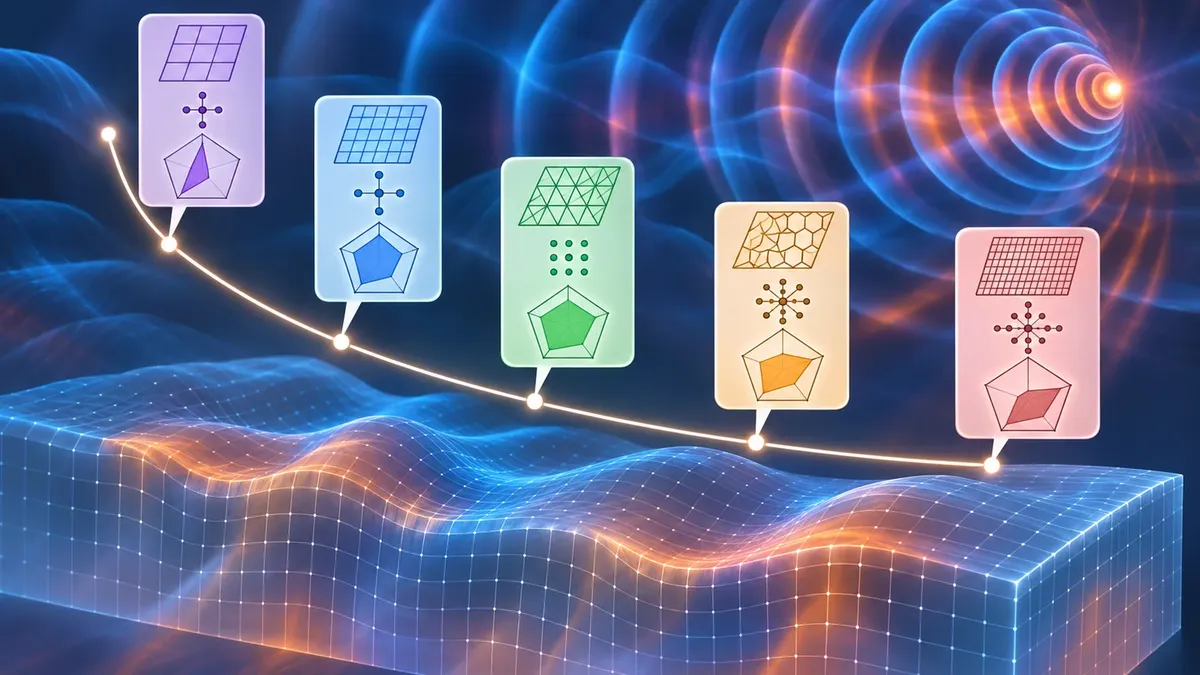
Could AI help design numerical tools for solving equations that describe sound, materials and heat? A preprint reports a system that asks language-model agents to propose and test combinations of established solver components.
Partial differential equations (PDEs) describe physical processes, including sound waves and the deformation of materials. Solving them numerically involves choices that can depend on the problem. A new preprint asks whether language-model agents can help explore those choices automatically—and return several options with different performance trade-offs rather than a single design.
A team of agents searches
The authors describe a multi-agent framework in which language-model agents propose, critique, implement and evaluate solver configurations. A configuration, called a meta-solver, can combine familiar numerical methods, preconditioners, block factorizations and neural operators.
Within the proposing agent, an evolutionary algorithm updates a population of candidates. It uses non-dominated sorting to seek a Pareto front: a set of options that represent trade-offs across six measured quantities. A candidate is non-dominated when no other candidate is at least as good on every measure and better on one or more. This lets the search preserve alternatives instead of reducing performance to one overall score.
The abstract says the system ran with small, open-weight language models served on a single laptop. The authors compared it with a single-agent approach on four problems. This article is based on the abstract, not the full paper, so its implementation details, measures and evaluation setup cannot be checked here.
Reported results vary by problem
For three-dimensional acoustic scattering and elasticity, the framework produced 47 and 48 convergent hybrid solvers, respectively, from 60 candidates in each case. Compared with Jacobi-preconditioned Krylov baselines, the best discovered solvers reportedly used fewer iterations and less online solve time. The abstract reports iteration-count reductions by factors of 4.7 for acoustic scattering and 60 for elasticity; online solve time fell by factors of 2.3 and 3.0, respectively.
The authors also tested coupled dynamic thermoelasticity in two and three dimensions, where the stated baselines failed. The framework completed 98 of 100 transient candidates. Compared with the single-agent system, it reportedly reached a given accuracy 15 times faster in two dimensions and achieved a 20-times-lower displacement error in three dimensions. These are results for the tests summarized in the abstract; they do not show that the framework will outperform conventional approaches on other PDEs or in other settings.
What the findings do—and don’t—show
The reported results suggest that the system can generate and evaluate multiple solver designs in the tested problems, using a laptop-scale setup. Searching for a Pareto front could be useful when researchers care about several performance measures at once, rather than only speed or accuracy.
Important questions remain. The abstract does not name the six measures or provide uncertainty estimates, and it offers limited information for judging how representative the four problems are. It also does not establish whether the results generalize to different equations, discretizations, hardware or application requirements. The meaning of “convergent” and the details behind the speed comparisons depend on the study’s definitions and experimental setup, which cannot be assessed from the abstract alone.
The source is an arXiv preprint. The available evidence does not establish peer-reviewed validation. These findings are an initial report, not proof that AI-designed solvers are ready to replace expert choices in scientific computing. Reviewing the full paper and independent replications would help establish reproducibility and practical reach.
- partial differential equations
- AI agents
- numerical solvers
- scientific computing
- evolutionary algorithms
- preprint
Reviewed cross-references
These connections were reviewed by a model, not independently fact-checked by a human. Similarity does not imply agreement; consult the original papers and the evidence below.
AI trained on physics equations speeds up models of spinning neutron stars
Shared method: Both studies use DeepONet neural operators in PDE-solving workflows: the origin paper includes neural components such as DeepONet-based deflation in hybrid iterative solvers, while Ray uses a physics-informed DeepONet to predict stellar profiles. Their roles and problem settings differ, so this is a methodological connection, not evidence that either approach outperforms the other.
Model review: · openai-codex/gpt-6-luna
Evidence and provenance
Selected excerpts, not complete papers. PDF extraction can omit figures or damage equations, tables and reading order; sources may be preprints.
2611.31611v1 — Original paper
Excerpt reference:
static/papers/2611.31611v1.md:232-309
Basis: Paper text
Source SHA-256:537759a43567003a20d76a7b66112f2fe4a1ff27fa4294c19019f004f8227e322611.05790v1 — Original paper
Excerpt reference:
static/papers/2611.05790v1.md:268-384
Basis: Paper text
Source SHA-256:0b588a3f2c9e7bdb96ce36229c29ea167b46305992b087d6462570d25b3acc86
Related reading
Automatically matched by shared topic keywords. These links do not imply that the sources agree or establish a consensus.
Can AI agents identify the equation behind the data?
Source published
Shared keywords: ai agents, partial differential equations, scientific computing
Can a language model build a neural network from physical laws?
Source published
Shared keywords: partial differential equations, scientific computing
Teaching Monte Carlo estimates to correct themselves
Source published
Shared keywords: partial differential equations, scientific computing
A Julia toolkit for exploring quantum billiards
Source published
Shared keywords: scientific computing
Why scientific computing needs human-guided AI proofs
Source published
Shared keywords: ai agents, scientific computing