TRANSMISSION // 2611.31607v1
Duet: Neural Decoding for Transversal-Gate Circuits
Source published
Duet builds known error-propagation rules into a neural decoder for logical Clifford circuits with transversal gates. Its abstract reports benchmark results, not universal performance.
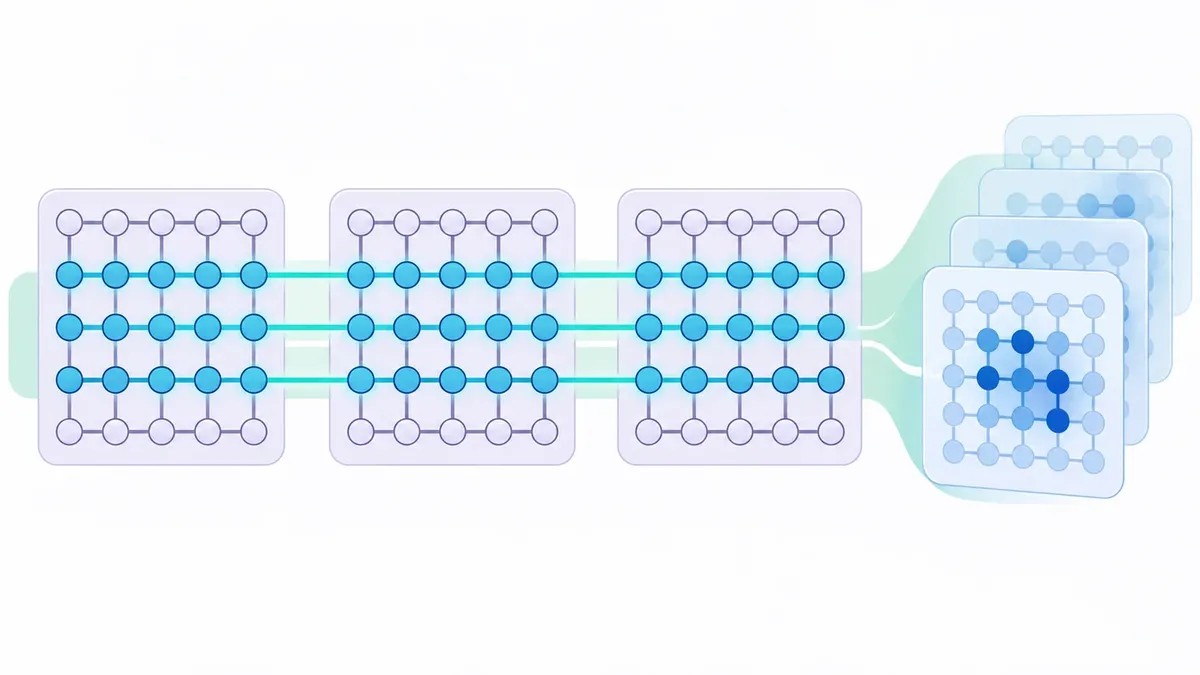
Transversal gates can make some logical operations faster, but they complicate decoding across encoded blocks. Duet is a neural decoder designed to use known circuit rules rather than learn them from scratch.
The decoding challenge
Quantum error correction stores information in logical qubits encoded across physical qubits. A decoder uses syndrome measurements—signals that provide clues about errors—to infer what happened and determine the logical outcome. In the circuits studied here, a transversal CNOT acts across two encoded blocks. The authors say this gate copies errors between blocks, so decoding may need to consider the blocks together.
The paper focuses on logical Clifford circuits with transversal gates, in the context of neutral-atom and trapped-ion machines. The authors say a transversal gate needs only one syndrome round and can make a logical gate take up to a factor of d less time than lattice surgery. That potential speed advantage comes with a decoding challenge: errors can be correlated across blocks.
How Duet uses known rules
The authors introduce Duet, a neural decoder that builds in known information about how errors and logical outcomes propagate through a circuit. Instead of learning those propagation rules, Duet learns which errors occurred, according to the abstract.
The design uses three features. First, the authors say each transversal gate moves an error to a fixed place, so the network exchanges features only between the sites connected by that gate. Second, logical outcomes propagate exactly and linearly through Clifford gates. Duet uses this known propagation: it predicts the flips caused by errors in each layer, then combines the layers with a “soft XOR.” Third, the authors’ circuits are built from the same small set of gates. The gate choices in each layer are supplied as input, allowing one network per code distance to handle circuits with different sizes and depths.
The authors also pair Duet with Tesseract, a search decoder. Tesseract re-decodes the shots—individual simulated runs—where Duet is least confident, rather than being applied to every shot.
What the abstract reports
For general circuits with two to four blocks and up to 16 layers, the authors report that Duet alone was more accurate than matching at the tested distances. With Tesseract, they report 44 times fewer failures than LoMatching at distance 9. These are the authors’ benchmark results; the abstract does not give enough detail to independently assess the comparison conditions or statistical uncertainty.
For random circuits attributed to the Lukin group, the abstract reports a failure rate 0.299 times that of the group’s neural decoder at distance 7. It does not make clear in this summary which version of the proposed decoder this comparison refers to, so the result should not be assigned specifically to Duet alone or to the Duet–Tesseract combination without consulting the full paper.
The authors report that the Duet–Tesseract composition takes 2.4–121.7 microseconds per layer. They say this is less than the Lukin group network’s time per gate at every distance. Layer and gate are different units, so this is the comparison as stated in the abstract, not a direct like-for-like timing measure.
Limits of this account
This article is based on the abstract, not a full examination of the paper’s methods, figures, or statistical analysis. The abstract does not specify details such as noise models, sample sizes, or uncertainty estimates; those details may be available in the full paper. Without them, the reported comparisons cannot be evaluated fully here, and benchmark results do not establish performance across all circuits or hardware.
The source is an arXiv preprint. Its review status cannot be determined from the supplied information, and this account does not imply that it has been peer reviewed or accepted. The findings should be read as claims reported by the authors for particular circuit tests, pending closer examination of the full study.
- quantum error correction
- neural decoding
- transversal gates
- logical Clifford circuits
- quantum computing
Reviewed cross-references
These connections were reviewed by a model, not independently fact-checked by a human. Similarity does not imply agreement; consult the original papers and the evidence below.
A proposed shortcut to addressable quantum gates
Shared method: Both papers use transversal operations in logical-circuit schemes: Duet studies decoding Clifford circuits with transversal gates between surface-code blocks, while Pecorari et al. use transversal couplings to an auxiliary code for addressable operations on quantum LDPC codes. The shared element is the gate implementation approach, not the decoder or code family; the excerpts do not establish comparable performance.
Model review: · openai-codex/gpt-6-luna
Evidence and provenance
Selected excerpts, not complete papers. PDF extraction can omit figures or damage equations, tables and reading order; sources may be preprints.
2611.31607v1 — Original paper
Excerpt reference:
static/papers/2611.31607v1.md:66-204
Basis: Paper text
Source SHA-256:2631363538640b405eecc317d89d4080741f040fc7b164582d199aa7c72ab9542511.06124v2 — Original paper
Excerpt reference:
static/papers/2511.06124v2.md:65-137
Basis: Paper text
Source SHA-256:4ce5e80365ee5a034433100f59f31c002cfc0843b23d73827ad0bad021d71d78
Related reading
Automatically matched by shared topic keywords. These links do not imply that the sources agree or establish a consensus.
A hardware-aware route to logical quantum gates
Source published
Shared keywords: logical clifford circuits, quantum computing, quantum error correction
Why some simple gate patterns cannot control every logical qudit
Source published
Shared keywords: quantum error correction, transversal gates
A cryptography shortcut helps classify quantum gates
Source published
Shared keywords: quantum computing, quantum error correction
Quantum error correction that adapts as noise drifts
Source published
Shared keywords: quantum computing, quantum error correction
Adding a third layer to quantum error correction
Source published
Shared keywords: quantum computing, quantum error correction