TRANSMISSION // 2611.31601v1
How 2D Point Relations Can Reveal 3D Structure
Source published
RePT learns to transfer relations between points across 2D views. The authors report that its representation reflects 3D geometry, even without 3D prediction targets.
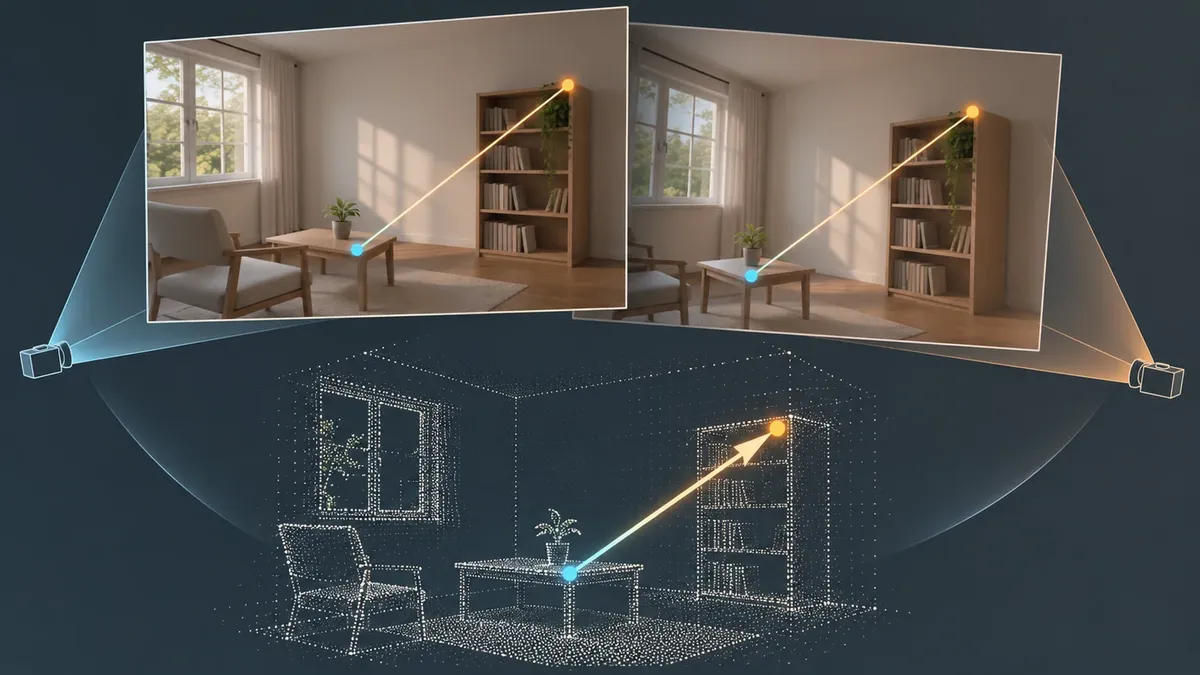
Can a visual model learn about 3D space without being asked to predict depth or 3D coordinates? A preprint called RePT explores this by training a model to transfer relationships between different points across images. The authors report that its learned representation reflects physical distances and directions, with important limits to what the results establish.
Learning 3D without predicting 3D
Visual models can be trained to match the same point across images or predict quantities such as depth. RePT takes another route: it learns to transfer a relationship between two distinct points from one set of views to another. Its training objective is to predict a point’s location in a 2D image—not to output 3D coordinates, camera pose or depth.
The researchers ask whether that task leaves a geometric pattern in the model’s internal representation. If so, 3D structure might be recoverable even though it was not an explicit prediction target.
How the study worked
RePT combines information from multiple views of a scene in a context representation. It encodes observations of two points as a compact, 16-dimensional relation token. A decoder applies that token to another view to predict where one point appears. Training rewards accurate 2D point predictions.
The main experiments used ARKitScenes, a collection of indoor scenes. To create persistent point tracks across views, the team used depth maps and camera poses during offline data preparation. These measurements were not provided to the model as inputs or used as prediction targets. In a separate experiment, the team trained a model using point tracks from an RGB-only tracker.
After training, the researchers compared relation tokens with the known 3D displacements between points. They examined the tokens directly and fitted linear maps from tokens to 3D displacements. For a cross-scene test, they fitted a shared map using 16 scenes and evaluated it on 39 held-out scenes. They also tested the ARKitScenes-trained model on ScanNet++.
This distinction is important: 3D was not a training prediction target, but the geometric readout was fitted using 3D displacement information. The study asks whether the representation makes geometry accessible to a simple readout—not whether the overall process uses no 3D information.
What the researchers found
The raw relation tokens showed geometric structure: their magnitudes tended to track distances between points, while angles between tokens tended to track angles between the corresponding 3D displacement vectors. A linear readout strengthened those associations.
On held-out scenes, the shared readout produced Pearson correlations of 0.72 for displacement length and 0.78 for angle. These numbers measure association, not accuracy percentages. The shared map was fitted on 16 scenes and kept fixed for the 39 held-out scenes when measuring length and angle. For 3D endpoint error, however, the researchers also estimated a scene-specific rotation in each held-out scene. That part of the evaluation therefore required additional scene-level calibration.
The authors report that geometric organization also appeared on ScanNet++ and when training correspondences came from RGB-only tracking. In controlled comparisons, learning relations between distinct points produced stronger geometric organization than a matched approach that followed the same point across views. The relation’s mathematical form mattered too: replacing an additive difference between point embeddings with a learned multilayer perceptron improved point-transfer performance but weakened the measured geometric organization. Success at the 2D prediction task did not necessarily mean the representation was more geometrically organized.
What remains uncertain
The findings suggest that cross-view relations can organize visual features in a way that reflects 3D displacement, without explicit 3D prediction targets. They do not establish that RePT reconstructs complete scenes, understands space as people do, or can already plan actions using its representation. The authors identify reasoning, planning and control as questions for future work.
The experiments focus on static indoor scenes. How well the method works in dynamic or non-rigid environments remains unknown. The authors hypothesize that changing distances between points could weaken the learned structure, but the reported experiments do not establish this. Cross-scene alignment also has a qualification: endpoint comparisons require estimating a rotation for each scene, and whether alignment can work without that calibration remains open. Reported endpoint errors after readout range from about 0.51 to 0.90 metres, depending on the evaluation setting.
Finally, this is an arXiv preprint: a publicly posted research manuscript, not evidence by itself that the findings have passed peer review. The results concern particular datasets and model variants; independent replication and broader testing would help establish how widely they generalize.
- computer vision
- 3D geometry
- spatial representation
- cross-view learning
- point transfer
- arXiv preprint
Reviewed cross-references
These connections were reviewed by a model, not independently fact-checked by a human. Similarity does not imply agreement; consult the original papers and the evidence below.
StereoVLM: Teaching AI to See in 3D with Two Cameras
Supporting evidence: Both studies report that cross-view visual information can support 3D spatial representations: RePT reports that predicting relations between distinct points across views yields tokens linearly related to 3D displacement, while StereoVLM reports benefits from calibrated binocular correspondence and disparity supervision. This is complementary evidence, not a matched comparison: RePT uses 2D point-transfer targets without 3D prediction targets, whereas StereoVLM uses calibrated stereo and explicit geometric supervision for depth and spatial reasoning.
Model review: · openai-codex/gpt-6-luna
Evidence and provenance
Selected excerpts, not complete papers. PDF extraction can omit figures or damage equations, tables and reading order; sources may be preprints.
2611.31601v1 — Original paper
Excerpt reference:
static/papers/2611.31601v1.md:111-167
Basis: Paper text
Source SHA-256:be8f86141a1b3fee4b191f61f79877ddbfe6697a0856857c27db9d71f851d52a2611.27915v1 — Original paper
Excerpt reference:
static/papers/2611.27915v1.md:87-124
Basis: Paper text
Source SHA-256:9b973c6d45672bfd3fd49da8acfa56ca4ad22ec0ec13c85183d7fb6b33db05df
Related reading
Automatically matched by shared topic keywords. These links do not imply that the sources agree or establish a consensus.
LEF-JEPA targets object structure without preserving every visual detail
Source published
Shared keywords: computer vision
Visual AI Models Differ in How They Represent Space
Source published
Shared keywords: computer vision, spatial representation
Coarse3D aims to make image-to-3D generation more controllable
Source published
Shared keywords: computer vision
GeoSurge turns liver anatomy into editable surgical plans
Source published
Shared keywords: 3d geometry
SplatLab puts an AI research loop to work on 3D scenes
Source published
Shared keywords: computer vision