TRANSMISSION // 2611.31582v1
When AI Agents Talk in Latent Space, Does It Help?
Source published
In tests of LatentMAS with Qwen3 models, mean accuracy fell 6.24 points for Qwen3-4B and 17.45 for Qwen3-8B versus a matched scaffold without latent messages.
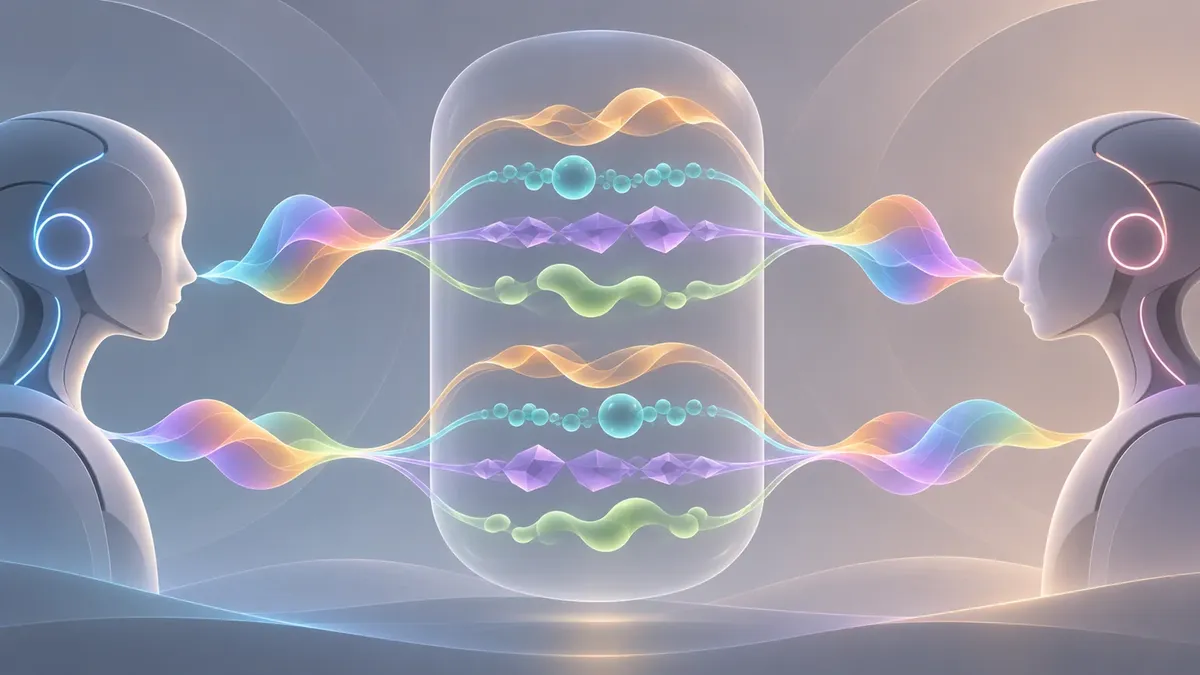
AI agents can exchange ordinary text or continuous numerical representations called latents. Latent communication is meant to pass information without decoding it into words—but does it help? LatentLens tests one such method, LatentMAS, while separating the interface from the surrounding multi-agent workflow.
The question: what part of the system gets credit?
A multi-agent AI system is more than models passing messages. It may give agents different roles, carry earlier context forward and add computation between steps. If the full system outperforms a single model, that alone does not show whether the gain came from its communication method or from this broader setup, known as the agent “harness.”
Latent communication replaces decoded text messages with continuous numerical representations from a model’s internal processing. But preserving information in a numerical representation does not necessarily mean another model can use it effectively.
In LatentLens: Rethinking Latent Interface in Multi-Agent Systems, Ziqing Yang, Kewei Cheng, Mingjie Li and Yang Zhang examine whether latent communication adds value once the harness is controlled, and which parts of the interface might help or hinder it.
A controlled comparison, then a closer look
The researchers studied LatentMAS, one particular latent-communication method, with Qwen3-4B and Qwen3-8B models on seven benchmarks spanning mathematics and science, commonsense reasoning and code generation. The main setup used a sequence of agents acting as planner, critic, refiner and final judge.
For the system-level comparison, they built a sequence of conditions. It starts with a single model, then adds a role-specific prompt and an agent scaffold that supplies upstream context. The key comparison is between Scaffold-Only, which keeps that scaffold but omits latent inputs, and LatentMAS, which adds them. A text-message system serves as a reference. This design helps distinguish the interface from the harness, although it does not eliminate every difference between conditions.
The researchers also examined three interface properties: whether transformed representations suit the receiving model’s input layer (“realignment compatibility”); whether useful information is accessible to the receiver; and how repeated latent steps affect later representations and outputs (“propagation dynamics”). They used interventions and classifiers, called probes, to test how much domain information could be decoded from representations.
The results: LatentMAS lowered mean accuracy
In these tests, Scaffold-Only outperformed the single-model baseline on average. Compared with that same scaffold, LatentMAS lowered mean accuracy by 6.24 percentage points for Qwen3-4B and 17.45 points for Qwen3-8B. The reduction was statistically significant on four of the seven tasks for each model, with especially large losses on code-generation benchmarks. The authors report that invalid or unparsable code outputs increased under LatentMAS.
This does not show that every latent-communication method will fail. It shows that this implementation did not improve accuracy over the matched harness in the tested settings. A result above a single-model baseline, by itself, would not establish that the latent interface caused the improvement.
The internal analyses point to possible explanations. For Qwen3-8B, removing the interface’s realignment matrix brought mean accuracy close to the Scaffold-Only result. This supports a role for incompatibility between transformed representations and the model’s input interface. However, the intervention also changed later states and context, so it does not isolate the matrix’s effect on a fixed representation.
For Qwen3-4B, which the paper describes as having near-identity realignment, accuracy still declined as the number of latent steps increased. This suggests that repeated feedback can be harmful even without a large realignment mismatch. The study reports performance trends, not a direct measurement that distortion grows at every step.
The probes found that domain information could be decoded from latent representations, especially early in the sequence. As latent states accumulated, domain and finer-grained subdomain signals generally became less accessible relative to text representations. But a probe’s ability to decode a label is only an indirect measure; it does not show that the receiving agent can use that information to reason better.
What remains uncertain
LatentLens focuses on LatentMAS, not every trained or training-free latent interface. The main task comparisons used one random seed. Statistical tests assess the reported paired outcomes, but do not replace replication across runs. The authors also note that probes measure linear decodability rather than direct usefulness to the receiver, and that comparisons between tied and untied model checkpoints may reflect differences beyond realignment.
The conclusion is therefore narrower than “latent communication does not work.” Preserving information is not enough: the receiver must be able to use it, and repeated processing must not undermine performance. This is an arXiv preprint, so its findings have not necessarily undergone peer review. Tests across more methods, models and repeated runs would help establish how widely the results apply.
- AI agents
- multi-agent systems
- latent communication
- large language models
- Qwen3
- AI benchmarks
- LatentLens
Reviewed cross-references
These connections were reviewed by a model, not independently fact-checked by a human. Similarity does not imply agreement; consult the original papers and the evidence below.
A New Way to Shrink What AI Agents Read from Their Tools
Supporting evidence: Both studies point to information usability as important for latent inputs: LatentLens identifies realignment compatibility and accessible information as requirements, while Coca-Cola maps compressed observations into the target agent’s embedding space and trains against next-action distributions. Coca-Cola’s web-search QA results and ablations support this design in its tested setting; they do not establish that the same approach would fix LatentMAS’s results or generalize to multi-agent communication.
Model review: · openai-codex/gpt-6-luna
Evidence and provenance
Selected excerpts, not complete papers. PDF extraction can omit figures or damage equations, tables and reading order; sources may be preprints.
2611.31582v1 — Original paper
Excerpt reference:
static/papers/2611.31582v1.md:90-150
Basis: Paper text
Source SHA-256:5c856df90ec042c9d25b667772371210c65044575973129b61428eb6724ac4ba2611.31582v1 — Original paper
Excerpt reference:
static/papers/2611.31582v1.md:907-962
Basis: Paper text
Source SHA-256:5c856df90ec042c9d25b667772371210c65044575973129b61428eb6724ac4ba2611.06500v1 — Original paper
Excerpt reference:
static/papers/2611.06500v1.md:355-489
Basis: Paper text
Source SHA-256:1650c72a30cde6f7b920e7c164a94bbf9ca974e604390150b95862844dbd34142611.06500v1 — Original paper
Excerpt reference:
static/papers/2611.06500v1.md:870-936
Basis: Paper text
Source SHA-256:1650c72a30cde6f7b920e7c164a94bbf9ca974e604390150b95862844dbd3414
Related reading
Automatically matched by shared topic keywords. These links do not imply that the sources agree or establish a consensus.
An AI coding team takes cues from a bee colony
Source published
Shared keywords: ai agents, multi agent systems
Why AI agents still struggle to work as a team
Source published
Shared keywords: ai agents, ai benchmarks, large language models
Can One AI Agent Learn From a Whole Team?
Source published
Shared keywords: ai agents, large language models, multi agent systems
ArgGYM tests AI on revisable reasoning
Source published
Shared keywords: ai benchmarks, large language models
Why AI Agents Still Stumble on Complex Tasks
Source published
Shared keywords: ai agents, large language models, multi agent systems