TRANSMISSION // 2611.31559v1
COGENT models the path from screen to action
Source published
COGENT makes simulated desktop users’ cognitive processes editable and inspectable. It improves some behavior measures, but results vary by test and metric.
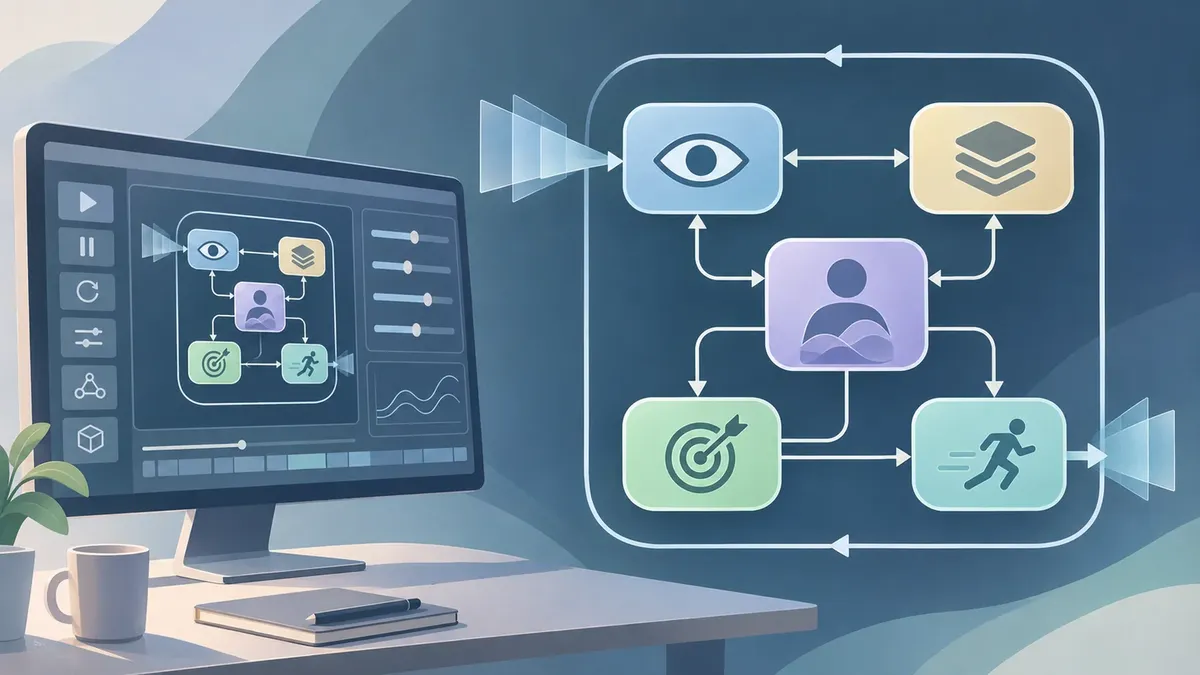
Computer-use agents are often judged by whether they finish a task. For interface research, the route matters too: what a user notices, remembers and tries can help explain how an interface is used. COGENT is a proposed architecture for modeling that route—and letting researchers inspect and change its parts.
People can reach the same goal in different ways. One may remember a shortcut; another may search menus; a third may stop and ask for help. If an AI agent is evaluated only on task completion, those differences can disappear. That matters to researchers studying interface use or evaluating another agent with simulated users.
A research team introduces COGENT, a modular architecture for simulating interaction with desktop interfaces. Rather than relying on a single prompt asking a language model to “act like” a person, the system represents processes between observing a screen and taking an action.
A model with inspectable parts
COGENT draws on ACT-R, a cognitive architecture, and Norman’s action cycle, which describes how people form intentions, act and interpret feedback. Its five modules handle observation, cognition, control, action reasoning and execution. Shared stores hold memory, an interpretation of the current situation, and user attributes, including stable traits and changing states.
In broad terms, COGENT processes a screenshot, represents what the simulated user notices, retrieves relevant knowledge and builds an interpretation. Control processes assess progress and update states or intentions; action reasoning selects an action, and execution carries it out. The next observation provides feedback for another cycle. The paper describes records passed between modules that make these operations inspectable. This is a designed architecture, not a claim that human cognition follows precisely this sequence.
Researchers can intervene by editing memory, setting a trait or initial state, or replacing a processing module. The paper illustrates these options with six paired demonstrations. For example, supplied knowledge of desktop icons lets the simulated user open a file manager with one click; with empty memory, it tries several icons first. In another example, a high-carefulness setting leads to reviewing a request before submission. A color-perception demonstration transforms the input image so status colors are harder to distinguish; the simulated user then reveals text labels before choosing. These are controlled examples of the system responding to edits, not proof that it captures typical human behavior.
What the benchmarks show
The researchers compared COGENT with computer-use baselines on AgentNetBench, A11y-CUA and SENSE-42. The tests examine different things: predicting recorded human actions, matching interaction patterns during tasks, and reproducing relationships among self-reported psychological attributes.
On AgentNetBench, COGENT matched the recorded next action exactly 59.8% of the time, compared with 53.7% for a baseline prompted to simulate a user. It also performed better on action-type accuracy and matched the overall distribution of action types more closely. These results concern the benchmark’s recorded actions, not a general measure of human likeness.
On A11y-CUA, a set of 43 Windows tasks, the principal comparison included successful, failed and unverifiable attempts. COGENT’s action sequences were significantly closer to human references than those of the prompted-user baseline, CUA-User. But a distinct baseline, CUA-User-CB, was designed to approximate COGENT’s overall step and model-call counts on this benchmark. Its sequence-distance result was not significantly different from COGENT’s. The authors caution that this is not a compute-matched test of the architecture alone. Measures that normalize agent–human disagreement by human–human variation also showed no significant differences in the main comparison.
In an analysis restricted to tasks all three principal agents completed, COGENT’s sequence distance was significantly lower than CUA-User’s, but not significantly different from the direct computer-use baseline’s. The distinction matters: results depend on which tasks and measures are compared.
SENSE-42 tested relationships among seven attributes, including sleepiness, effort and frustration. COGENT captured much of the ordering of relationships, but their strengths were imperfectly calibrated. Neither of the two tested attribute–behavior associations was statistically significant in the simulation; one estimate pointed in the opposite direction from the human result.
What remains uncertain
The findings support a limited conclusion: this architecture performed better on selected behavioral measures, while other comparisons were inconclusive or showed calibration gaps. The evaluations cover selected desktop tasks and particular human reference datasets. A11y-CUA uses sighted-user references, and the authors note that broader participant coverage is needed. Experiments used GPT-5.4, but configurations and interfaces differed across baselines; the paper explicitly cautions against treating the comparisons as equal-compute tests of architecture alone.
The SENSE-42 analysis used one partial simulation run, so it cannot show how stable the attribute patterns would be across independent runs. The authors also note that pretrained model knowledge may affect interpretation even when explicit memory is empty; this is a possible influence, not evidence that it caused a particular result. In a separate module-edit experiment, some changes produced no statistically significant differences on the primary measures.
COGENT is presented in a preprint, which has not necessarily undergone peer review. The paper describes analysis and reproduction materials; its task selection, metrics and statistical procedures are important context for interpreting the results. Tests across additional tasks, models and participant groups could help establish when these simulated users are useful—and where their behavior diverges from people’s.
- COGENT
- user simulation
- cognitive architecture
- human-computer interaction
- AI agents
- desktop interfaces
Related reading
Automatically matched by shared topic keywords. These links do not imply that the sources agree or establish a consensus.
Fast AI decision models followed shopping defaults almost every time
Source published
Shared keywords: ai agents, human computer interaction
Designing AI Agents for When Attention Is Elsewhere
Source published
Shared keywords: ai agents, human computer interaction
When an AI remembers the details but loses sight of the plan
Source published
Shared keywords: user simulation
A tougher test for conversational search systems
Source published
Shared keywords: user simulation
Virtual shopping benchmark tests whether AI can recommend, listen and guide
Source published
Shared keywords: user simulation