TRANSMISSION // 2611.31554v1
When AI Agents Retry, Harm May Go Beyond Duplicates
Source published
A study of AppWorld agent runs finds lasting task violations during recovery, including duplicates, deletions and wrong writes—but not all can be attributed to the partial execution.
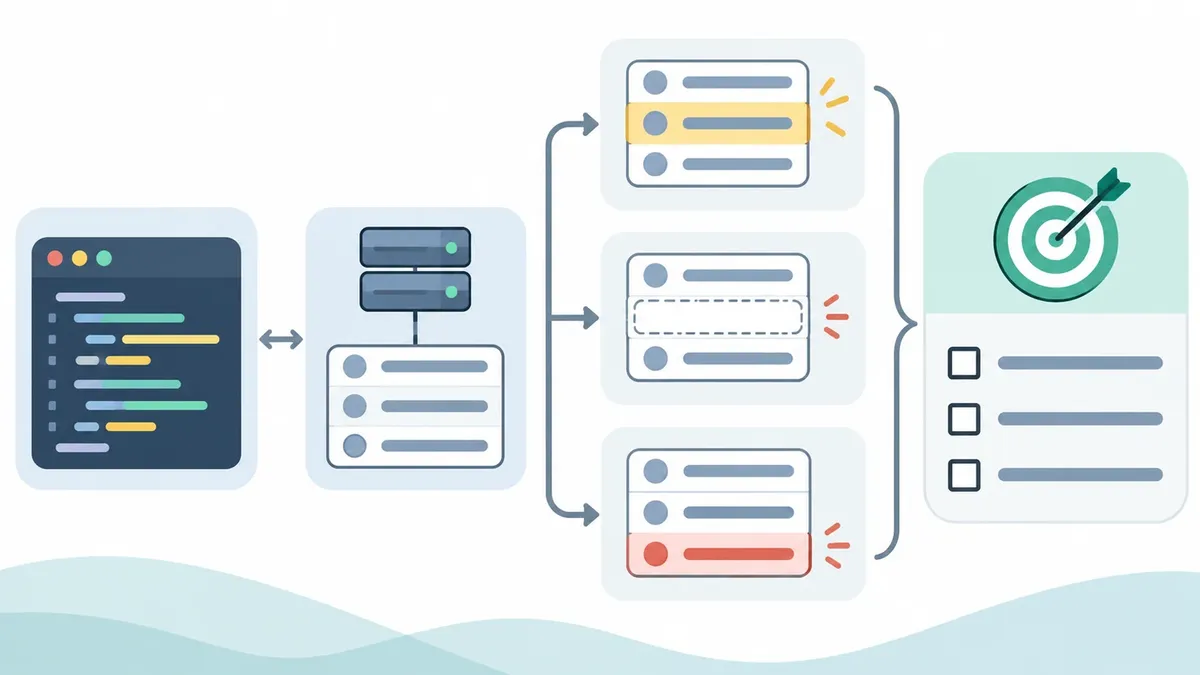
When code fails after an online service has already accepted some changes, an AI agent may rewrite and run the code again. A study of recorded AppWorld episodes examines what harmful changes appear during recovery, how often repeat detection catches them, and what the results can—and cannot—tell us.
An AI agent may send several instructions to an online service in one block of code: add an item to a cart, save an address, then place an order. If the block fails after some actions have succeeded, the service may already have changed. When the agent continues, the final state may include a repeated action or another task violation.
In Agent Recovery Gone Wrong: Measuring Harm Beyond Duplicate Calls, Artem Trofimov and Boris Novikov ask how often harmful changes appear during recovery after partial execution, whether repeat-call rules can detect them, and whether idempotency keys can help. Such a key is an identifier intended to let a service recognize requests for the same logical operation and avoid applying the effect twice.
Tracing recorded episodes
The researchers used AppWorld, a benchmark where agents execute Python code against simulated applications backed by databases. They began with 13,988 AppWorld runs, then assembled a registry of 1,917 candidate episodes from official and leaderboard outputs. Candidates were failed code blocks with at least one apparent write before the error. The study sampled from this registry—not directly from all 13,988 runs—using two model-release-year strata. Its 200 sampled episodes covered ten models.
The team replayed each episode and captured database snapshots before the failed block, after it, and at the end of the run. These helped establish whether a write had taken effect and whether the final state violated the task. The researchers classified harmful changes as duplication, destruction of pre-existing state unrelated to the task, or a wrong change, such as an unrequested order.
Of the 200 candidates, 145 had partial execution confirmed by the database state. Two confirmed episodes had outcomes that could not be determined, leaving 143 for the main estimate. Thirty had a harmful action during the continuation, with the violation still present at the end. Weighting for the registry’s sampling strata, the authors estimate that 24.6% of confirmed partial executions with determinable outcomes in that sampling frame were followed by lasting harm; the reported 95% interval is 15.6% to 34.4%.
That estimate is not a rate for all agent tasks or all failures. Nor does it show that the partial execution alone caused every later violation. The authors explicitly note that a wrong first-time write during recovery could also be an ordinary planning error. Most confirmed episodes concerned the shopping application: 26 of 135 determinable continuations there were harmful. Snapshot coverage of other applications was more limited.
What repeat detection catches
Two thirds of the 30 harmful recoveries after confirmed partial execution involved duplication. The rest involved deletions or wrong first-time writes. A rule that looked for repeated calls detected 75% of duplications. For all harmful continuations, its recall was 41% across 195 sampled episodes with determinable labels—including unconfirmed episodes, not only the 30 confirmed harmful recoveries. The rule’s limited checks could miss some duplicates, while a call-repeat signal cannot identify a first-time deletion or an incorrect new write.
The authors also examined two ways to provide idempotency keys. In a pilot of 17 episodes with one local model, model-supplied identifiers did not detectably reduce harm. In the three observed conflicts with completed work, the model avoided each conflict by using a new identifier. This is a finding from a small pilot, not evidence that models generally behave this way.
A separate analysis was counterfactual: the researchers checked whether keys derived from call content would have matched harmful writes in the recorded episodes. Depending on how arguments were normalized, such a key would have matched all harmful writes in 14 to 18 of the 30 harmful recoveries. It would not have covered recoveries with wrong first-time writes. It also would have matched writes considered necessary for the task in 30 episodes, so automatically suppressing a match could block legitimate work.
Limits and implications
The study suggests that preventing repeated calls alone is not enough. The authors argue that recovery writes should be limited and that systems should compare the resulting state with the task. But they did not evaluate a complete recovery system: content-derived identity was tested against past trajectories, and an agent might behave differently when a request is refused.
Other limitations matter. Language-model annotators labeled the continuations; one author reviewed disagreements and audited a subset. The sample was concentrated in a few model configurations: one configuration contributed 77 of the 143 confirmed episodes with determinable outcomes, and only nine sampled episodes used models from 2026. Snapshot coverage also limits conclusions beyond the shopping application.
The paper is an arXiv preprint, so its findings should not be treated as peer-reviewed evidence. They measure outcomes in a simulated benchmark and do not establish how often similar harms occur in deployed services. The results do, however, show why researchers distinguish harm observed during recovery from harm proven to have been caused by the original partial execution.
- AI agents
- LLM recovery
- API writes
- idempotency
- software reliability
- AppWorld
Reviewed cross-references
These connections were reviewed by a model, not independently fact-checked by a human. Similarity does not imply agreement; consult the original papers and the evidence below.
When an AI tool call fails, did it still work?
Supporting evidence: Both studies indicate that preventing repeated effects does not by itself resolve all recovery risks: the AppWorld study found harmful recoveries that were deletions or wrong first-time writes, while the fault-injection study found post-effect outcomes remained ambiguous without reconciliation despite no observed duplicates. The comparison is limited because one labels harm in recorded benchmark trajectories and the other tests injected faults in a single-host runtime.
Model review: · openai-codex/gpt-6-luna
Evidence and provenance
Selected excerpts, not complete papers. PDF extraction can omit figures or damage equations, tables and reading order; sources may be preprints.
2611.31554v1 — Original paper
Excerpt reference:
static/papers/2611.31554v1.md:13-66
Basis: Paper text
Source SHA-256:21d59c7fd85d001b0931180096a1e678be2c025bc78105999ecb1c48d7883d612611.31554v1 — Original paper
Excerpt reference:
static/papers/2611.31554v1.md:610-680
Basis: Paper text
Source SHA-256:21d59c7fd85d001b0931180096a1e678be2c025bc78105999ecb1c48d7883d612611.23353v2 — Original paper
Excerpt reference:
static/papers/2611.23353v2.md:16-79
Basis: Paper text
Source SHA-256:78f8224a1e3a4a65fe507f46562f8cf3617f36095e8a9788d9a437060dc604772611.23353v2 — Original paper
Excerpt reference:
static/papers/2611.23353v2.md:871-961
Basis: Paper text
Source SHA-256:78f8224a1e3a4a65fe507f46562f8cf3617f36095e8a9788d9a437060dc60477
Related reading
Automatically matched by shared topic keywords. These links do not imply that the sources agree or establish a consensus.
When an AI tool call times out, did it still happen?
Source published
Shared keywords: ai agents, software reliability
When an AI tool call fails, did it still work?
Source published
Shared keywords: ai agents
What Should an AI Agent Do After a Tool Times Out?
Source published
Shared keywords: ai agents
AI agents can resume after failure—but often don’t recover
Source published
Shared keywords: ai agents, software reliability
AI Agents Struggle When the World Changes Around Them
Source published
Shared keywords: ai agents