TRANSMISSION // 2611.31543v1
When AI agents repeatedly choose the same partners
Source published
Ten repeated simulations found recurring communication pairs among language-model agents. The result describes one simulated setup, not human society.
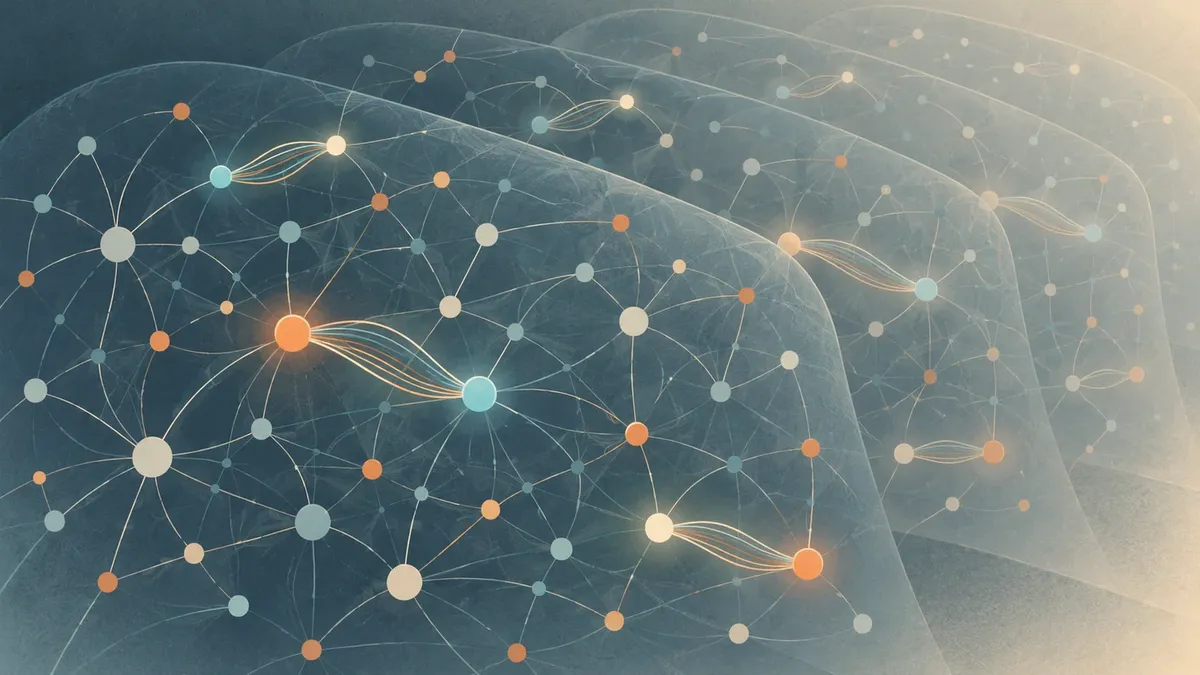
If language-model agents can choose freely whom to contact, do the same communication patterns appear when the simulation is repeated? A preprint explores this question by running one simulated world ten times.
Repeating a simulated society
A pattern in one simulation might reflect that particular run rather than something that recurs in the system. To examine repeatability, the authors created a framework with 50 persona-conditioned agents. Each had persistent memory and could decide whether, with whom and how to communicate across three social platforms. The researchers ran the same world ten times from identical initial conditions, reporting 700 hours of simulation in total, and measured network- and agent-level patterns over time.
They compared recurring pairs across runs with chance expectations and with what could be accounted for by agents’ individual sociability. They also examined whether personality similarity or expressions during first contact were associated with later pair formation. In additional interventions, they swapped agents’ persona prompts or accumulated memories and observed how recipients behaved.
Some communication pairs recurred
In all ten runs, communication that began broadly contracted into sparse, sustained pairs, which the study calls dyads. Many of the same pairs appeared across different runs more often than expected by chance or from agent-specific sociability alone. These are reported results for this particular setup and its measurements; they do not establish that similar patterns would occur in other simulations.
Static personality similarity largely failed to predict which pairs formed. Instead, alignment and extremity in the emotions and traits agents expressed during first contact predicted whether a pair later became sustained. The abstract reports an association, not evidence that those early expressions caused the relationship to develop.
The authors also report that agents’ emotion and trait expressions in their chain-of-thought predicted their future behavior. This concerns generated internal reasoning in the system; it is not a direct measure of human-like feelings.
After persona prompts or accumulated memories were swapped, recipients behaved more like the agents who supplied them. The authors describe both types of transplant as moving recipients about 60% of the way toward the donor personality. Agents receiving another agent’s memory state began behaving similarly from their next turn. The abstract does not give enough detail to interpret the percentage as a general measure of personality transfer.
What can be concluded
The study’s main contribution, as reported in its abstract, is evidence that some measured network and agent patterns were stable across repeated runs of the same simulated world. Repetition allows the authors to identify patterns that recurred in this configuration rather than relying on a single run. It does not show that AI agents have human-like relationships, emotions or stable personalities, or that human social ties work the same way.
This account is based on the abstract, not a review of the full paper. Detailed methods, statistical procedures, definitions and caveats therefore cannot be independently assessed here. The work is an arXiv preprint; the supplied evidence does not establish whether it has been peer reviewed. The findings should be understood as the authors’ reported results, limited to the described simulation.
- large language models
- AI agents
- social simulation
- multi-agent systems
- reproducibility
- agent memory
Related reading
Automatically matched by shared topic keywords. These links do not imply that the sources agree or establish a consensus.
How AI agents can learn from interaction over time
Source published
Shared keywords: agent memory, ai agents, large language models, multi agent systems
Can AI agents model how people react emotionally to events?
Source published
Shared keywords: large language models, social simulation
AI models produce different opinion dynamics under the same discussion rules
Source published
Shared keywords: ai agents, large language models, social simulation
A broader checklist for judging whether AI can be trusted
Source published
Shared keywords: ai agents, large language models
How AI tuning agents can learn from past experiments
Source published
Shared keywords: agent memory, ai agents, large language models