TRANSMISSION // 2611.31494v1
A neural network learns several possible maps of cosmic filaments
Source published
A graph-based generative model reproduces statistical patterns in simulated galaxy-traced filaments and offers multiple possible reconstructions. The early study does not yet recover filaments directly from the underlying matter field.
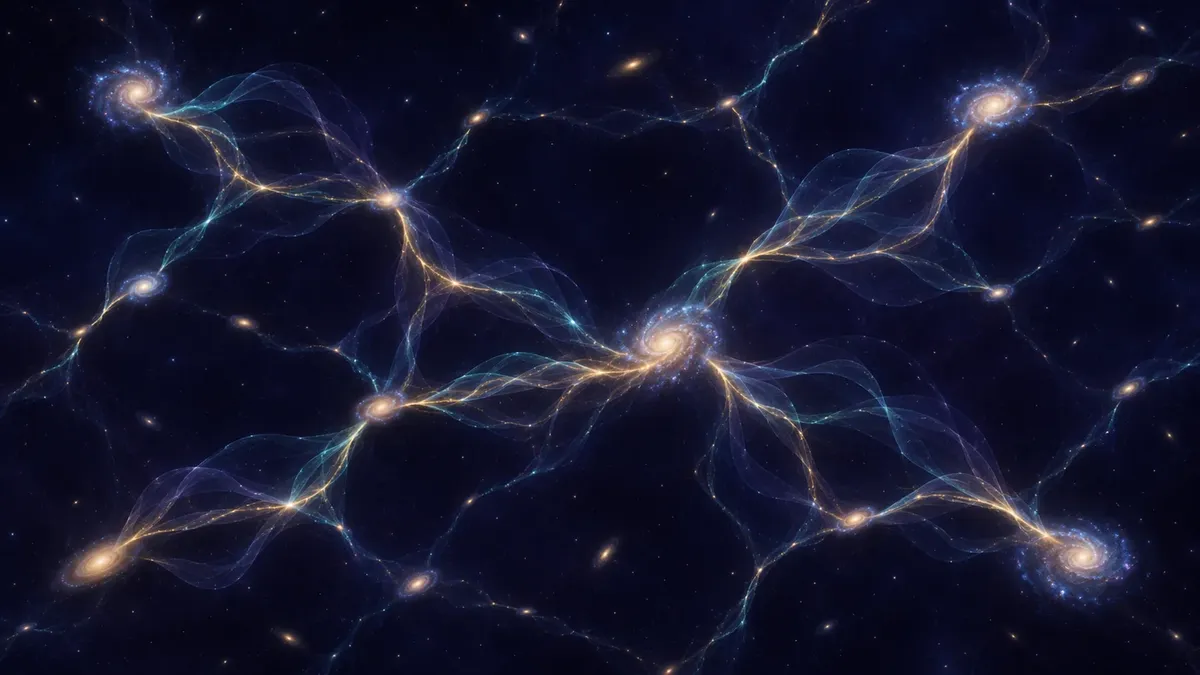
Cosmic filaments connect dense regions in the Universe, but galaxies reveal only a sparse, imperfect picture of them. Researchers have tested whether a generative model can turn galaxy catalogues into plausible filament maps while representing uncertainty—not just returning one fixed answer.
Cosmic filaments are long, threadlike structures that connect dense regions of the Universe. They are part of the cosmic web, alongside clusters, walls and vast underdense voids. But a galaxy survey does not provide a complete map of the matter that forms this web: it records discrete galaxies, which act as tracers of a more complicated underlying distribution. Even the definition of a filament can vary between identification methods, especially for weaker structures.
In a new preprint, Alexis Tastet, Daniela Galárraga-Espinosa and Leander Thiele explore whether a generative machine-learning model can infer filament patterns from galaxy catalogues—and represent the ambiguity involved. Their work is an initial methods study, not yet a reconstruction of the full cosmic web from observational survey data.
Learning a flow from galaxies to filaments
The team trained and tested its model using the Quijote suite of cosmological simulations. These simulations model dark matter; the researchers added mock galaxies using a standard prescription for how galaxies occupy dark-matter haloes. They created 120,000 training examples, using different simulated cosmologies and galaxy assignments. The analysis focused on the present-day universe in the simulations, at redshift zero.
For each example, the target filaments were identified from the mock galaxy catalogue with DisPerSE, an established algorithm. Filaments shorter than 30 megaparsecs divided by h were excluded for computational reasons. Thus, the model’s task was to reproduce filaments identified from galaxies by a particular existing method—not to discover a uniquely defined, objectively known filament map.
The model combines a graph neural network with a generative technique called flow matching. In broad terms, it starts with test points sampled more often near dense galaxy regions, then learns how to move those points toward filament-like patterns. The graph represents relationships among galaxies and test points, allowing the network to use their local arrangements. At inference, different random starting samples can produce different outputs for the same galaxy catalogue.
Statistical agreement, with differences in individual maps
In the examples reported, the generated points broadly trace the target filament distribution. The researchers also compared statistical summaries, including two-point correlations, and report that the model reproduces key patterns of the target population. Their comparison of how the output responds to changes in cosmological parameters found behaviour close to that of DisPerSE in the tested setups.
That agreement does not mean the model recovers every filament in every catalogue. The authors report moderate cross-correlation between generated and target points on large scales, declining on smaller scales. Individual outputs differ from the DisPerSE targets, and the model sometimes produces additional filament-like structures. The paper suggests these may reflect the model’s stochasticity or less likely structures; it also notes that the training data’s artificial minimum-length cut is difficult to learn.
To turn generated points into discrete filaments, the researchers used a simple linking procedure, which joins nearby points according to a chosen maximum distance. This part of the method was not finalized. In the resulting length distributions, the model produced many short filaments compared with its DisPerSE targets, while the distribution of longer filaments was recovered more closely for one tested linking choice. That is a practical limitation, not evidence that the extra short structures are real cosmic filaments.
What the uncertainty means—and what remains
Generating multiple outputs gives a distribution of possible configurations rather than a single map. But the variation should not be read as a calibrated measure of the Universe’s true uncertainty. The authors say it arises from the finite training set and the model’s capacity, even though the DisPerSE targets themselves are deterministic. It therefore reflects properties of this learning setup, not necessarily all the physical uncertainty in mapping galaxies to matter.
The central limitation is the choice of target. The paper identifies its next goal as moving beyond DisPerSE filaments derived from galaxies and defining targets using the underlying total-matter density and velocity fields. That would be closer to the physical structure the researchers ultimately want to infer. The method also needs better ways to connect generated points into discrete filaments.
For now, the result is a proof of concept: a graph-based generative model can reproduce some population-level properties of an established filament finder while producing varied candidate maps. Whether it can reliably infer physically meaningful filaments from real survey data remains an open question. This work is a preprint, and its findings should be treated as preliminary rather than as a validated survey-ready method.
- cosmic filaments
- cosmic web
- graph neural networks
- flow matching
- cosmological simulations
- galaxy surveys
Reviewed cross-references
These connections were reviewed by a model, not independently fact-checked by a human. Similarity does not imply agreement; consult the original papers and the evidence below.
Simulated cosmic filaments reveal a shared dark-matter pattern
Shared method: Both studies use DisPerSE: Tastet et al. use its galaxy-catalog filament identifications as training targets, while Xu et al. extract filaments from density grids in TNG50 and refine their spines. This is a shared filament-finding method, not evidence that either study validates the other; their inputs and aims differ.
Model review: · openai-codex/gpt-6-luna
Evidence and provenance
Selected excerpts, not complete papers. PDF extraction can omit figures or damage equations, tables and reading order; sources may be preprints.
2611.31494v1 — Original paper
Excerpt reference:
static/papers/2611.31494v1.md:89-137
Basis: Paper text
Source SHA-256:b33cef3368a46ae0da4882223ba24bf08c10a4bfdd9cef7ba28c1c0f3d8f11b32604.05033v2 — Original paper
Excerpt reference:
static/papers/2604.05033v2.md:120-189
Basis: Paper text
Source SHA-256:2a0743bc3f476e5e953f4e488c09a109a75c8906051c0712a7ec5ed34fa68ff9
Related reading
Automatically matched by shared topic keywords. These links do not imply that the sources agree or establish a consensus.
Simulated cosmic filaments reveal a shared dark-matter pattern
Source published
Shared keywords: cosmic filaments, cosmic web, cosmological simulations
Reading the early universe through the cosmic web
Source published
Shared keywords: cosmic web, cosmological simulations
Testing a faster engine for cosmic structure simulations
Source published
Shared keywords: cosmological simulations, galaxy surveys
How Galaxy Formation Shapes Cosmological Clues
Source published
Shared keywords: cosmological simulations, galaxy surveys
Why Galaxy Bias Depends on How You Measure It
Source published
Shared keywords: cosmological simulations, galaxy surveys