TRANSMISSION // 2611.31480v1
Can Open-Weight AI Build Scientific Workflows?
Source published
A study tested open-weight AI models inside a real science gateway. Leading models scored similarly in initial trials but varied in speed, while evaluation glitches showed how agent tests can mislead.
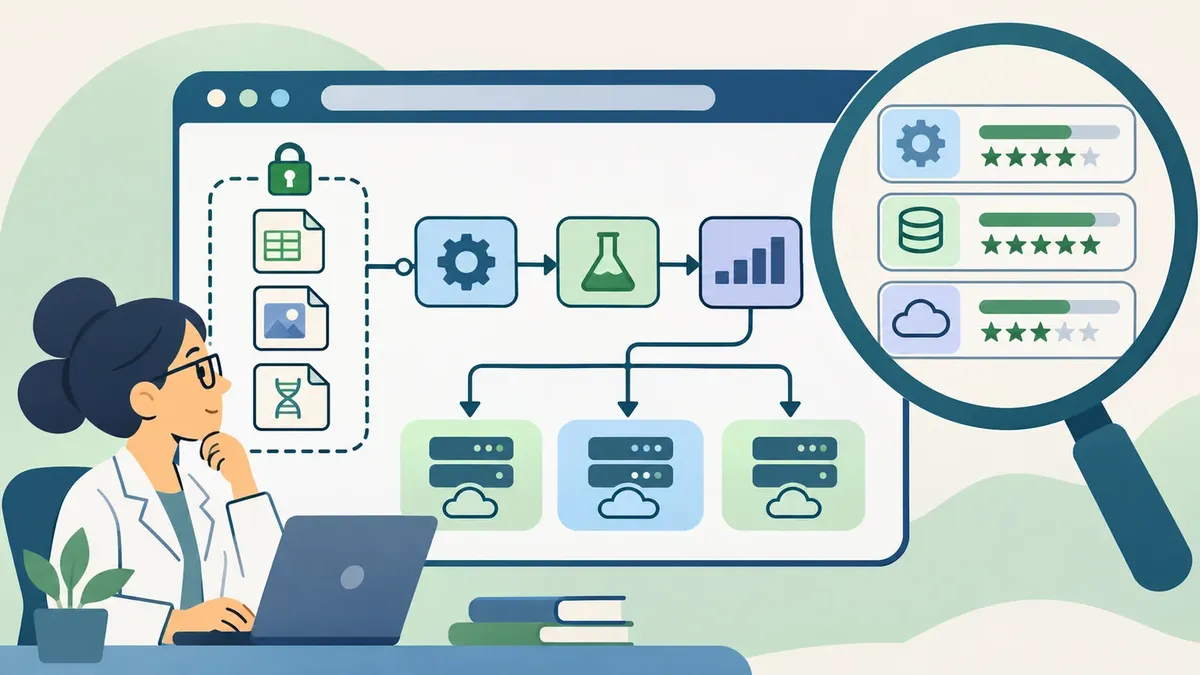
Scientific computing can involve linking many jobs, files and computing sites into a reliable workflow. Could open-weight AI models help scientists build those workflows without relying on paid frontier-model access—and how should their performance be tested?
A scientific workflow is a recipe for a computer: it specifies the steps, the data each step needs and how the results connect. For large analyses, writing that recipe for a system such as Pegasus takes specialized knowledge. AI coding agents may help, but reusable instructions and examples written for one model may not work equally well with another.
Komal Thareja and colleagues tested whether open-weight models could use skills originally developed with a frontier model in PegasusAI Studio, a science gateway with a chat interface. They also asked which models might suit a gateway serving varied users, and what the skills needed to explain more clearly.
Testing models in the gateway
The researchers built an evaluation harness that gave tasks to models through Studio’s chat API, much as a user would. Agents could use files and shell tools to create workflow projects, which the gateway then checked. The evaluation stopped at planning: workflows were not submitted to computing resources for execution.
The study covered 21 open-weight models and 17 tasks, including building workflows, converting existing pipelines, reviewing flawed workflows and diagnosing failures. Each model first attempted each task once. The team also ran repeated build trials for Claude Opus 5.5 and three open-weight models.
The scoring system had two parts. L0 used mechanical checks, including whether requested files were written and whether the workflow could be generated and planned. L1 was a separate rubric-based rating by a judge model, which assessed aspects such as the job graph, wrappers and data staging. The reported build and judgment scores are mean L1 ratings for their respective task groups; they are not combined L0-and-L1 scores.
Similar initial scores, different response times
Five open-weight models formed a leading group, with initial build scores between 0.669 and 0.707. The authors cautioned that one attempt per task was not enough to establish a reliable ranking within that group. Their median response times differed twelvefold, making speed a more striking distinction than score in that comparison.
In repeated build trials, the best-performing open-weight model among those repeated, deepseek-v4-flash, scored 0.761, compared with Claude’s 0.820. The reported difference was 0.059, with a 95% interval of 0.023 to 0.097 across 12 tasks. This comparison concerns workflow-building scores under the study’s setup; it does not establish how the models perform on other scientific work or on executed analyses. Deepseek-v4-flash was slower than Kimi-K2.6 in the repeated trials. The gateway developers chose a Qwen model partly because it was available across their research testbeds.
Recurring errors led to five changes to the skills. Problems included unclear file paths, deliverables that were not explicit and instructions open to different interpretations. For example, after the team clarified how paths should be given, one model placed its project correctly in three of four trials, compared with zero of four before the change. This is a targeted example, not evidence that every change improved every model.
The evaluation can fail, too
A key finding was methodological: when agents and evaluators share an environment, a low score may reflect a problem with the test setup rather than the model. The study recorded infrastructure defects that could affect scores. In one case, the harness failed to recognize an agent’s question; after the detector was fixed, Claude’s score on that task rose from 0.179 to 0.971.
The team also tested whether examples and templates helped by making them unreadable. In the first version, agents accessed blocked material through several routes: they restored permissions on files, read another copy in the container image, or reached copies the harness had archived. The block had been applied within the agents’ privilege domain, so it did not prevent these routes. The initial results showed a statistically significant score drop, but that comparison did not successfully keep the examples from the agents.
The researchers then enforced the restriction outside the agents’ privilege domain and checked every copy before each trial. Agents tried to read the files, but none succeeded. With the restriction properly enforced, the measured effect disappeared: the average change was small and not statistically significant. The earlier drop therefore did not show that removing examples harmed performance; it reflected a flawed experimental control and other low-scoring trials.
What the results do—and do not—show
The study suggests that open-weight models can build and plan workflows in this particular gateway, and that clearer skills and careful evaluation matter. But most models were tested only once per task; repeated trials covered selected models and build tasks. The study assessed planning rather than executing workflows. A container-building problem on the evaluation host also affected scores on some tasks: later replay of the affected stages succeeded in many cases, but those results did not replace the original scores.
This is an arXiv preprint, so it should not be treated as necessarily peer-reviewed. Its findings are specific to the models, tasks, skills and gateway tested, and some model endpoints changed or became unavailable during the study. The authors say the harness, tasks, trial records and analysis scripts are publicly available, allowing further scrutiny and testing.
- open-weight models
- AI agents
- scientific workflows
- Pegasus
- science gateways
- agent evaluation
- AI skills
Reviewed cross-references
These connections were reviewed by a model, not independently fact-checked by a human. Similarity does not imply agreement; consult the original papers and the evidence below.
A Better Paper Trail for Updating AI Skills
Shared method: Both studies use evaluation evidence to guide iterative skill refinement: Thareja et al. feed recurring gateway failures into skill changes and evaluate again, while Yan et al. connect case-level evidence to human-reviewed revisions and bounded tests. This is a methodological connection, not evidence of equivalent validation; Thareja et al. note that skill changes were measured only on individual models during screening, and Yan et al. caution that case-level links do not establish causation.
Model review: · openai-codex/gpt-6-luna
Evidence and provenance
Selected excerpts, not complete papers. PDF extraction can omit figures or damage equations, tables and reading order; sources may be preprints.
2611.31480v1 — Original paper
Excerpt reference:
static/papers/2611.31480v1.md:134-209
Basis: Paper text
Source SHA-256:36abb2ac6f40c7e8c985a071b009e13f28f12f00a1b3ba99bbec2d563f7fbf1d2611.31480v1 — Original paper
Excerpt reference:
static/papers/2611.31480v1.md:702-772
Basis: Paper text
Source SHA-256:36abb2ac6f40c7e8c985a071b009e13f28f12f00a1b3ba99bbec2d563f7fbf1d2611.28706v1 — Original paper
Excerpt reference:
static/papers/2611.28706v1.md:1324-1385
Basis: Paper text
Source SHA-256:ebd233f3cc1672b8baec9ac92a1300f100cb8e5072e230b09c303bd1910baf752611.28706v1 — Original paper
Excerpt reference:
static/papers/2611.28706v1.md:337-414
Basis: Paper text
Source SHA-256:ebd233f3cc1672b8baec9ac92a1300f100cb8e5072e230b09c303bd1910baf75
Related reading
Automatically matched by shared topic keywords. These links do not imply that the sources agree or establish a consensus.
Making AI Agents Accountable on Shared Research Computing
Source published
Shared keywords: ai agents, scientific workflows
A Better Paper Trail for Updating AI Skills
Source published
Shared keywords: ai agents
When AI Skills Learn from the Tools They Use
Source published
Shared keywords: ai agents
How to Evaluate AI Agents When “Correct” Is Unknown
Source published
Shared keywords: agent evaluation, ai agents
Why AI Agents Still Stumble on Complex Tasks
Source published
Shared keywords: agent evaluation, ai agents