TRANSMISSION // 2611.31477v1
How Rapid Fields Reshape Hopping on a 2D Lattice
Source published
A semiclassical analysis predicts how rapidly oscillating fields reshape long-range hopping in a rectangular lattice—and why suppressing motion in some directions may not stop it everywhere.
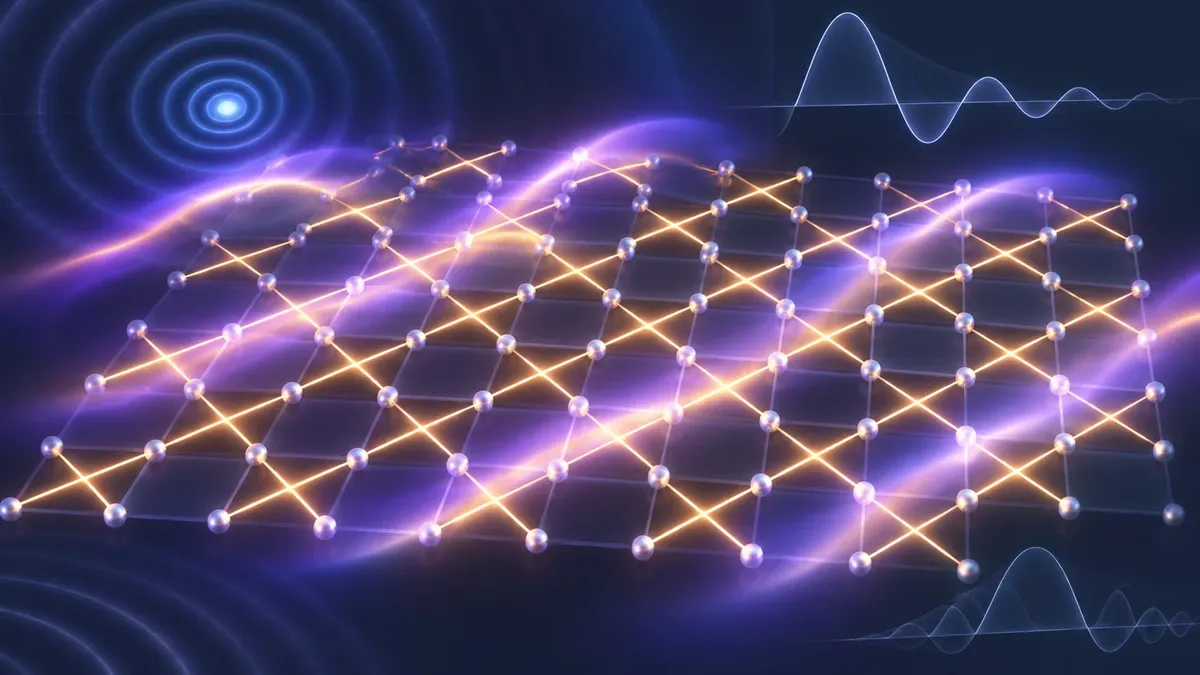
Can a rapidly oscillating force effectively switch off particle motion in a two-dimensional lattice? This study develops a semiclassical description of how such a drive and a static potential reshape hopping between lattice sites, including hops to distant neighbors. Its central caution: suppressing the main, axis-aligned hops does not necessarily eliminate diagonal ones.
A driven lattice, viewed over time
In a tight-binding lattice, particles move between discrete sites by hopping. A rapidly oscillating external field can change the effective strength of that motion. Under some conditions, hopping is suppressed—a phenomenon known as dynamic localization. But in a two-dimensional lattice, particles can hop not only along the two axes but also diagonally and to more distant sites. Does suppressing the familiar axis-aligned motion stop all transport?
Evaristo Mamani and Diego Sanjines develop a theoretical framework to address that question for a rectangular lattice with interactions extending to all neighboring sites. Their analysis considers a rapidly oscillating field and a static potential, both described in the abstract as arbitrary. The paper’s stated contribution is a general effective Hamiltonian: a description of the lattice dynamics averaged over the rapid drive, rather than a record of every fast oscillation.
How the analysis works
The authors extend earlier semiclassical formalisms using three ingredients: a canonical transformation, a semiclassical approximation, and Kapitza-type time averaging. In plain language, these tools reorganize the driven problem into an effective description of slower, averaged motion.
The reported results are organized by powers of the inverse drive frequency, 1/ω. At zeroth order, the effective hopping depends on Bessel-function factors. At a higher order, 1/ω², new hopping contributions arise from the coupling between the oscillating field and the curvature of the static potential—its second spatial derivative. The abstract also distinguishes fields with even and odd symmetry in time: for the odd-symmetry case, the analysis predicts an effective shift of the energy band in addition to changes in hopping.
This is a theoretical derivation, not a report of an experiment. The abstract says the authors also numerically identify one scenario, but does not provide the simulation setup or quantitative details. The conclusions should therefore be read as results within the stated effective-model and approximation framework, not as direct evidence that a particular material or device has been dynamically localized.
Why “switching off” motion can be incomplete
The paper generalizes an exact dynamic-localization condition previously formulated for two-dimensional systems. Its key finding is that the resulting band collapse can be anisotropic: hopping along the lattice axes can be suppressed while some diagonal hopping remains.
That distinction matters. A lattice can appear to have its main routes of motion switched off without every possible route being eliminated. According to the abstract, exact dynamic localization in the stroboscopic sense—the behavior observed when the system is considered once per drive cycle—is guaranteed only when the band collapse is complete for all neighbors. Axis-aligned suppression alone is not enough to establish full localization.
The authors also report a numerically identified “effective-duplication” scenario for the rectangular lattice. It is associated with approximate solutions to a Pythagorean-type relation among zeros of the zeroth-order Bessel function. The abstract does not explain what is duplicated in practical terms or give numerical examples, so this result is best treated as a reported feature of the model rather than a ready-made prediction for an experiment.
What remains uncertain
The available source material for this article is the paper’s abstract only. It does not supply the equations, parameter ranges, derivation details, numerical methods, or tests of how well the approximation holds in particular physical settings. Those details are important for judging when the effective Hamiltonian is accurate and whether the predicted effects are experimentally accessible. The abstract’s description of the field and potential as arbitrary should not be taken to mean that every real-world drive or potential is equally well captured by the approximation.
The paper is identified as an arXiv preprint. The supplied information does not establish whether it has been peer reviewed, and the findings should not be presented as settled consensus. What the abstract supports is a theoretical message: in a driven rectangular lattice, effective hopping can depend on drive symmetry and potential curvature, and localization must be checked across diagonal as well as axial routes.
- dynamic localization
- tight-binding lattice
- semiclassical approximation
- driven quantum systems
- effective Hamiltonian
- Bessel functions
- quantum physics
Reviewed cross-references
These connections were reviewed by a model, not independently fact-checked by a human. Similarity does not imply agreement; consult the original papers and the evidence below.
Periodic driving reshapes mobility edges in a quasiperiodic model
Supporting evidence: Both papers report that high-frequency periodic driving can renormalize lattice hopping through Bessel-function factors and suppress effective tunneling. The rectangular-lattice study derives this at zeroth order for even-symmetry fields, while the GPD-model study maps its high-frequency effective Hamiltonian to a static model; these are related results in different lattice models and do not establish identical localization conditions.
Model review: · openai-codex/gpt-6-luna
Evidence and provenance
Selected excerpts, not complete papers. PDF extraction can omit figures or damage equations, tables and reading order; sources may be preprints.
2611.31477v1 — Original paper
Excerpt reference:
static/papers/2611.31477v1.md:13-68
Basis: Paper text
Source SHA-256:21e709f1a5b1461b003da35eff8bef7a89ada4f5b92fcd4b096b4707dbf1e7b72604.21992v2 — Original paper
Excerpt reference:
static/papers/2604.21992v2.md:12-56
Basis: Paper text
Source SHA-256:13c4ff601c7e922e05f2cab85091838a217c3ae5ad560e634d99f910529c4a17
Related reading
Automatically matched by shared topic keywords. These links do not imply that the sources agree or establish a consensus.
When two atoms interact more strongly than they radiate
Source published
Shared keywords: quantum physics
A Magnetic-Drive Model Predicts a Superradiant Phase
Source published
Shared keywords: quantum physics
Can light reveal a subtly altered phase space?
Source published
Shared keywords: quantum physics
How fast can Yang–Baxter circuits grow in complexity?
Source published
Shared keywords: quantum physics
A broader message-passing method for tensor networks
Source published
Shared keywords: quantum physics