TRANSMISSION // 2611.31466v1
An AI agent researches products before making video ads
Source published
AdProducer combines web and image search with storyboard planning to help video generators make more product-faithful advertisements.
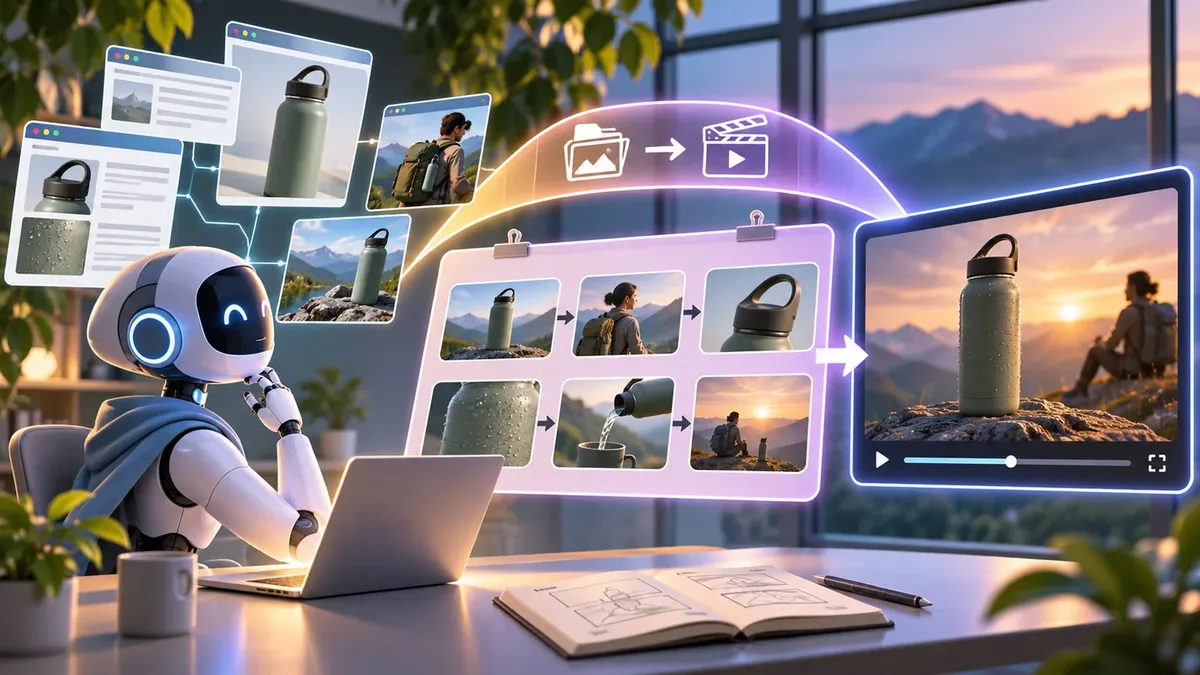
A video can look polished yet show the wrong product or miss what makes it distinctive. AdProducer is a research-and-planning system designed to address that gap: it gathers product information, turns it into a shot-by-shot plan, then hands the plan to a video generator.
The challenge: more than making a video look good
Text-to-video systems can produce striking images, but an advertisement has a harder job than simply looking attractive. It should depict the intended product, present accurate details and show why the product might matter to a buyer. A convincing-looking clip can still get the device, design or specifications wrong—or fail to demonstrate a key feature.
AdProducer, introduced in a new arXiv preprint, tackles this problem by adding product research and creative planning before video generation. The researchers ask whether a multimodal AI agent can use web and image search to understand a product, then design a storyboard that helps an existing video generator make a more faithful, purposeful advertisement.
Research first, storyboard second
Given a short creative brief, AdProducer’s agent searches for product information, examines webpages and retrieves product images. It uses the gathered material to write a structured storyboard specifying shots, timing, actions, camera movements, reference images and on-screen text. A separate video generator then renders that plan. In the reported experiments, the generator remains frozen: the researchers train the agent that researches and plans, rather than changing the video model itself.
The agent is trained in two stages. First, supervised fine-tuning teaches it to imitate example research-and-storyboard trajectories. Then reinforcement learning adjusts its decisions using feedback about both the storyboard and the rendered video. The two signals are intended to complement each other: a good plan does not guarantee that a video model will follow it, while a rendered clip alone may be a noisy measure of the agent’s decisions because the generator has its own limitations.
To support training and testing, the team constructs datasets from product briefs, searches, verified facts, reference images and storyboards. Its AdCreation-Bench holds out 305 briefs spanning eight domains, with no product overlap between the training and evaluation sets. The benchmark includes recently released, less prominent and “evergreen” products, and measures product correctness and creative execution with PG-Score. A separate Ad-Score, assigned by another AI judge, rates broader advertising qualities such as narrative flow and persuasiveness.
What the tests found
On the benchmark, the reported PG-Score for MiniMax H3 rose from 17.3 with direct prompting to 51.3 when paired with AdProducer. The agent also improved the score for Veo 3.1, from 28.0 to 35.9, without additional training on that generator. The paper reports gains in Ad-Score and VideoScore2 as well, and says the improvements were especially evident in product fidelity, factual accuracy and showing selling points.
The researchers also ran a human evaluation: 15 participants rated 40 clips based on eight briefs from five domains. AdProducer paired with MiniMax H3 received higher ratings on the reported dimensions, including product fidelity and informativeness. This offers a human check alongside the automated scores, but it is a small study, not evidence about how real audiences would respond to a large advertising campaign.
The method is not a guarantee of accurate advertising. A search agent can retrieve or interpret incorrect information, and a video generator can still mishandle a reference or render text poorly. The paper itself notes that the smaller gain with Veo 3.1 may reflect that generator’s weaker adherence to reference images. In other words, better research and planning can help, but the final result still depends on the rendering system.
What remains uncertain
The benchmark’s scores are not sales results. Ad-Score is produced by an AI judge, and the reported human study measures people’s ratings of a limited set of clips—not whether viewers actually buy products or how performance compares in real advertising placements. The evaluation also uses a specific set of briefs, tools and video generators, so results may not carry over to other products, languages, workflows or systems.
Finally, this is an arXiv preprint: a publicly shared research paper that may not have undergone peer review. Its reported results should be treated as preliminary until independently checked. The authors say code, models and data are released, which could help other researchers test the approach. For now, AdProducer offers evidence that a research-and-storyboard stage can improve benchmarked product grounding, while leaving open how reliably that translates to everyday commercial use.
- AI video generation
- advertising
- multimodal agents
- product research
- storyboards
- video benchmarks
Reviewed cross-references
These connections were reviewed by a model, not independently fact-checked by a human. Similarity does not imply agreement; consult the original papers and the evidence below.
Loupe gives video AI a research assistant
Shared method: Both systems use external search and visual references to ground a structured plan before video generation: AdProducer researches products and builds selling-point storyboards, while Loupe retrieves and verifies evidence to create temporal prompts with reference images. The shared approach is evidence-grounded planning, not identical training or evaluation; their benchmarks and tasks differ.
Model review: · openai-codex/gpt-6-luna
Evidence and provenance
Selected excerpts, not complete papers. PDF extraction can omit figures or damage equations, tables and reading order; sources may be preprints.
2611.31466v1 — Original paper
Excerpt reference:
static/papers/2611.31466v1.md:312-397
Basis: Paper text
Source SHA-256:95e12c7d9c1982faa0b0cbb8bb7159340277cbb97d361c3e498108a31b1aad1a2611.31895v1 — Original paper
Excerpt reference:
static/papers/2611.31895v1.md:65-110
Basis: Paper text
Source SHA-256:583df140c537310df970868f719d8eb1e5bcadfe3f00a1061c074fe7d20a5f8c
Related reading
Automatically matched by shared topic keywords. These links do not imply that the sources agree or establish a consensus.
How PhyMotion scores AI-generated human movement
Source published
Shared keywords: ai video generation
Can AI Keep Math Videos Tied to Their Solutions?
Source published
Shared keywords: ai video generation
Loupe gives video AI a research assistant
Source published
Shared keywords: ai video generation
Teaching GUI Agents to Assemble—and Repair—3D Machines
Source published
Shared keywords: multimodal agents
Teaching Video AI When to Speak
Source published
Shared keywords: video benchmarks