TRANSMISSION // 2611.31461v1
Could Cosmic Structure Help Explain Acceleration?
Source published
AFIC is a theoretical framework in which matter’s large-scale distribution can produce an effective dark-energy-like term. Its illustrative estimate is uncertain, and the mechanism remains to be tested.
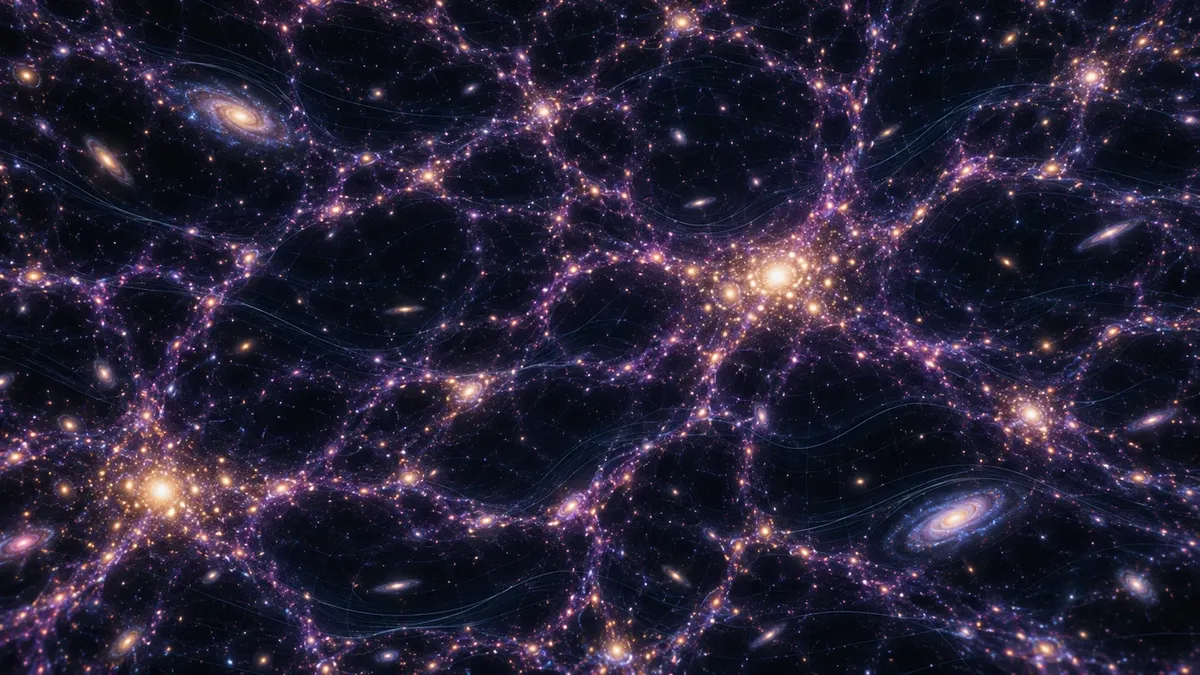
The universe’s expansion is accelerating, but what drives that acceleration remains an open question. A new framework explores whether the evolving distribution of matter could contribute an effective dark-energy-like term—an idea that still needs observational tests.
Galaxies and clusters form a lumpy cosmic web, with less matter in the spaces between them. Could this uneven distribution help explain the universe’s late-time acceleration? In a preprint, Mariano Cadoni and colleagues propose a framework called Anisotropic Fluid Inhomogeneous Cosmology, or AFIC, that explores this possibility within general relativity.
The proposal does not show that cosmic structure causes the observed acceleration. Rather, it sets out a way to describe inhomogeneous matter and spacetime together, then identifies conditions under which a dark-energy-like contribution appears in the model’s large-scale limit.
Modeling an uneven universe
AFIC represents matter as an effective fluid with different pressure in the radial and tangential directions. The authors use this anisotropy to describe radial variations in matter while retaining a spherically symmetric geometry. The framework’s central input is the Misner–Sharp mass: a geometric measure of the mass enclosed within a radius. Its profile varies with radius and cosmic time, encoding the distribution and evolution of matter.
The authors derive exact solutions to Einstein’s equations for this setup, given suitable boundary conditions. Unlike approaches that assume metric fluctuations remain small, AFIC is designed to describe nonlinear structure. Its geometry recovers the familiar homogeneous and isotropic Friedmann–Lemaître–Robertson–Walker (FLRW) form when inhomogeneities are negligible, and at sufficiently large scales at late times. The paper treats the early-time case as a regime before nonlinear structure growth, not as a new calculation of all early-universe physics.
An effective term at large scales
The proposed dark-energy-like contribution depends on the mass profile’s behavior at large scales. In the framework, an extensive term associated with inhomogeneities can appear in the large-scale FLRW description. A particular choice makes it behave like a cosmological-constant-like term; other choices could allow it to evolve over time.
The authors emphasize that this extensive contribution does not enter the exact metric for local inhomogeneous spacetime in the same way as a conventional cosmological constant. They describe it as a large-scale effect, not an additional local gravitational force. The paper also cautions that the framework does not identify the physical process by which inhomogeneities would generate the effective term. It cannot exclude the alternative interpretation that the term reflects a dark-energy component already present earlier in cosmic history.
What the estimate does—and does not—show
To illustrate the framework, the paper constructs a simplified, analytically tractable model. In this example, the effective cosmological-constant-like quantity is related to a mass-profile coefficient and a matter quadrupole, a measure of the distribution’s departure from spherical symmetry. For its estimate, the authors consider matter within a spherical volume, choose an origin at the centre of an overdensity, and use the linear matter power spectrum to estimate the quadrupole. Exact spherical symmetry would give a zero quadrupole, so the estimate relies on departures from that idealized symmetry.
The resulting range spans several orders of magnitude. The paper says its upper end is within about one order of magnitude of the observed value, while the lower end is several orders smaller. This is a semi-quantitative estimate, not a precise prediction or evidence that structure explains acceleration. The authors use simplifying assumptions, including a standard matter-power-spectrum prescription rather than one calculated self-consistently within AFIC. They also note that their model does not capture the full anisotropic structure of real matter distributions. The validity of the simplified model and the observational determination of its relevant mass and quadrupole remain open problems.
Tests ahead
A central challenge is to reconstruct the Misner–Sharp mass profile from observations and compare the framework with the measured expansion history. The authors point to possible information from galaxy surveys, cosmic microwave background lensing, and the late integrated Sachs–Wolfe effect, an imprint of evolving structures on the microwave background. These are potential routes to testing the proposal, not tests completed in this paper.
AFIC is a theoretical proposal, not an established alternative to the standard cosmological model. This source is an arXiv preprint; the available material does not establish that it has undergone peer review. Its exact solutions follow from the stated model, but whether the effective-fluid assumptions describe the real universe—and whether the proposed large-scale term matches observations—remains unsettled.
- cosmology
- cosmic acceleration
- dark energy
- general relativity
- large-scale structure
- anisotropic fluid
- Misner–Sharp mass
Reviewed cross-references
These connections were reviewed by a model, not independently fact-checked by a human. Similarity does not imply agreement; consult the original papers and the evidence below.
Can Cosmic Structure Help Explain Acceleration?
Shared method: Both papers use the AFIC framework, whose exact General Relativity solution is parametrized by the Misner–Sharp mass profile; the companion study uses DESI BAO and Type Ia supernova data to constrain that mass. This is a theory-and-application connection, not independent confirmation: the papers identify themselves as companion work, and the observational result is reported as agreement with ΛCDM under the model’s assumptions.
Model review: · openai-codex/gpt-6-luna
Evidence and provenance
Selected excerpts, not complete papers. PDF extraction can omit figures or damage equations, tables and reading order; sources may be preprints.
2611.31461v1 — Original paper
Excerpt reference:
static/papers/2611.31461v1.md:112-160
Basis: Paper text
Source SHA-256:c413927f79ba1da24ed3ef016c9cbb9e79847b83d14d7fbb6445e29ebf124da22611.31374v1 — Original paper
Excerpt reference:
static/papers/2611.31374v1.md:103-208
Basis: Paper text
Source SHA-256:7c759d274b67c017a3f59c858e6a7c127e5d4df092cd9e1e86c5b5919c1a90ec
Related reading
Automatically matched by shared topic keywords. These links do not imply that the sources agree or establish a consensus.
Can Cosmic Structure Help Explain Acceleration?
Source published
Shared keywords: cosmic acceleration, dark energy, misner sharp mass
A softly broken symmetry offers a route across the phantom divide
Source published
Shared keywords: dark energy, large scale structure
Could Entangled Spins Reveal Screened Dark Energy?
Source published
Shared keywords: dark energy, general relativity
How changing neutrino masses could mimic phantom dark energy
Source published
Shared keywords: dark energy
Stability Limits a Class of Interacting Dark-Sector Models
Source published
Shared keywords: cosmic acceleration, dark energy