TRANSMISSION // 2611.31460v1
Beyond the Stopwatch: Do Coding Agents Make Software Faster for the Reasons They Claim?
Source published
In 82 runnable, mostly Python pull requests, researchers compared timing with kernel and hardware signals. A matching signal supports—but does not prove—a claimed reason for a speed change.
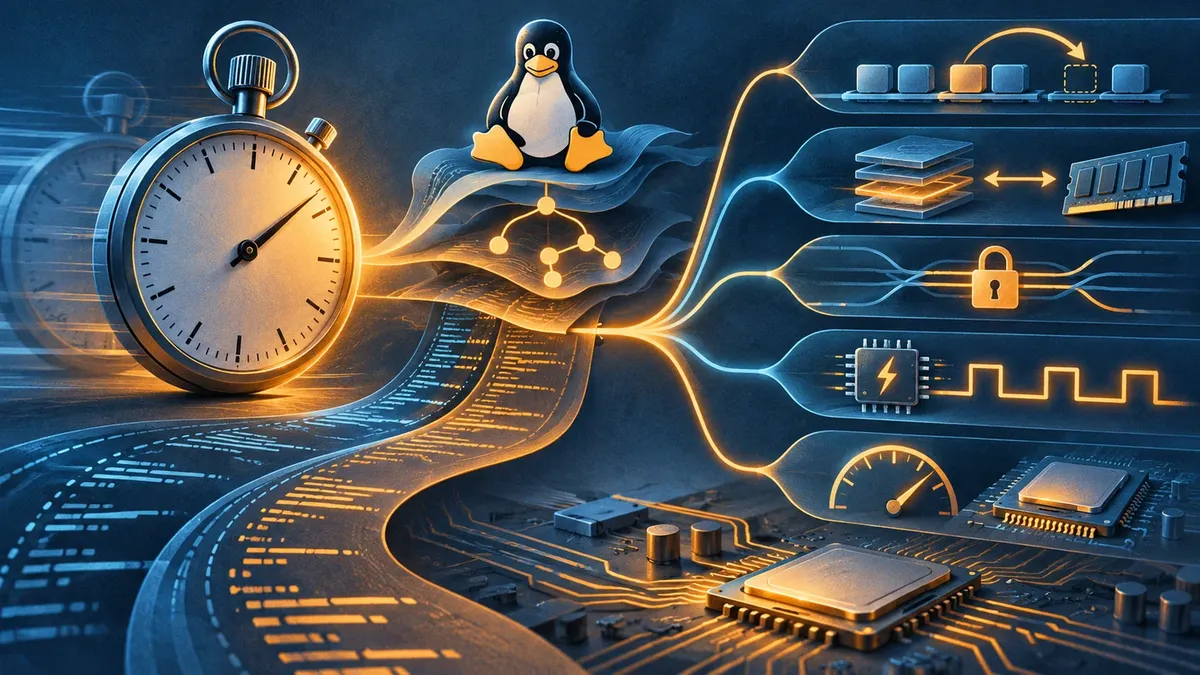
A faster stopwatch reading does not explain why software sped up. Researchers tested whether the reasons given in a selected set of coding-agent pull requests matched changes in operating-system and hardware signals when the code ran.
A pull request can make software run faster without demonstrating the reason given for the improvement. If a change claims to avoid repeated file access, timing alone cannot show whether the expected file-operation signals changed. The arXiv preprint Below the Stopwatch explores whether operating-system and hardware measurements can help examine such claims.
The authors built a pipeline called Below to compare code before and after performance-related pull requests (PRs) from AI coding agents. In the AIDev dataset, they identified 1,343 PRs that aimed to improve runtime performance. They categorized the mechanisms the PRs claimed—such as caching, reducing memory use or avoiding unnecessary work—and mapped each to signals expected to change if the claim was true. For avoiding repeated I/O, for example, the mapped signals included fewer file-opening or read calls, or fewer bytes read.
A build agent recreated both versions and prepared a workload to exercise the changed code. It could see the code and its differences, but not the PR description or the researchers’ extracted claim. That blinding was intended to prevent the claim from steering the workload. The researchers measured timing, hardware counters and Linux kernel activity using LTTng traces. They also compared the original version against itself to check run-to-run variation on the same machine.
The evidence supplied with PRs was often limited: 57.3% offered only reasoning or no evidence, and 31.4% stated an effect size. The build agent produced workloads that passed the study’s checks for 91 of the first 150 PRs it attempted. Detailed performance analysis covered 82 PRs from 53 repositories, selected from those the pipeline could run and measure.
In this measured group, 32 PRs ran faster, 28 showed no clear change and 22 ran slower. The claimed mechanism showed its expected signal in 34 cases. It held in 28 of the 32 faster PRs, but in only 3 of the 22 slower ones; in the other 19 slower cases, the mechanism did not meet the study’s criterion for a hold. These patterns suggest that traces can add evidence about a stated reason, but a matching signal is not proof that the reason caused the speed change.
The type of signal mattered. Among faster PRs, kernel-trace signals—such as system calls or time spent waiting—moved in the claimed direction for 48.8% of claimed mechanisms, compared with 28.7% of mechanisms the PR did not claim. Instruction counts were less useful for distinguishing the stated mechanism: they moved in the expected direction for 87.9% of claimed mechanisms and 76.7% of unclaimed ones. A reduction in instructions can accompany a speed-up without identifying its specific explanation. Kernel signals offered more clues about mechanisms, but were not perfectly specific.
Speed and program behavior are separate questions, too. The workload’s output changed in 42 of the 82 PRs, for example through new defaults or error messages. The study does not establish whether those changes were intended. Its examples include a faster change whose traces did not support its stated explanation, and a slower change where traces showed increased work.
The authors describe important limits. The 82-PR sample is small and early, and includes up to 15 PRs from one repository. An agent-written workload may not represent real use or exercise the conditions where a mechanism matters: a caching change, for instance, may require repeated calls. Local stand-ins for external services cannot reproduce network delays or server-side work. Each PR was measured once on one machine. AI models helped classify PRs, extract claims and build workloads; a planned human check of a stratified sample had not yet been completed.
This study does not estimate how often all coding-agent performance claims are correct, or show that tracing can settle every question about a code change. It demonstrates a method for checking whether claimed mechanisms leave observable signals in a limited set of runnable, mostly Python PRs. Because this is an arXiv preprint, it may not have been peer reviewed. Its results are best read as an early method and bounded set of observations, not a final verdict on coding agents.
- AI coding agents
- software performance
- kernel tracing
- pull requests
- program analysis
- preprint
Reviewed cross-references
These connections were reviewed by a model, not independently fact-checked by a human. Similarity does not imply agreement; consult the original papers and the evidence below.
A benchmark asks coding agents to show their work
Shared method: Both use program execution to ground evaluation in observable behavior: Below rebuilds and runs code before and after PRs, measuring timing and system signals, while RepoEviAgent uses tests or verification code when needed to support repository Q&A. This is a limited methodological overlap; their tasks and outcomes differ, and the excerpts do not establish equivalent validation procedures.
Model review: · openai-codex/gpt-6-luna
Evidence and provenance
Selected excerpts, not complete papers. PDF extraction can omit figures or damage equations, tables and reading order; sources may be preprints.
2611.31460v1 — Original paper
Excerpt reference:
static/papers/2611.31460v1.md:86-238
Basis: Paper text
Source SHA-256:94395522ce81b4d9adcb2d87d92d6af5d4785b1e90141c33715ce8bf9f6dc34a2611.31873v1 — Original paper
Excerpt reference:
static/papers/2611.31873v1.md:443-527
Basis: Paper text
Source SHA-256:a75bdb7ea9417da5285c868a02a78f8dfe759d7fa5a5b2396a76030d80386aff
Related reading
Automatically matched by shared topic keywords. These links do not imply that the sources agree or establish a consensus.
How Faults Could Spread Across AI-Written Code Changes
Source published
Shared keywords: ai coding agents, pull requests
Why AI coding agents need more than a rulebook
Source published
Shared keywords: ai coding agents
When AI coding agents get a map to the rules
Source published
Shared keywords: ai coding agents
Turning Programs into Graphs for Verification Reuse
Source published
Shared keywords: program analysis
When AI code review speeds up work—and adds more of it
Source published
Shared keywords: pull requests