TRANSMISSION // 2611.31457v1
How Taxi helps inspect AI-agent behavior at scale
Source published
Taxi combines step clustering, scoped database queries and experimental decision models to analyze agent runs. Its technical report presents production anecdotes and a SastBench walkthrough, while noting important limitations.
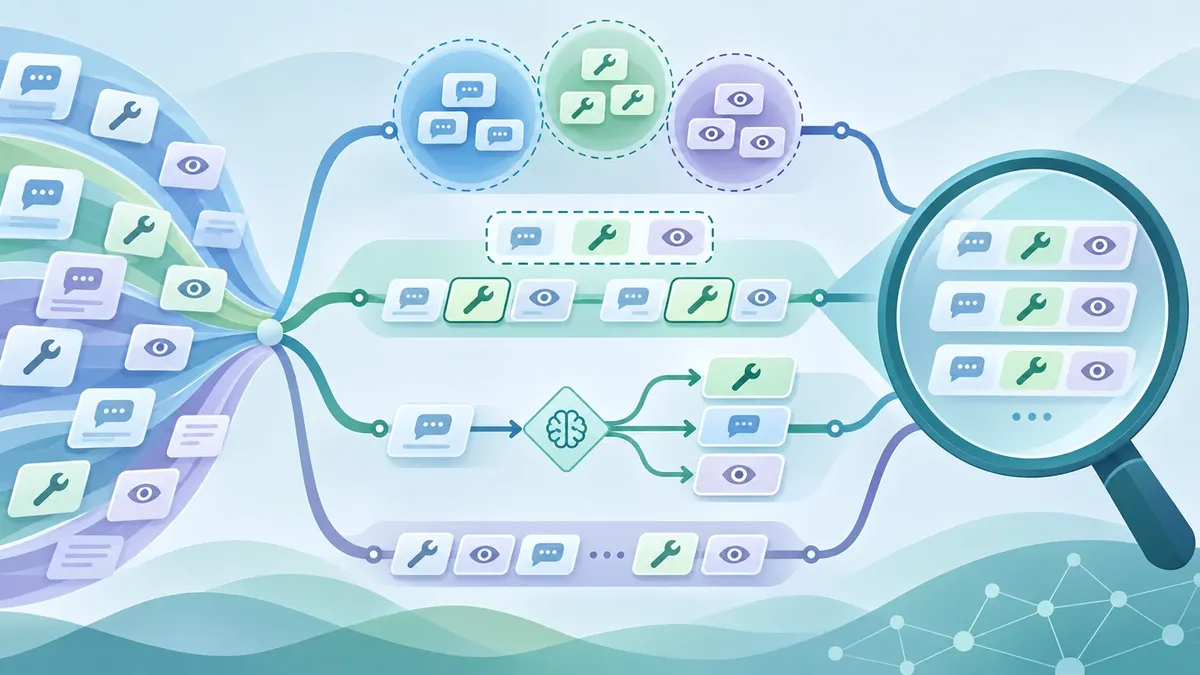
Long-running AI agents leave trails of messages, tool calls and observations. Guy Dar’s arXiv technical report introduces Taxi, a system for organizing and querying those trails to help teams investigate recurring behavior—not a controlled demonstration that the system improves agent performance.
The challenge: making agent runs observable
An agent’s trajectory is the sequence of messages, tool calls and observations produced during a run. Looking at one trajectory can reveal a mistake, but recurring problems may be harder to notice across many runs: an unnecessary lookup repeated over and over, a tool failure that agents work around, or behavior outside a request’s stated scope.
Taxi is designed to help teams inspect such records at scale. The report argues that logging alone is not enough: people also need a structured overview of behavior and a way to ask detailed questions about it. Rather than sending every step to a generative language model for analysis, Taxi combines several methods that the authors describe as cheaper or more scalable for particular tasks.
A taxonomy, plus ways to investigate it
Taxi stores trajectories in a shared database, with each trajectory represented as ordered steps. It computes text embeddings for steps and can use those representations to cluster similar steps. Clusters can be organized into a hierarchical taxonomy—a tree that provides a structured overview of the corpus.
Embedding clustering is one routing method, not the only one. Taxonomies can also use regular expressions to match recognizable text patterns, or Jev-style decision models to route steps according to semantic category definitions. Different methods can be combined in one taxonomy, although siblings at a given level use the same routing method.
The report describes both a simple, flat pipeline and an agent-guided construction process. In the flat version, clustering proposes groups and a language model labels them using samples. In the more involved process, an agent can inspect examples and distinctive terms, then revise the proposed structure by splitting or merging groups before publishing a new version. The report presents this inspection loop as a construction option, not a step used for every taxonomy.
A taxonomy is an overview, not a substitute for investigating the records. Taxi offers scoped, read-only SQL queries over the data available to a project or selected data sources, along with text and pattern matching. These tools can be used to ask questions about phrases, tool errors, runs, or changes over time. In the authors’ design, the overview can guide queries, while queries help examine specific patterns in the corpus.
The report also describes an experimental path using “Jev-style” decision models. Rather than generate free-form explanations, these models answer bounded questions and return typed decisions with probabilities. The authors propose them for semantic distinctions that embeddings or literal searches may not capture. That is a design rationale, not evidence that the models outperform those alternatives; the report says these features have not been tested end to end across the full system.
Other features include evaluators, which check whether defined behavioral patterns recur, and scheduled insight reports that review newer trajectories for notable behavior.
What the report describes
The authors recount five production cases from organic use of Taxi. These include a cluster of search failures associated with a tool mishandling patterns, steps that appeared to exceed a stated scope, repeated rediscovery of static information, repeated attempts to use an unavailable dependency, and authentication failures that the authors linked to a revoked credential. These are anecdotes reported by the authors, not controlled tests establishing that Taxi caused the issues to be detected or how reliably it would find them elsewhere.
A more extensive walkthrough analyzes SastBench, a static-analysis benchmark. Four agents used the same ReAct harness to assess 2,737 findings, generating 10,515 runs and 87,140 steps. The report uses queries, taxonomies and behavioral analyses to examine shared errors, tool failures and investigation patterns. This is a substantial worked example of the system’s analysis workflow on one corpus. It does not establish that Taxi improves the agents’ accuracy.
What remains uncertain
Taxi’s analyses depend on the quality of its groupings. The authors note that long text, including code, can complicate clustering, that settings can be difficult to choose, and that even agent-guided taxonomy construction can miss nuances. Behavior may also change over time, making an older taxonomy a stale lens on newer runs. The Jev-based routing and evaluation paths are experimental, and the report says multi-agent systems are not supported out of the box.
The SastBench analysis and production anecdotes provide examples, but the report does not give a systematic estimate of Taxi’s problem-detection rate or an external comparative evaluation. Its evidence therefore supports a description of the system and its use in these cases, not a general claim about performance across settings. The authors say their analyzed trajectories came from their own agent systems and public data, and did not involve human-subjects data.
This is an arXiv technical report, or preprint; its presence on arXiv does not by itself establish peer review. The authors’ central design framing is to combine structured grouping with direct queries, using heavier semantic judgments selectively. Whether that approach is useful in a particular setting depends on the data, the taxonomy and the checks—and on people verifying patterns against the underlying runs.
- AI agents
- agent observability
- trajectory analysis
- clustering
- SQL
- AI monitoring
- debugging
Related reading
Automatically matched by shared topic keywords. These links do not imply that the sources agree or establish a consensus.
Can questioning an AI agent improve safety?
Source published
Shared keywords: ai agents, ai monitoring
Can an AI Monitor Tell Score Manipulation From a Mistake?
Source published
Shared keywords: ai agents, ai monitoring
Why SQL agents need knowledge while they work
Source published
Shared keywords: ai agents
Monitoring one AI communication route can move the conversation, not stop it
Source published
Shared keywords: ai monitoring
An AI can match a financial answer while using the wrong history
Source published
Shared keywords: ai agents