TRANSMISSION // 2611.31444v1
When quantum controls also reshape quantum noise
Source published
A two-level-system study suggests that controls can influence open quantum dynamics more strongly when the model lets them change the system’s interaction with a thermal bath.
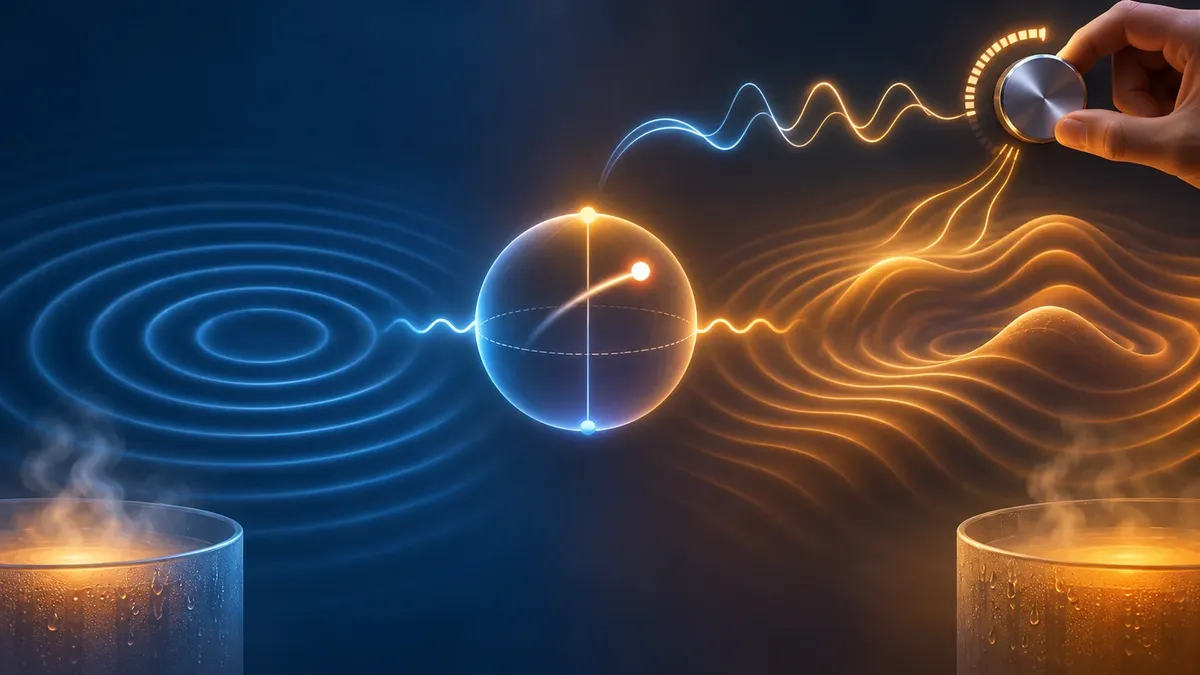
A control pulse may do more than rotate a quantum state: in a thermodynamically consistent model, it can also change how the environment acts on that state. A theoretical study compares this picture with one in which the noise stays fixed.
Quantum controls are usually introduced as ways to steer a system’s energy levels and quantum state. But when the system is connected to a thermal environment, changing its Hamiltonian can also change how it exchanges energy and information with that environment. A new theoretical study asks what happens to controllability—the range of states a system can be steered toward—when this link between control and decoherence is included.
The researchers compare two descriptions of an open quantum system. In one, a Lindblad-type model keeps the dissipative part of the dynamics fixed as the controls change. In the other, a secular Redfield model makes the dissipation depend on the system’s changing Hamiltonian. The distinction matters because a thermal bath is expected to bring a system toward an equilibrium state determined by its Hamiltonian. If that Hamiltonian changes, the corresponding equilibrium state changes too.
A two-level system in a changing landscape
The authors study a two-level system, a simplified quantum system with two possible energy states, coupled to a thermal bath. They describe its state using a Bloch vector: a point inside a sphere, where the direction represents aspects of the state and its distance from the centre relates to purity. A pure state lies on the sphere’s surface; mixed states lie inside.
They derive equations for both models and analyze how control functions affect the system’s motion. Their work combines mathematical controllability arguments with numerical simulations of example control sequences. The Redfield treatment assumes weak system–bath coupling, a Markovian approximation, and controls that change slowly compared with the bath’s correlation time. For simplicity, the model also uses a specified form of system–bath coupling rather than representing every possible physical setup.
What changes when the bath response follows the controls?
In the fixed-dissipation model, coherent controls rotate the state, but the dissipative contribution does not adjust to those controls. The paper describes the resulting long-time motion as restricted to particular unitary orbits—sets of states with the same purity—under the conditions considered.
In the control-dependent model, changing the Hamiltonian also changes the predicted relaxation and dephasing. The authors show analytically that, within the interior of the Bloch sphere, suitable constant controls can make any target mixed state asymptotically reachable and stable: the system approaches it over time. Their analysis also says the model can reach such targets in finite time under stated conditions, although the target is then not necessarily stable. Pure states on the sphere’s boundary are not included in the asymptotic-controllability result; at nonzero temperature, the bath’s thermal equilibrium is mixed.
Numerical examples illustrate the difference. Compared with the fixed-dissipation cases examined, the control-dependent model predicts stronger influence of controls on populations and coherences—the probabilities of energy states and the phase relations between them. In some simulated conditions, stronger Hamiltonian control coincides with slower coherence decay. This is a result of the model and examples, not a general promise that stronger pulses preserve coherence in real devices.
The study also examines purity. Because the model’s dissipative terms vary with the controls, those controls can influence changes in purity more directly than in the fixed-dissipation description. The authors argue that trajectories in their model naturally move into regions where purity rises, in relation to the moving thermal equilibrium state. That does not mean decoherence is simply beneficial: the effect depends on the bath, the controls, and the assumptions built into the equations.
What the result does—and does not—establish
The main message is about modeling: treating dissipation as independent of control can miss ways that controls affect open-system dynamics. The paper’s conclusions concern a mathematical two-level model, not a demonstrated improvement in a quantum computer or sensor. Its authors identify broader systems, optimization, and control protocols as directions for future work.
The comparison also relies on approximations. Markovian, weak-coupling descriptions are useful in suitable regimes, but actual environments may have memory or fall outside those conditions. The paper’s slow-control assumption is important to its derivation, and a simplified coupling cannot capture every bath. Its numerical comparisons use selected fixed dissipators, so they are illustrations rather than an exhaustive comparison with all possible Lindblad models.
This article is based on the arXiv version identified as v1. An arXiv posting is a preprint and should not, by itself, be taken as evidence of peer review. The results are therefore best read as a theoretical proposal for how control-dependent decoherence may change controllability, with further analysis needed to establish how broadly the conclusions apply.
- quantum control
- decoherence
- open quantum systems
- Redfield equation
- Lindblad equation
- two-level system
Reviewed cross-references
These connections were reviewed by a model, not independently fact-checked by a human. Similarity does not imply agreement; consult the original papers and the evidence below.
How Helix Twist May Shape Electronic Decoherence
Shared method: Both studies use Redfield master-equation methods: the origin paper analyzes control-dependent decoherence with a secular Redfield equation, while Moudgal et al. use Redfield tensor coefficients to calculate decoherence rates in a helical model. This is a shared theoretical framework, not evidence that their systems or findings are directly comparable.
Model review: · openai-codex/gpt-6-luna
Evidence and provenance
Selected excerpts, not complete papers. PDF extraction can omit figures or damage equations, tables and reading order; sources may be preprints.
2611.31444v1 — Original paper
Excerpt reference:
static/papers/2611.31444v1.md:107-138
Basis: Paper text
Source SHA-256:d6c850e4e111c683e01604b2205d76c3d015ec09f19a09d7b2674ef5f0f36b5d2611.31847v1 — Original paper
Excerpt reference:
static/papers/2611.31847v1.md:132-304
Basis: Paper text
Source SHA-256:bec21c168d7c20c57d644636e1dc5e4dbaaa471b0f8bc4b54c4b4e00b950f9bd
Related reading
Automatically matched by shared topic keywords. These links do not imply that the sources agree or establish a consensus.
Simulating quantum noise by enlarging the quantum system
Source published
Shared keywords: lindblad equation, open quantum systems
Quantum entanglement could build patterns that outlast it
Source published
Shared keywords: open quantum systems
A Trapped Ion Could Help Cool and Control a Levitated Nanoparticle
Source published
Shared keywords: quantum control
How quantum systems behave over the long run
Source published
Shared keywords: open quantum systems
A straighter route to charging a quantum battery
Source published
Shared keywords: quantum control