TRANSMISSION // 2611.31441v1
A Hadronic Hint in a Supernova Remnant’s Gamma Rays
Source published
A broadband analysis favors a model with both electrons and protons for HESS J1731-347, even after separating a nearby molecular-cloud region. The result depends on simplifying assumptions; CTAO forecasts promise better spectra, not a definitive verdict.
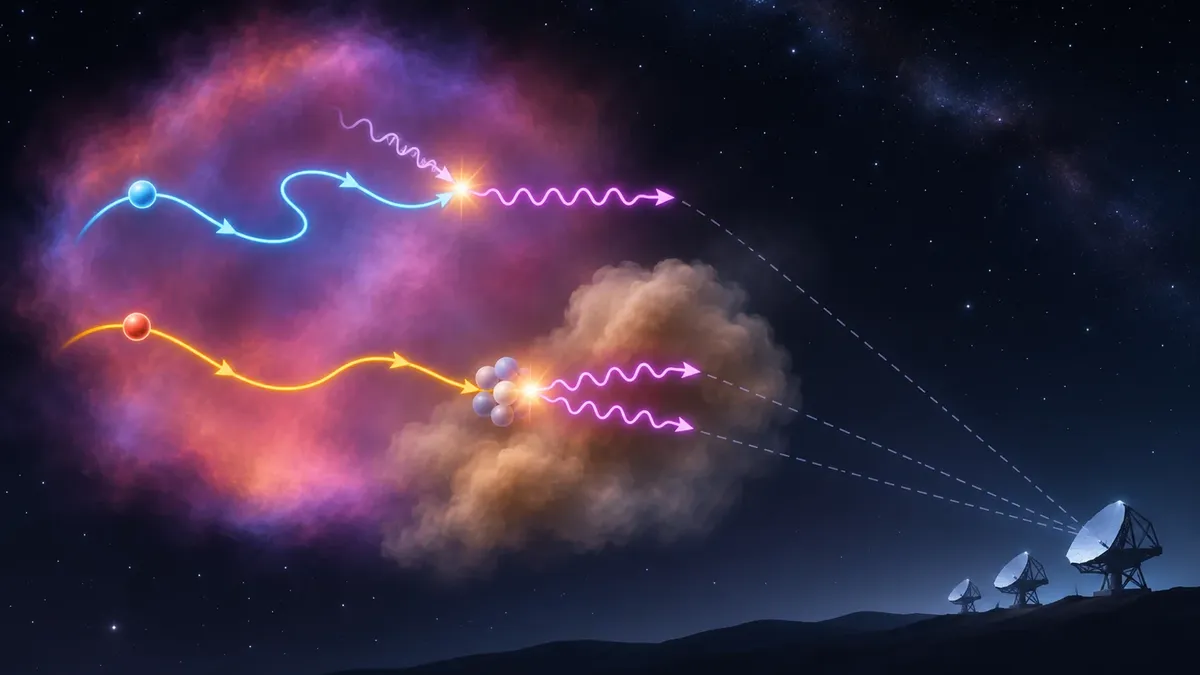
Gamma rays from a supernova remnant can be made by energetic electrons or by protons colliding with gas. A new analysis of HESS J1731-347 finds that a model including both particle types fits the assembled observations better than an electron-only model—even when emission near a molecular-cloud core is excluded. But that statistical preference applies to particular simplified models, not proof of the gamma rays’ origin.
When a supernova explodes, its expanding shock can accelerate particles to high energies. Those particles may produce gamma rays in different ways: electrons can boost ambient light to gamma-ray energies, while protons can collide with gas and ultimately produce gamma rays through the decay of short-lived particles called neutral pions. Because either process can help explain a source’s broad spectrum, distinguishing them is a longstanding challenge.
HESS J1731-347 is a shell-shaped supernova remnant with radio, X-ray and very-high-energy gamma-ray emission. Its western side overlaps, on the sky, with a molecular-cloud core that has its own GeV gamma-ray component. The study asks whether the remnant’s gamma rays are better explained by accelerated electrons alone or by a mixture of electrons and protons—and whether that answer depends on including the cloud-associated emission.
Combining observations across the spectrum
The researchers assembled archival radio and X-ray measurements, published TeV gamma-ray data from H.E.S.S., and a new analysis of about 16 years of observations by the Fermi Large Area Telescope. They compared spatial descriptions of the GeV emission, then built two data sets for broadband modeling: one retaining the full region, and one excluding the molecular-cloud core from the remnant template while fitting the associated GeV source separately.
For each data set, they used Bayesian sampling to fit two one-zone models. In the electron-only version, electrons account for the radio and X-rays through synchrotron radiation and for gamma rays by scattering ambient light. The second, called lepto-hadronic, includes those electron processes plus gamma rays from proton collisions with gas. A one-zone model treats the source as a simplified region with shared physical properties, rather than resolving conditions across the shell.
The comparison used the Bayesian Information Criterion, or BIC, which balances how well a model fits against how many adjustable parameters it uses. Lower BIC means a preferred fit among the models being compared; it does not establish that a model is physically true.
A preference that survives the cloud cut
In both spatial treatments, the lepto-hadronic model had a substantially lower BIC than the electron-only model. In the cloud-excluded case, the reported BIC difference was 33.67 in favor of the lepto-hadronic model. This supports the authors’ conclusion that the preference is not driven solely by emission associated with the molecular-cloud core.
For that cloud-excluded fit, the model inferred a magnetic field of about 85 microgauss and a hard proton energy spectrum, with a proton index of 1.69 ± 0.10. The estimated proton energy above 1 GeV was about 4.4 × 10⁴⁸ erg, assuming a surrounding hydrogen density of 20 particles per cubic centimeter. That density was fixed in the analysis, not measured by the fit; the inferred proton energy depends on it.
The LAT analysis also found that the GeV component associated with the cloud region was nominally softer than the remaining remnant’s emission. But the difference was only about 1.2 standard deviations, so the authors treat it as a trend, not strong evidence for distinct particle populations.
What the result does—and does not—show
The result is a model comparison, not a direct identification of protons. The authors fix the distance at 3.2 kiloparsecs and the gas density at 20 particles per cubic centimeter. The remnant’s environment is uneven, so one density and one magnetic field cannot describe every part of its shell. The cloud-excluded TeV spectrum is also an approximation: published H.E.S.S. data were scaled by a fixed fraction, rather than re-measured with spatially resolved TeV observations. The calculation omits radiation from secondary electrons and positrons produced in proton collisions.
The preferred proton spectrum is harder than expected from the simplest textbook picture of shock acceleration. The authors emphasize that this is a requirement of their fitted interpretation, not independent evidence that standard acceleration theory explains the source. More broadly, their BIC comparison covers two specific one-zone models; it does not rule out more complex, multi-region explanations.
The team simulated 50 hours of observations with the planned southern array of the Cherenkov Telescope Array Observatory (CTAO). For the chosen best-fit models, simulations predict a detection at roughly 13–18 standard deviations and more precise measurements of the TeV spectrum. The predicted models differ in spectral curvature below a few TeV and in how sharply their emission falls at higher energies. However, the simulations use best-fit spectra and do not propagate the full uncertainty in model parameters. They therefore do not show that CTAO will distinguish every plausible electron and proton scenario.
The paper is available as an arXiv preprint; the supplied source does not establish its publication or peer-review status. Its conclusions should therefore be understood as the authors’ reported analysis, not settled consensus. The central finding is narrower but useful: under the assumptions tested, adding a proton contribution improves the fit even when the cloud-core region is removed. Better spatially resolved data and fuller modeling will be needed to determine how robust that interpretation is.
- HESS J1731-347
- gamma-ray astronomy
- supernova remnants
- cosmic rays
- Fermi-LAT
- CTAO
- hadronic emission
Reviewed cross-references
These connections were reviewed by a model, not independently fact-checked by a human. Similarity does not imply agreement; consult the original papers and the evidence below.
Why Two Gamma-Ray Components Sometimes Form Separate Peaks
Supporting evidence: Both papers describe a softer GeV component associated with the molecular-cloud region of HESS J1731-347 and harder or higher-energy emission from the remaining remnant. The first paper reports the spectral difference as only about 1.2σ and does not treat it alone as evidence for distinct particle populations; the second interprets the components with a two-component model, so the shared support is for the spatial-spectral pattern, not for a common emission mechanism.
Model review: · openai-codex/gpt-6-luna
Evidence and provenance
Selected excerpts, not complete papers. PDF extraction can omit figures or damage equations, tables and reading order; sources may be preprints.
2611.31441v1 — Original paper
Excerpt reference:
static/papers/2611.31441v1.md:2027-2132
Basis: Paper text
Source SHA-256:672aa37820d980a82072b88017aec5497db735ff4ddff177207b0590bcd83f062611.14107v1 — Original paper
Excerpt reference:
static/papers/2611.14107v1.md:1393-1491
Basis: Paper text
Source SHA-256:1501a989cbf4cb9098cf2eb1343339baa134d4ff6fb88410df9333c7a5d7fd73
Related reading
Automatically matched by shared topic keywords. These links do not imply that the sources agree or establish a consensus.
One Gamma-Ray Glow, Two Possible Sources
Source published
Shared keywords: cosmic rays, fermi lat, gamma ray astronomy
Why Two Gamma-Ray Components Sometimes Form Separate Peaks
Source published
Shared keywords: cosmic rays, gamma ray astronomy, supernova remnants
How ground-based telescopes are tracing the Universe’s most extreme particles
Source published
Shared keywords: cosmic rays, gamma ray astronomy
Gamma rays reveal differences in how galaxies retain cosmic rays
Source published
Shared keywords: cosmic rays, fermi lat, gamma ray astronomy
A Southern Window on the Highest-Energy Gamma Rays
Source published
Shared keywords: cosmic rays, gamma ray astronomy