TRANSMISSION // 2611.31429v1
How an AI tutor can give away answers in installments
Source published
A persistent disclosure ledger caught worked solutions to numerically altered homework problems in tests, but gains were limited by parser misses and did not extend to split requests in live runs.
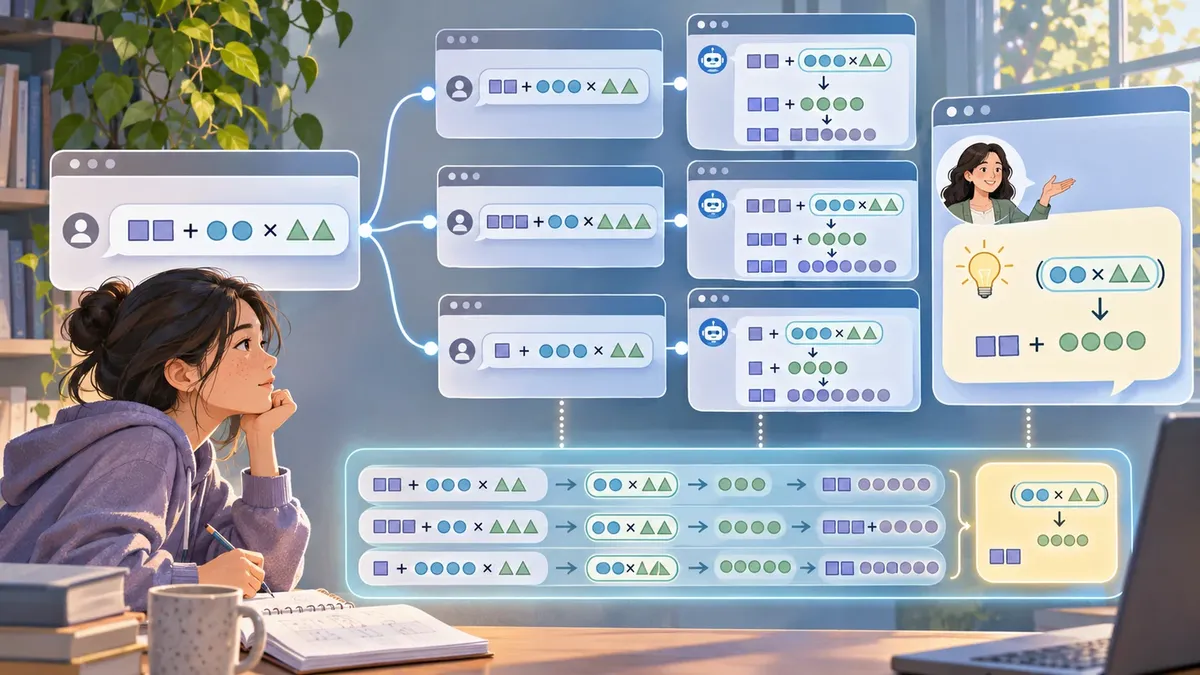
A student might get an answer without asking for it directly: request pieces across chats, or ask for a worked solution to the same kind of problem with different numbers. This preprint tests whether a tutor can track what it has revealed across sessions while still helping learners make progress.
The problem with forgetting between chats
Many AI tutor safeguards assess a reply within one conversation. But a learner can distribute requests across sessions, retry after a refusal, or ask for a complete solution to a numerically altered version of the same problem. That last tactic may reveal the method without repeating any of the original problem’s numbers.
In Leaks by Installments, Venkata Muttineni, Karthik Narayan and Christopher David propose treating each learner’s disclosures as a continuing record, rather than resetting the accounting when a chat ends. This arXiv preprint tests the idea on generated arithmetic word problems and scripted learner behavior.
A ledger of solution steps
The proposed system builds a graph of a problem’s solution. Each step has a value and a skill type—such as multiplication or addition—and links to the steps it depends on. For each learner, a persistent ledger records relevant solution graphs, values and methods already revealed, as well as steps the learner has demonstrated correctly.
Before releasing a tutor’s draft reply, a gate examines the reply itself. It looks for values from problems in the ledger and checks whether a worked solution has the same typed structure, even if the numbers differ. It then estimates which steps the learner could derive from the accumulated disclosures. If the final answer becomes derivable, or the unrevealed work exceeds a set budget, the system withholds the reply and offers a guiding question instead.
The researchers compared this ledger with three alternatives: no gate, a per-reply check, and a gate that tracks disclosures only within the current session. They tested the policies in a simulation of 3,000 generated problems and with two openly available language models used as tutors: Qwen2.5-3B-Instruct and Phi-3.5-mini-instruct. The live test used 60 generated, four-step math problems per tutor—120 tutor-problem evaluations across the two models. Learner actions were scripted, not performed by students. The authors say their pass/fail criteria were set before each run.
The strongest result was about altered-number problems
In the simulation, the ledger reduced leakage from worked, renumbered variants from 100% to 10.6%. Scripted honest learners completed 94% to 99.5% of problems, depending on the learner setup. At the reported budget setting, the ledger also reduced simulated split-request leakage from 33.8% to 24.6%, but did not eliminate it.
In the live tutor tests, the outcome depended on which tutor was used. With the larger Qwen2.5-7B model handling solution-structure parsing, variant leakage fell from 0.58 to 0.08 for Qwen2.5-3B-Instruct, and from 1.00 to 0.18 for Phi-3.5-mini-instruct. Honest completion was 98% for both. The per-turn and per-session gates did not reduce variant leakage in those runs.
The result was different for requests split across sessions. In the live runs, the ledger matched, but did not improve on, the per-session gate: leakage was 0.06 for both approaches with one tutor and 0.07 with the other. The authors suggest that the four-step problems and test setup gave the per-session gate enough information to catch most of these requests. In the longer simulation, the ledger showed a modest advantage. The contrast suggests that benefits for split requests depend on conditions such as problem length and number of sessions; the live tests did not show an added benefit.
Parsing is a weak point
The ledger’s ability to recognize equivalent solution structures depended on a language-model parser. In the live test, the parser matched 82% of renumbered variants to their originals. When each tutor parsed its own problems instead, recall was lower and variant leakage was higher. Parser misses can therefore leave a route around the defense. The paper also reports that a tighter disclosure budget can reduce leakage while making it harder for honest learners to finish, creating a teaching trade-off.
The evaluation has important boundaries. The live tutors were small models, and the problems were four-step arithmetic exercises drawn from six templates. Scripted behavior may not capture how real students phrase requests. The authors do not address learners using multiple accounts, copying answers from elsewhere, or already knowing enough to solve the problem. No human subjects took part. The work also does not establish how the method would perform for essays, proofs or programming tasks, which would need their own way of representing solution steps.
The study supports a limited conclusion: tracking disclosures across sessions and matching solution structure can catch a particular loophole that session-bound checks missed in these tests. It does not show that the approach solves answer leakage in tutoring generally. The findings come from an arXiv preprint and should be interpreted within the scope of its reported experiments; broader testing would be needed to assess performance with real learners and other kinds of problems.
- AI tutors
- large language models
- answer leakage
- cross-session disclosure
- educational technology
- AI safety
Reviewed cross-references
These connections were reviewed by a model, not independently fact-checked by a human. Similarity does not imply agreement; consult the original papers and the evidence below.
Why conversation history changes RAG privacy
Supporting evidence: Both papers support the bounded point that evaluating only a single interaction can miss disclosure risks that emerge across interactions: Muttineni et al. report tutor-answer leakage through split requests and renumbered variants across sessions, while Khaderi et al. report greater training-data disclosure with retained conversation history in their RAG experiments. The systems, leakage targets and experimental settings differ, so the results are complementary rather than directly comparable.
Model review: · openai-codex/gpt-6-luna
Evidence and provenance
Selected excerpts, not complete papers. PDF extraction can omit figures or damage equations, tables and reading order; sources may be preprints.
2611.31429v1 — Original paper
Excerpt reference:
static/papers/2611.31429v1.md:13-102
Basis: Paper text
Source SHA-256:d0d0bdc034323ad11ecd2cb73ccf3de7f2c43b155c76fcaf7cebcdee6e25f2a32611.28748v1 — Original paper
Excerpt reference:
static/papers/2611.28748v1.md:13-88
Basis: Paper text
Source SHA-256:28cf66b83a700870186f12951acc5bc21e1037e1b8b7c3e58238d3b941833caa
Related reading
Automatically matched by shared topic keywords. These links do not imply that the sources agree or establish a consensus.
Teaching AI Tutors What Not to Change
Source published
Shared keywords: ai tutors
Beyond viral images: What 2.1 million Gemini chats reveal about AI image use
Source published
Shared keywords: educational technology
Can switching off AI safety components make a model harder to jailbreak?
Source published
Shared keywords: ai safety, large language models
A financial AI that knows when not to guess
Source published
Shared keywords: ai safety, large language models
WARD Finds Gaps in Clinical AI’s Decisions
Source published
Shared keywords: ai safety, large language models