TRANSMISSION // 2611.31418v1
Reading the Third Peak in Ancient Starlight
Source published
A reanalysis of stellar spectra finds that reliable measurements of osmium, iridium and platinum point to fairly consistent ratios with europium in r-process-enhanced metal-poor stars.
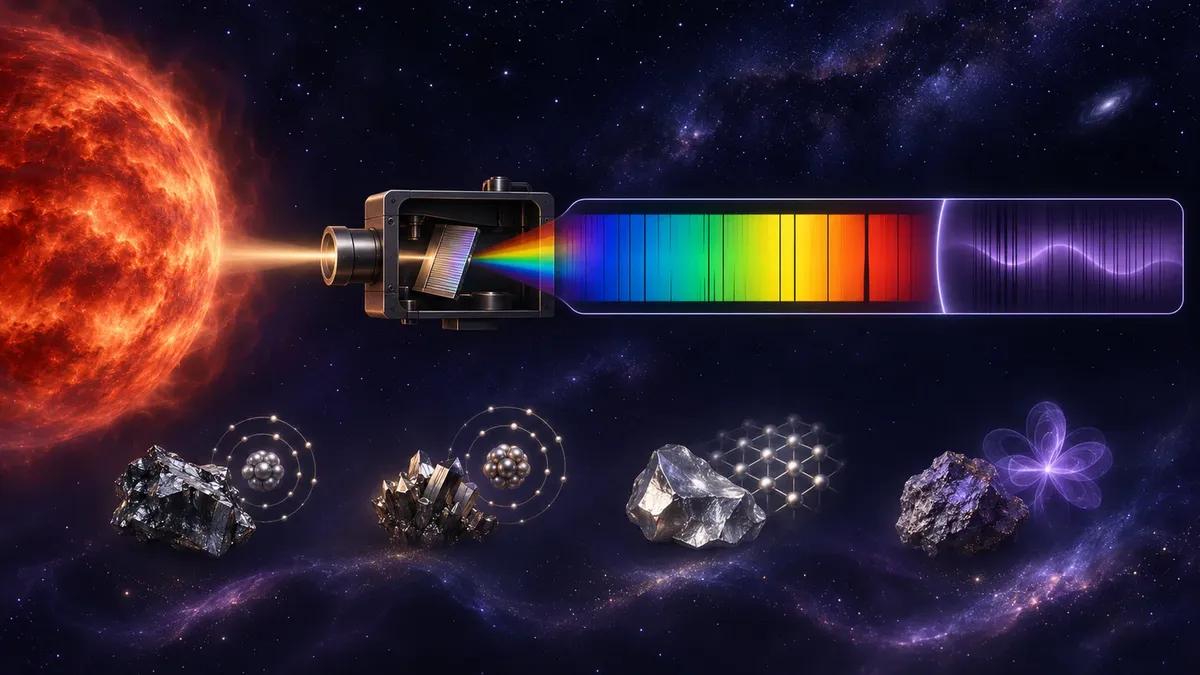
The faint lines of heavy elements in old stars can preserve clues about the neutron-rich conditions that forged them. But some spectral lines give misleading readings. A new analysis checks which are dependable, then revisits how consistently third-peak elements appear alongside europium.
Astronomers use the chemical fingerprints in old, metal-poor stars to investigate the rapid neutron-capture process, or r-process. In this process, atomic nuclei capture neutrons quickly, helping create many of the heaviest elements. A key question is whether elements near the third r-process peak—osmium (Os), iridium (Ir) and platinum (Pt)—are made in fairly consistent amounts relative to europium (Eu), a lanthanide often measured in stellar spectra.
Abundance ratios can help constrain the conditions in which elements formed. But a star’s spectrum does not display element abundances directly: researchers infer them from absorption lines, and weak or blended lines can give misleading results.
Checking the lines before counting the elements
The researchers examined spectra of 13 metal-poor giant stars with ultraviolet (UV) and optical observations. The strongest lines of Os, Ir and Pt tend to occur at shorter wavelengths, with many below the atmospheric cutoff and accessible only from space. Some useful lines are optical, however, and the team compared abundances inferred from particular optical lines with results from other available indicators, including UV lines.
Some optical measurements did not agree with the other indicators. The Os I lines at 3301.56 and 4420.47 ångströms are not recommended when Os abundances from recommended lines are below about log ε(Os) = −0.8, or when log ε(Eu) is below −1.7. In that low-abundance regime, the 3301.56 Å result should be confirmed using another Os indicator or discarded. The Ir I line at 3513.65 Å is likewise not recommended below about log ε(Ir) = −0.8, or log ε(Eu) = −1.7; the authors recommend the Ir lines at 3220.78 and 3800.12 Å instead. The Pt I line at 3301.86 Å did not produce consistent results in the tested metal-poor giants at any abundance level, so the authors recommend UV Pt lines.
The authors attribute these problems to the lines’ intrinsic weakness and blending with other elements, rather than errors in atomic data or stellar parameters. With those cautions applied, they compiled published abundances from 35 studies of 77 r-process-enhanced metal-poor stars. This meta-analysis combines existing measurements; it is not a new, uniform remeasurement of every star.
The mean abundance ratios were log ε(Os/Eu) = 0.86, log ε(Ir/Eu) = 0.88 and log ε(Pt/Eu) = 1.12. The reported uncertainties on these means were 0.02, 0.03 and 0.04 dex, respectively. The values are within 0.05 dex of the inferred Solar System r-process ratios.
For 90% of the sampled r-process events that enriched these stars, the reported ranges correspond to factors of less than 3.2 for Os/Eu, 3.6 for Ir/Eu and 2.8 for Pt/Eu. The authors therefore describe the ratios as relatively consistent in the measured, r-process-enhanced stars. They also find no evidence for a high third-peak-to-Eu plateau among stars with low europium once questionable optical measurements are treated as upper limits rather than detections.
What the ratios suggest—and what they cannot settle
The researchers compared the measurements with calculations from one representative neutron-star-merger accretion-disk model, varying assumptions about nuclear physics. In that model, yields from material with a low electron fraction (Ye below 0.2) overlap the observed ratios and are less sensitive to the tested nuclear inputs. The authors infer that the observations favor models with a substantial contribution from such neutron-rich material. This is a model-based inference, not a direct measurement of conditions in the stars’ original enrichment events. The paper says the implications will be explored across a wider assortment of astrophysical models in future work.
The combined data were not homogenized, so their measured spread may include differences in methods and uncertainties between studies. The authors treat it as an upper limit on the true star-to-star cosmic spread. Their new line checks cover 13 stars, while the meta-analysis draws on prior work with differing data and methods. The analysis also uses local-thermodynamic-equilibrium abundances; the authors note that a consistent set of non-LTE corrections for Eu, Os, Ir and Pt is not currently available. Finally, two stars with low europium have only Pt upper limits. These suggest a possible deficiency in third-peak elements relative to lanthanides, rather than establishing a pattern for all such stars.
The source is an arXiv preprint whose manuscript states that it was accepted for publication in The Astrophysical Journal. The takeaway is specific: after questionable lines are excluded, existing measurements support fairly consistent third-peak-to-europium ratios in r-process-enhanced metal-poor stars, while leaving room for different patterns in stars with weaker r-process enrichment.
- r-process
- stellar abundances
- metal-poor stars
- ultraviolet spectroscopy
- europium
- nucleosynthesis
Related reading
Automatically matched by shared topic keywords. These links do not imply that the sources agree or establish a consensus.
Testing a radioactive clock for the Milky Way’s oldest stars
Source published
Shared keywords: metal poor stars
A Star’s Chemical Clues to Early Supernovae
Source published
Shared keywords: stellar abundances
A rare Sculptor star points to enrichment by two early stellar explosions
Source published
Shared keywords: stellar abundances
Low-resolution starlight reveals 133 candidate chemical families in the Milky Way
Source published
Shared keywords: stellar abundances
Debris around a white dwarf changes its dominant rhythm
Source published
Shared keywords: ultraviolet spectroscopy