TRANSMISSION // 2611.31408v1
Reading a Warp in a Planet-Forming Disk
Source published
Simulations show when gas motions can reveal a disk’s warp—and when the same signals may mislead.
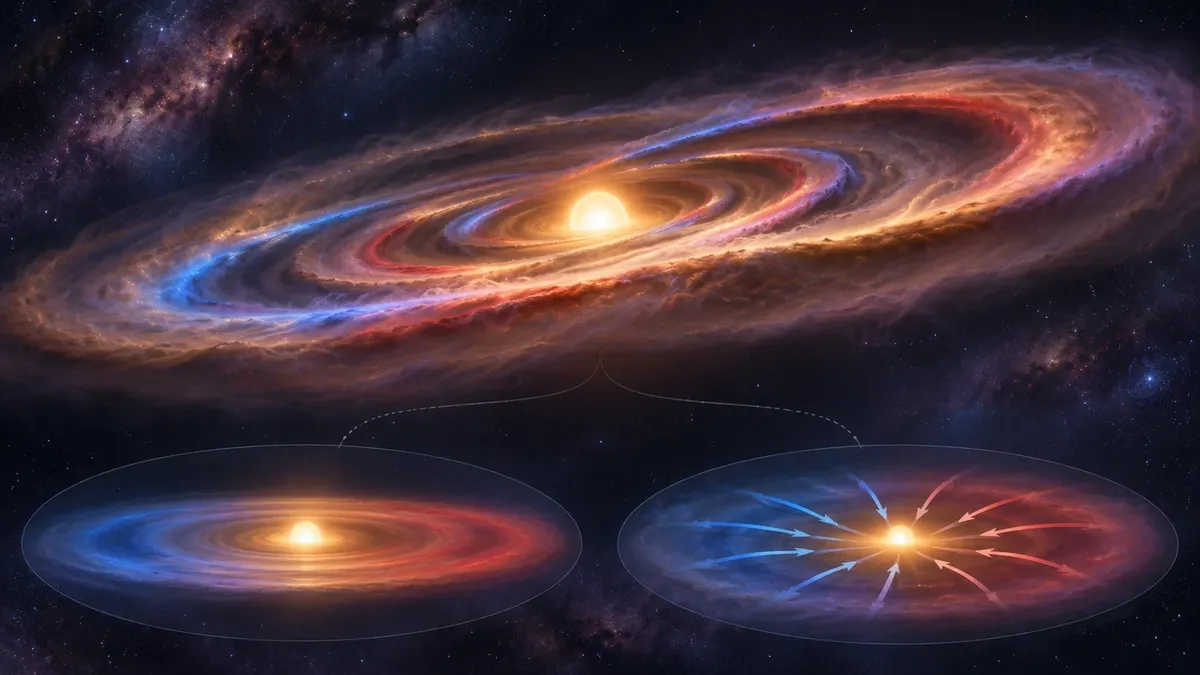
A planet-forming disk’s gas can carry clues to its three-dimensional shape. But can astronomers reliably tell a warped disk from one that only looks warped in its motion? Simulations suggest the answer depends on viewing angle, disk structure and other gas motions.
The shape hidden in a disk’s motion
Young stars are surrounded by disks of gas and dust where planets form. These disks are not always flat: their orientation can change with distance from the star, creating a warp. A warp’s shape may help astronomers understand how a disk has evolved, but it is difficult to infer from images alone. Shadows and other visible features can have more than one explanation.
A complementary clue comes from gas motion. In an undisturbed disk, gas largely follows a predictable orbit around its star, called Keplerian rotation. Astronomers can compare observed gas velocities with this expected pattern. The differences—called residuals—may reveal a warp. The challenge is that other features, including flows within the gas or errors in the assumed disk geometry, can also leave residuals.
The study by C. N. Kimmig and colleagues tests how well one method can recover a warp from those velocity differences, and where its interpretation becomes unreliable.
Building simulated observations
The researchers created computer models of disks with prescribed warp shapes, including changes in tilt and twist from the inner disk to the outer disk. They used radiative-transfer calculations to simulate emission from carbon monoxide gas, a common tracer in observations made with the Atacama Large Millimeter/submillimeter Array (ALMA).
They then produced synthetic velocity maps and applied a fitting method that interprets residual patterns as changes in a disk’s apparent inclination and position angle at different radii. By comparing the fitted profiles with the warp shapes put into the simulations, the team could test what the method recovered. They varied factors such as viewing angle, disk thickness, spectral resolution and how sharply the warp changes. They also examined whether radial gas flows and motions caused by the evolving warp could imitate or distort a warp signal.
These are simulations, not a direct measurement of a new disk. Their value is that the researchers know the true shape in each model, allowing a controlled test of the fitting method.
Where the method works—and where it struggles
In the models, the method generally recovered the broad, qualitative warp shape most reliably for nearly face-on disks with small to moderate misalignments. In those cases, the overall pattern could remain traceable even when the researchers did not precisely know some disk properties, such as the height from which the gas emission originates. For the tested models, the shape could also be recovered at spectral resolutions as modest as about 0.8 kilometres per second.
The method became less dependable as disks were viewed at higher inclinations. The paper identifies inclinations above about 40 degrees as a regime where recovery can break down, although accuracy worsens progressively and depends on the model and assumptions. A vertically extended disk can introduce geometric effects the fitting method does not fully account for. Sharp transitions between differently oriented regions are also difficult to recover: the telescope’s limited spatial resolution can blur them, particularly when the transition is smaller than roughly two beam widths.
The study also demonstrates a central ambiguity. In a deliberately constructed example, an unwarped disk with a particular radial flow produced residuals that the method interpreted as a warp. The authors note that this flow pattern is specific, and that other diagnostics—such as the disk’s brightness distribution—may help distinguish the scenarios. In a separate evolving-disk simulation, motions associated with the warp produced an apparent twist in the fitted shape even though the model began untwisted.
A useful clue, not a verdict
The results do not mean that velocity residuals are useless, nor that every apparent warp is an artefact. Rather, gas kinematics can constrain a disk’s overall warp under suitable conditions, but the inferred shape depends on how well the disk’s geometry and physical structure are represented. Inclination, emission height, spatial resolution and additional gas motions all matter. The authors recommend interpreting kinematic evidence alongside other observations, such as shadows or asymmetries in continuum emission.
There are important limits to the test. The disk models use a chosen, parametrized family of warp shapes, and the simulated maps omit thermal noise. The authors also assume some quantities—such as the outer disk orientation—are known exactly in parts of the analysis, while real observations have uncertainties and possible degeneracies. Their simulations therefore establish how the method behaves in these tested setups, not a universal accuracy guarantee for every observed disk.
The source is an arXiv preprint presented as an Astronomy & Astrophysics manuscript. A preprint is publicly shared research that may not yet have completed peer review; readers should treat its conclusions as provisional. The broad takeaway is careful but useful: residual gas motions can help map disk warps, provided astronomers also ask what else could have produced the same pattern.
- protoplanetary disks
- disk warps
- gas kinematics
- ALMA
- radiative transfer
- astronomy
Reviewed cross-references
These connections were reviewed by a model, not independently fact-checked by a human. Similarity does not imply agreement; consult the original papers and the evidence below.
A passing star can make a planet-forming disc look more warped than it is
Supporting evidence: Both studies caution that kinematic residuals need not trace disk geometry alone: Kimmig et al. report that radial and vertical motions can create apparent warps, while Prasad et al. find in flyby simulations that non-Keplerian spiral residuals can persist without a warp and lead simple warp fits to overestimate warping. The mechanisms and simulation setups differ, so this supports a limited caution about interpreting residuals, not a direct comparison of measured warp accuracy.
Model review: · openai-codex/gpt-6-luna
Evidence and provenance
Selected excerpts, not complete papers. PDF extraction can omit figures or damage equations, tables and reading order; sources may be preprints.
2611.31408v1 — Original paper
Excerpt reference:
static/papers/2611.31408v1.md:1526-1603
Basis: Paper text
Source SHA-256:5bb8e8d93cabb577a45bc5e9749e63738acccf1041681f90ac00a278c98844ba2611.12543v1 — Original paper
Excerpt reference:
static/papers/2611.12543v1.md:1242-1304
Basis: Paper text
Source SHA-256:4bfe8988b62970060e7dc822c98e455d9cde642f686770ede324165b3986a125
Related reading
Automatically matched by shared topic keywords. These links do not imply that the sources agree or establish a consensus.
WISPIT 2’s gas shows clues near known planets
Source published
Shared keywords: gas kinematics, protoplanetary disks
Gas persists inside the dust gaps of three planet-forming disks
Source published
Shared keywords: protoplanetary disks
A passing star can make a planet-forming disc look more warped than it is
Source published
Shared keywords: gas kinematics
A Spiral Twist in HL Tau’s Dust Polarization
Source published
Shared keywords: protoplanetary disks
A new look at the spirals around IM Lup
Source published
Shared keywords: protoplanetary disks