TRANSMISSION // 2611.31406v1
TOI-2120 b: a small planet with a big composition question
Source published
New transit and stellar-wobble measurements refine the size and mass of TOI-2120 b, but its uncertain mass leaves its interior composition unresolved.
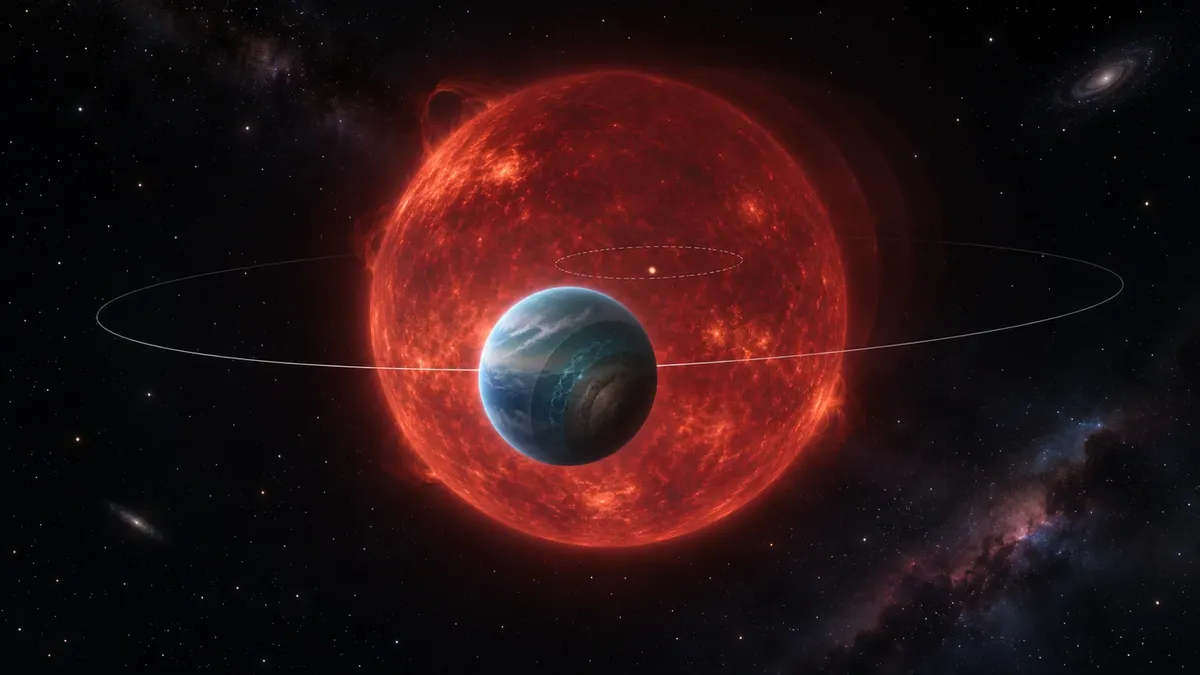
TOI-2120 b is a sub-Neptune that circles a cool, low-mass star every 5.8 days. A new analysis combines transit observations with measurements of the star’s motion to estimate the planet’s size and mass. The result points to a low-density world, but does not yet tell astronomers whether it is rich in water or has a hydrogen-helium atmosphere.
A planet can look much the same size whether it is made mostly of rock, contains a large amount of water, or carries a light atmosphere. To tell these possibilities apart, astronomers need both a planet’s radius and its mass: together, those measurements give its average density. For TOI-2120 b, a planet orbiting a cool M dwarf, the mass has been difficult to pin down.
A team led by Rachel B. Fernandes revisited the system using observations of the planet crossing its star and measurements of the star’s small back-and-forth motion. The planet, first identified in TESS data, completes an orbit in about 5.8 days. It is a sub-Neptune: larger than Earth, but smaller than Neptune. Its size is interesting because planets in this range can have very different interiors.
Measuring a transit and a stellar wobble
When a planet passes in front of its star, it blocks a small fraction of the starlight. The depth and shape of that transit help reveal the planet’s size. The researchers combined archival TESS observations and earlier ground-based transit data with two additional ground-based observations: one from the Red Buttes Observatory and one using the ARCTIC camera on the ARC 3.5-meter telescope.
They also measured the star’s radial velocity—the movement toward or away from us—using the Habitable-zone Planet Finder spectrograph. A planet’s gravity makes its star wobble, and the wobble’s size helps constrain the planet’s mass. The team combined the transit and velocity data in a joint statistical fit, allowing for factors such as differences between instruments and extra scatter in the measurements.
The analysis estimated a radius of about 2.31 Earth radii and a mass of about 5.81 Earth masses. The paper reports the mass uncertainty at the 2-sigma level: roughly 2.69 to 2.94 Earth masses below or above the central estimate. Combining the estimated mass and radius gives an average density of about 2.62 grams per cubic centimeter, also with substantial uncertainty.
A hint, not an interior diagnosis
That density is consistent with a planet containing abundant volatile material—substances that are not rock or metal under ordinary planetary conditions. In models comparing planets made of different mixtures, the result lies toward a water-rich region. But the authors emphasize that the mass measurement is not precise enough to make a detailed composition claim. A low-density planet might contain a substantial water inventory, or it might have a hydrogen-helium envelope; the current measurements do not distinguish those possibilities.
The revised radius is larger than the earlier estimate, but the two estimates are consistent within 2 sigma. The authors attribute the difference mainly to the additional transit observations. The new mass estimate is consistent with the earlier study’s upper limit of 6.8 Earth masses; it is a measurement with broad uncertainty, not a sharply determined value.
There are other open questions. The team examined several indicators of stellar activity and found no significant correlations with the new velocity measurements. That suggests activity is unlikely to be the main source of the observed variability, though it does not remove all measurement uncertainty. The researchers also found only a 1.6-sigma preference for a non-circular orbit. The data therefore do not clearly establish whether the orbit is modestly elliptical or nearly circular.
The team did not include the earlier Subaru/IRD velocity measurements in its final fit. When combined with the new data, those measurements showed a strong long-term trend, and the authors say they could not investigate its origin because they lacked access to the underlying data and reduction details. They therefore based their final mass estimate on the HPF velocities alone. More radial-velocity observations could improve the mass constraint. Atmospheric observations might eventually provide a separate clue to the planet’s volatile inventory.
TOI-2120 b is a useful individual case for studying small planets around very cool stars, but one system cannot settle what compositions are typical across that population. This account is based on a November 2026 arXiv preprint. A preprint is a research paper shared before journal peer review, and its findings may change as the work is reviewed or new observations become available.
- TOI-2120 b
- exoplanets
- sub-Neptune
- M dwarf
- planetary density
- radial velocity
- transits
Related reading
Automatically matched by shared topic keywords. These links do not imply that the sources agree or establish a consensus.
Four Sub-Neptunes Get New Mass Measurements
Source published
Shared keywords: radial velocity
GJ 9404 b remains an uncertain planet candidate
Source published
Shared keywords: radial velocity
Stellar Wobbles Point to Planets for Future Imaging
Source published
Shared keywords: radial velocity
Stellar pulses point to two binaries—and spectra confirm the motion
Source published
Shared keywords: radial velocity
Gaia and Hipparcos map possible companions around 100,000 stars
Source published
Shared keywords: radial velocity