TRANSMISSION // 2611.31389v1
Could gravitational lensing explain GW231123?
Source published
A study finds cross-model support for a lensing explanation of GW231123, but says the evidence is not strong enough to confirm one.
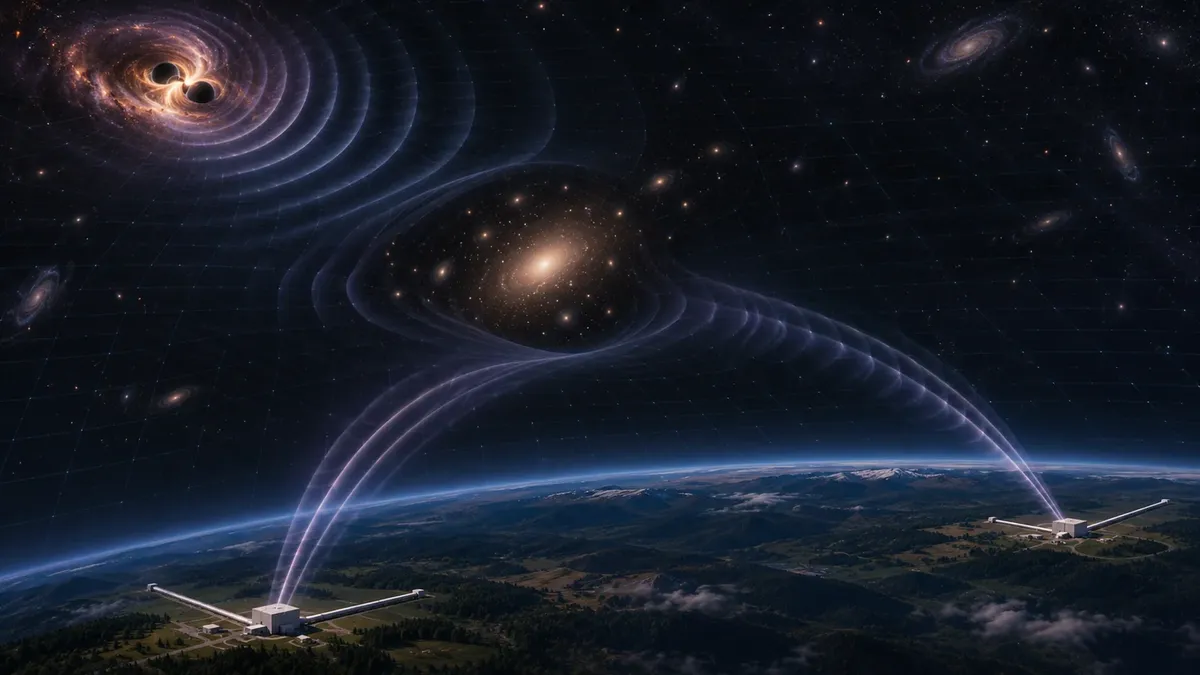
The unusually massive black-hole merger GW231123 has produced different parameter estimates with different waveform models. Researchers tested whether gravitational lensing could help explain the signal’s puzzling features—and found an intriguing, but not definitive, case.
Gravitational waves are ripples in spacetime, and massive objects can bend their paths much as they bend light. If a gravitational wave is lensed, the detector may receive several versions of the same merger, shifted in time and altered in strength and phase. No gravitational-wave lensing event has been confirmed so far. A new study examines whether lensing could explain features of GW231123, a notably massive black-hole merger whose inferred properties depend strongly on how researchers model its waveform.
The challenge is that GW231123’s signal is short, and different waveform models have not agreed well on its properties. Standard, “unlensed” analyses interpret it as a very massive merger with high black-hole spins. But those estimates may be sensitive to the waveform models’ limitations in this part of parameter space. Lensing is one possible explanation—not the only one. Glitches in detector data, overlapping signals and other missing or mis-modelled effects have also been discussed.
Testing a lensing explanation
The authors compared two explanations of the detector data: a single, unlensed merger, and a lensed signal represented as multiple overlapping copies of one merger. In the latter model, each copy has the same underlying waveform but can have a different amplitude, arrival time and phase. This flexible approach tests a broad range of possible lensing patterns without committing to one specific kind of lens.
They analysed the event with four waveform models, each of which includes effects such as black-hole spin precession and higher waveform modes. For each model, they used Bayesian evidence to compare the lensed and unlensed explanations. In plain language, this asks which model accounts for the data better while taking its complexity into account. The researchers also tested the signal separately in data from the two LIGO detectors, and compared their result with simulated unlensed mergers added to real detector noise.
All four waveform models favoured the lensed explanation, although the strength of support differed. Three models favoured a configuration with three overlapping images; the fourth gave slightly more support to two. The analyses also found broadly consistent estimates of the images’ relative brightness and delays across models. The researchers report that support for lensing appears in both detectors, rather than being driven by just one detector’s data.
A key consequence is that the inferred black-hole properties change when the analysis allows for lensing. The different models’ mass estimates become more consistent with one another, and the results give less support to extremely high spins. The paper argues that lensing-related changes in the waveform could otherwise be mistaken for properties of the black holes themselves. This does not show that the unlensed estimates are wrong; it shows how the interpretation depends on the signal model.
Evidence, not confirmation
To gauge how often an unlensed signal in detector noise might seem to favour lensing, the team analysed a background of 450 simulated mergers added to real noise. None produced a Bayes factor as large as the observed value. Because this background is limited in size, the authors extrapolated its tail using a statistical fitting method. After accounting for a trials factor for other events, they estimate a significance of 3.96, with a reported uncertainty range of +0.68 and −0.30 sigma.
That number is not the probability that lensing is true, nor does it establish a detection. It summarizes how unusual the observed result is under the study’s model of an unlensed background. The estimate relies on extrapolating beyond the finite set of simulations; the authors also report a second tail-fitting check that gave a similar result. They note that high-mass events are under-represented in the background sample and that waveform systematics can create apparent support for lensing.
The lensing model is deliberately flexible, but it does not identify a particular object as the lens or demonstrate that a plausible lens population would produce this configuration often enough. The paper says that astrophysical odds for specific lens scenarios remain uncertain. Nor does the analysis rule out other explanations for the event’s unusual features.
The authors therefore describe lensing as a compelling interpretation, not a confirmed one. Their work is a preprint, and its conclusions should be treated as provisional pending further scrutiny. Independent analyses, improved background studies and tests of specific physical lens models could help clarify whether GW231123 is truly a lensed merger. For now, it is an interesting candidate—and a reminder that interpreting a gravitational-wave signal can depend on how its journey through the universe is modelled.
- gravitational waves
- gravitational lensing
- GW231123
- black holes
- LIGO
- waveform models
Reviewed cross-references
These connections were reviewed by a model, not independently fact-checked by a human. Similarity does not imply agreement; consult the original papers and the evidence below.
Eccentricity remains uncertain in three gravitational-wave events
Supporting evidence: Both analyses identify waveform-model sensitivity as a limitation in interpreting GW231123: the lensing study reports that lensing brings mass and spin inferences into closer agreement across its four models, while Malagon and O’Shaughnessy report ambiguous eccentricity evidence and substantial waveform systematics for this event. These are compatible observations about model dependence, not independent confirmation of lensing or eccentricity; the studies use different analyses and waveform sets.
Model review: · openai-codex/gpt-6-luna
Evidence and provenance
Selected excerpts, not complete papers. PDF extraction can omit figures or damage equations, tables and reading order; sources may be preprints.
2611.31389v1 — Original paper
Excerpt reference:
static/papers/2611.31389v1.md:85-127
Basis: Paper text
Source SHA-256:12d4c9bef368a5a7e5a43848e3ebf1d7965d2f32143c96f3873ee5cd6f2bd1742611.31389v1 — Original paper
Excerpt reference:
static/papers/2611.31389v1.md:271-457
Basis: Paper text
Source SHA-256:12d4c9bef368a5a7e5a43848e3ebf1d7965d2f32143c96f3873ee5cd6f2bd1742605.12818v2 — Original paper
Excerpt reference:
static/papers/2605.12818v2.md:1719-1774
Basis: Paper text
Source SHA-256:634a343fdb718c91e5f5cc4e2dff70ede3caf8758d45ea18aa11263de71fcef8
Related reading
Automatically matched by shared topic keywords. These links do not imply that the sources agree or establish a consensus.
Eccentricity remains uncertain in three gravitational-wave events
Source published
Shared keywords: gravitational waves, waveform models
Eccentric black-hole signals may reveal the environments around them
Source published
Shared keywords: gravitational waves
Could LIGO triggers hint at sub-solar objects?
Source published
Shared keywords: gravitational waves
How a black hole inside a star could make an eccentric pair
Source published
Shared keywords: gravitational waves
A Swarm-Based Search for Gravitational-Wave Echoes
Source published
Shared keywords: gravitational lensing, gravitational waves