TRANSMISSION // 2611.31387v1
A tiny interface may reshape a galaxy’s inner halo
Source published
Models suggest that unresolved physics where a galaxy’s disk meets its hot halo can change predicted gas structure near the rotation axis. Simulations and Milky Way estimates favor different flow patterns, so the real interface remains uncertain.
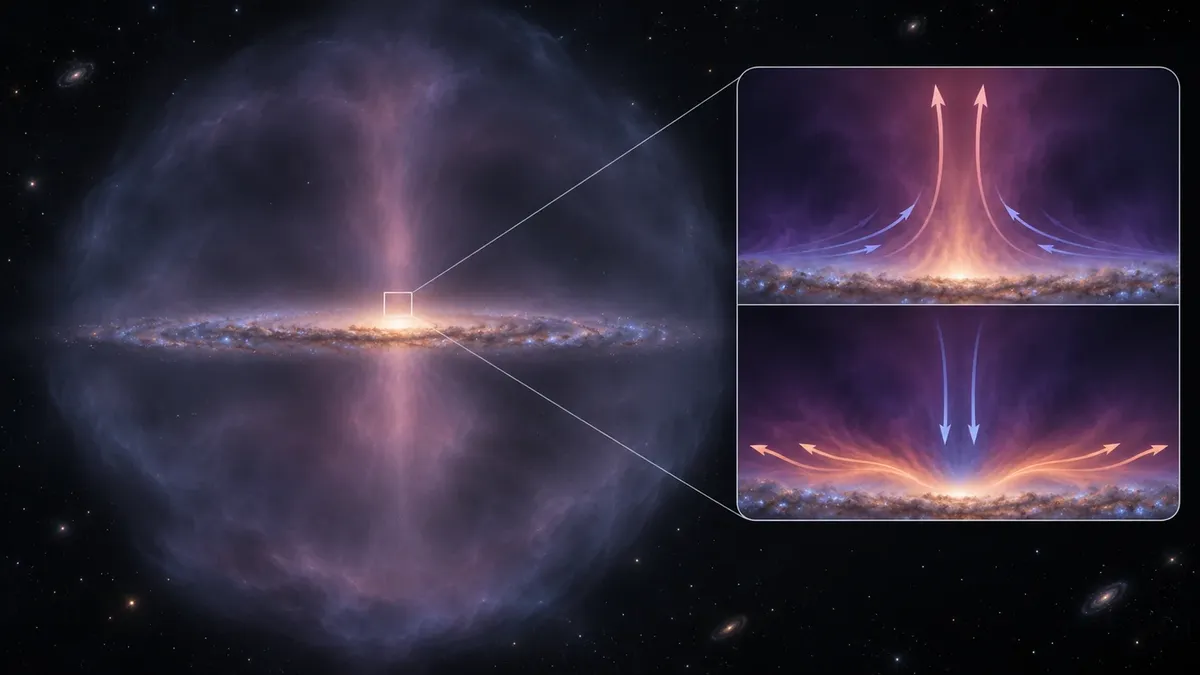
Hot circumgalactic gas is expected around massive disk galaxies, and observations support its presence around the Milky Way. A new study examines how the small-scale boundary between disk and halo could shape this gas farther out. Its simulations and interpretation of Milky Way measurements point to different patterns, leaving the physical flow unsettled.
A galaxy’s visible disk sits within a much larger atmosphere of gas called the circumgalactic medium, or CGM. In Milky Way-mass systems, some of this gas is hot—around a million degrees. This study asks how hot gas moving toward a galaxy’s disk affects the CGM’s structure, particularly near the galaxy’s rotation axis.
The researchers focus on the disk–halo interface, where hot halo gas meets much cooler disk gas. Their key question is whether gas moves inward slowly enough to cool as it goes, or passes through the interface faster than it can radiate energy. The alternatives produce different density, temperature and entropy profiles. Here, entropy is represented by the gas’s thermodynamic function K = Pρ⁻⁵ᐟ³.
Two modeled flow patterns
In a “cooling flow,” gas loses substantial entropy as it moves inward, so entropy decreases toward the galaxy’s center. In a faster, approximately “isentropic” flow, entropy stays nearly constant. Turbulent mixing with cooler material or returning gas in galactic fountain flows might drive the faster inflow, the authors suggest. Although gas accretion can replenish material in a galaxy, this study focuses on the halo’s structure rather than demonstrating a particular fuel supply for star formation.
The team first calculated one-dimensional flow models near the rotation axis, changing the conditions at the inner boundary. They then ran idealized three-dimensional hydrodynamic simulations: one included the cool disk in the simulated region, while another replaced it with an inner boundary that imposed a slower inflow. They also examined selected Milky Way-like galaxies and ELVIS galaxies in the FIRE-2 cosmological simulations. For that analysis, they filtered for hot-phase gas and considered radii of at least 10 kiloparsecs; inner bins contained too few particles for their analysis. Finally, they compared model profiles with existing estimates for the Milky Way.
In the idealized models, the cooling-flow case was about ten times denser near the rotation axis above the disk than the faster, nearly isentropic case. The authors estimate that this density contrast could correspond to roughly a hundredfold difference in X-ray emission measure, a quantity sensitive to how gas density is distributed along a sightline. These are predictions for a modeled region, not measurements of a halo-wide difference.
The idealized simulations that include the disk do not resolve the thin cooling layer at the interface. The authors infer that numerical mixing—mixing caused by finite resolution and the simulation method—makes hot gas cool and join the disk too quickly. The inflow speed changes with grid resolution. Extrapolating this trend, they estimate that a grid spacing of about one parsec would be needed for their setup to reach the slower inflow speed associated with the cooling-flow model. This is not a demonstration that a one-parsec grid resolves the cooling layer. In a separate constructed idealized setup, an imposed inner boundary with slower inflow produced a flow resembling the cooling-flow solution; it does not establish how the real Milky Way interface behaves.
In the selected FIRE-2 simulations, the analyzed near-axis profiles have nearly flat entropy, resembling the isentropic model. The authors cannot tell whether this comes from physical turbulent mixing or numerical limitations: the interface is unresolved, and even the largest relevant turbulent eddies are only marginally resolved. The sensitivity to interface conditions is strongest near the axis and weaker farther away, so the results should not be read as a description of the entire halo.
What Milky Way estimates suggest
For the Milky Way, the researchers combine published density constraints with X-ray emission measurements to infer an entropy profile. They find that the estimates suggest entropy decreases inward, a trend more consistent with their cooling-flow solution than their isentropic one. This inference depends on assumptions about gas temperatures and X-ray path lengths. Some density estimates come from spherical fits, which constrain density averaged over direction; the authors use them to infer axial density only at large radii, where the modeled flow is roughly spherical. Their treatment of a shock associated with the eROSITA bubbles is simplified. Including a modeled shock makes the isentropic profile harder to reconcile with the inferred entropy trend.
The comparison is suggestive, not decisive. The work combines analytical calculations, idealized simulations, selected FIRE-2 simulations and existing observational constraints. The analytic equations neglect heating by supernovae and active galactic nuclei; the paper notes that the strength and timing of such heating are uncertain. The physical entrainment of gas at the FIRE interface is also unresolved, and the bubble-shock treatment is simplified.
The authors leave an important tension open: FIRE-2’s analyzed near-axis profiles resemble an isentropic flow, while their interpretation of Milky Way estimates favors inward-decreasing entropy. Resolving the small-scale interface across a substantial part of a galaxy disk remains a major computational challenge. The source is an arXiv draft; this account does not establish its peer-review status.
- circumgalactic medium
- Milky Way
- galaxy simulations
- gas cooling
- numerical resolution
- X-ray emission
Related reading
Automatically matched by shared topic keywords. These links do not imply that the sources agree or establish a consensus.
CosmicGrain follows dust histories through a simulated galaxy
Source published
Shared keywords: circumgalactic medium, galaxy simulations
How charge exchange could reveal turbulent cosmic boundaries
Source published
Shared keywords: circumgalactic medium
A better way to read gas flows in barred galaxies
Source published
Shared keywords: galaxy simulations
Radio bursts offer tentative clues to gas around nearby galaxies
Source published
Shared keywords: circumgalactic medium
A radio burst’s crowded path reveals the challenge of tracing cosmic gas
Source published
Shared keywords: circumgalactic medium