TRANSMISSION // 2611.31386v1
A cosmic lens sharpens the view of a distant quasar
Source published
Using a rare six-image gravitational lens, researchers locate a distant quasar’s X-ray emission relative to its optical light. The signals overlap within the study’s limits, with no detected evidence for extended X-ray structures at the scales probed.
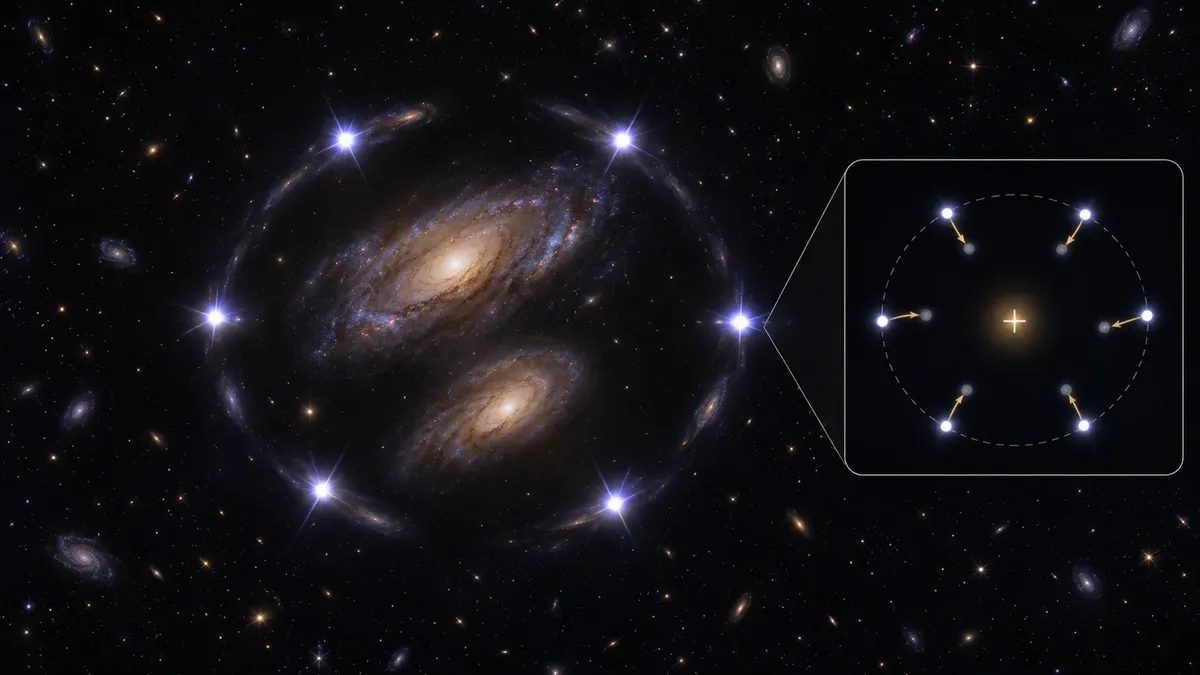
How can astronomers investigate the region around a black hole billions of light-years away when a telescope cannot directly resolve it? A study uses a rare gravitational lens to turn small shifts in a quasar’s position into measurable changes in its multiple images. The X-rays and optical light are consistent with coming from the same region, though the analysis cannot rule out smaller features or companions.
A quasar is a bright galactic core powered by material falling toward a supermassive black hole. Such cores can launch jets or outflows, and some galaxies may host more than one active black hole. At great distances, even powerful telescopes struggle to distinguish structures smaller than a galaxy. A study of the distant quasar J1721+8842 uses an unusual gravitational lens to test whether its X-ray emission is displaced from its optical light.
J1721+8842 lies at a redshift of 2.38, an era when cosmic star formation and black-hole growth were especially active. Two foreground galaxies bend its light, producing six apparent images. The system is known as an Einstein “zig-zag” lens because of the complex way light passes the two deflectors. In this arrangement, a small shift in the quasar’s position can produce a larger, measurable shift in the positions of its lensed images.
The researchers combined optical positions from the Gaia space telescope and the Hubble Space Telescope with archival X-ray observations from Chandra. They modeled how the foreground galaxies bend the light, using Gaia’s measured positions for five images and Hubble’s position for the sixth. The five Gaia positions drive the fit and are reproduced to milliarcsecond precision; the model does not reproduce the sixth image within its stated Hubble uncertainty, so that image has less influence on the analysis.
Next, the team simulated how Chandra would record X-rays from trial source positions around the modeled optical source. They compared those predictions with the observed X-ray images using a likelihood analysis to estimate the X-ray position relative to the optical one. This is an indirect measurement: Chandra does not resolve tiny structures at the quasar itself. Instead, the researchers infer the source position from how shifts in the source would affect its lensed images. The method depends on both the X-ray data and a model of the lens.
The most likely X-ray position is about 44 parsecs from the optical position. But that offset is not statistically decisive: the optical position falls inside the study’s 68% confidence region for the X-rays. The region is an ellipse about 139 by 30 parsecs in the source plane. The soft and hard X-ray emission are also consistent with overlapping the optical source within the reported one-standard-deviation uncertainties. The authors find no evidence in these data for a significant X-ray displacement, extended X-ray structures such as a jet or outflow, or an active second black hole separated by more than roughly 140 parsecs in projection. That approximate physical scale depends on the lens model and its uncertainties, so it should not be read as a precise, hard cutoff.
This is a limit on what the analysis detected, not proof that such features do not exist. The observations contain a finite number of X-ray photons, which the authors identify as a key constraint. Uncertainty in the lens model affects the magnification and therefore the physical scale assigned to an angular separation. The authors argue that the positional overlap is less affected than the exact physical scale, but the scale remains model-dependent.
The result also does not rule out a close pair of black holes, an inactive companion, or structures below the scales this analysis can probe. The paper notes that more X-ray counts could improve sensitivity to smaller offsets. The caustic method, on its own and with these data, does not resolve the detailed spatial extent of the emitting regions.
For this source, the authors estimate that the lensing method improves Chandra’s effective angular resolution by a factor of 30. That does not mean Chandra directly produced sharper images. Rather, gravitational lensing and modeling allowed the team to infer relative source positions at finer scales than the telescope could image unaided.
This work is an arXiv preprint. Its findings concern one unusually favorable lens system, not a general census of distant quasars. Further observations could test the result, while alternative lens models could help assess how model choices affect the inferred physical scale.
- gravitational lensing
- quasars
- X-ray astronomy
- Chandra
- active galactic nuclei
- black holes
Related reading
Automatically matched by shared topic keywords. These links do not imply that the sources agree or establish a consensus.
Steep X-ray Continua in Early Quasars
Source published
Shared keywords: x ray astronomy
A variable quasar reveals changing clouds of ionized gas
Source published
Shared keywords: x ray astronomy
JWST finds where a Little Red Dot’s red rise stops
Source published
Shared keywords: gravitational lensing
Hyperion’s Densest Regions Show More X-ray-Active Black Holes
Source published
Shared keywords: active galactic nuclei
Little Red Dots at Cosmic Noon: What Spectra Reveal
Source published
Shared keywords: active galactic nuclei