TRANSMISSION // 2611.31382v1
A quasar companion’s gas is weakly excited
Source published
ALMA observations find a large molecular gas reservoir in a distant quasar companion, while showing why gas-mass estimates depend on which spectral lines are measured.
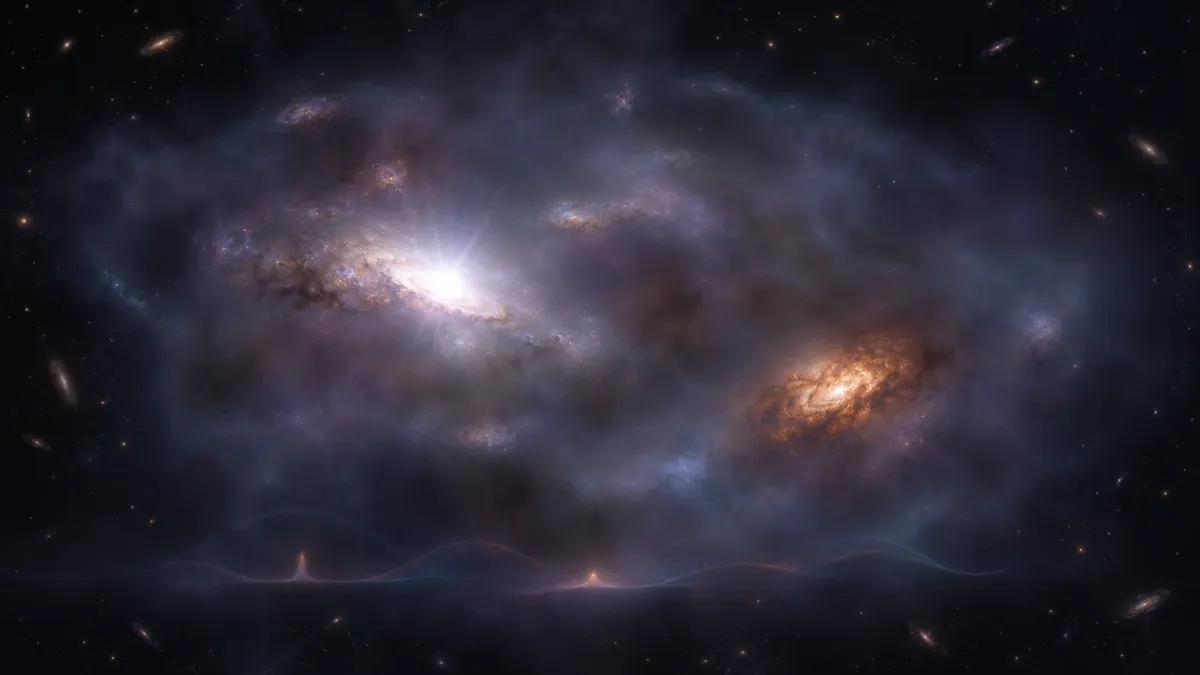
Some distant galaxies contain abundant star-forming fuel even when particular molecular lines are faint. In a galaxy seen as it was about 12.5 billion years ago, ALMA measurements reveal weakly excited gas and show how different tracers can yield different mass estimates. The nearby quasar may affect the gas, but the observations do not establish that it does.
Astronomers cannot weigh the molecular gas in a distant galaxy directly. Instead, they infer its amount from signals such as carbon-monoxide lines, carbon emission and dust. Turning those signals into a gas mass requires assumptions about how the gas emits and, for some tracers, conversion factors. At high redshift, the cosmic microwave background (CMB)—the afterglow of the Big Bang—also affects both molecular excitation and the contrast of a spectral line against its background.
A new study examines these issues in LAE-2, a galaxy associated with Lyα emission in the BR1202−0725 system. The system contains a quasar and a submillimeter galaxy, as well as Lyα-emitting companions. LAE-2 is about 14.5 kiloparsecs from the quasar in projection. At a redshift of about 4.7, the system is seen when the universe was roughly 1.3 billion years old. The researchers ask how much molecular gas LAE-2 contains and whether the quasar could be affecting its conditions.
Comparing gas tracers
The team used the Atacama Large Millimeter/submillimeter Array (ALMA) to observe LAE-2 in CO(5–4), a transition of carbon monoxide, and neutral carbon. They also measured its 3-millimeter continuum and combined these data with a previously reported CO(2–1) measurement and archival far-infrared observations. Line ratios can help constrain how gas is excited; carbon and dust measurements provide complementary ways to estimate the reservoir. The analysis includes corrections for CMB effects and uses models of molecular excitation and photon-heated gas.
LAE-2’s CO(5–4)-to-CO(2–1) line-luminosity ratio is 0.22 ± 0.04. That is about four times lower than the ratio measured for the quasar host and the submillimeter galaxy in the same system, and is consistent with values reported for high-redshift main-sequence galaxies.
To interpret the lines, the authors use a non-LTE model: one that does not assume the molecular energy levels are in local thermodynamic equilibrium. In that model, the CO(5–4) excitation temperature is 19.5 kelvin, about 4 kelvin above the 15.56-kelvin CMB at this redshift. This is a model result, not a direct temperature measurement. The paper emphasizes that the gas temperature and density are not independently well constrained: different combinations can fit the line ratio, and changing the assumed model geometry can shift inferred properties.
A substantial reservoir, with method-dependent mass
After correcting for the CMB’s effect on the neutral-carbon line contrast, the authors estimate a molecular gas mass of about 9 × 10¹⁰ solar masses. An estimate based on [C II] emission, using a separate calibration, is consistent. Dust-based estimates give a lower mass, illustrating that different methods need not agree exactly.
The CO(5–4) line would yield a mass about four times lower if interpreted as optically thick, thermalized gas at 40 kelvin and with the same CO-to-hydrogen conversion factor. That comparison depends on this specific assumption; it is not a general rule that CO gives too little mass. The authors’ point is that a survey relying on a mid-level CO transition may underestimate weakly excited gas if it applies an unsuitable excitation correction. The CMB matters here because it changes both the level populations and the observed line contrast, and the reported gas-mass estimate applies a CMB correction.
The dust-spectrum fit favors a temperature near 25 kelvin. This result is not exact: alternative fits span about 18–37 kelvin, and a far-infrared measurement at 160 micrometers is in tension with other continuum data and was not included in the fit. The authors estimate a star-formation rate of about 120 solar masses per year, consistent with the high-redshift star-forming main sequence. Using their preferred carbon-based gas mass, LAE-2 has roughly four times as much molecular gas as stellar mass and a depletion time of about 0.7 billion years. A depletion time describes how long the measured gas would last at the current star-formation rate if conditions stayed constant; it is not a forecast of the galaxy’s future.
The quasar’s role remains open
Models of the gas emission can be matched by a radiation field supplied by LAE-2’s own star formation. The quasar’s radiation could also contribute, but the observed lines do not require quasar heating and do not rule it out. The study therefore does not show that the quasar caused the gas conditions—or that it had no effect.
The team also detects CO(5–4) near LAE-1, another Lyα emitter in the system. The signal appears offset from the emitter’s stellar peaks. It may arise from extended gas between the quasar and the submillimeter galaxy, perhaps including tidal material, but its origin is uncertain; neutral carbon and dust are not securely detected there.
These conclusions concern one system, and inferred masses and temperatures depend on measurements, calibrations and modeling assumptions. The paper tests alternatives, but those tests cannot remove every systematic uncertainty. This article is based on an arXiv manuscript that identifies itself as an Astronomy & Astrophysics manuscript; the provided source does not establish its final publication or peer-review status. The result supports a cautious takeaway: some quasar companions may hold substantial, weakly excited gas that estimates based on a single mid-level CO line could undercount.
- high-redshift galaxies
- molecular gas
- quasar companions
- ALMA
- carbon monoxide
- cosmic microwave background
- galaxy evolution
Reviewed cross-references
These connections were reviewed by a model, not independently fact-checked by a human. Similarity does not imply agreement; consult the original papers and the evidence below.
Infrared-bright galaxies occupy the middle ground between steady star formation and starbursts
Shared method: Both studies use CO rotational-line observations to investigate molecular gas: the BR1202−0725 study combines CO(5–4) with literature CO(2–1) for LAE-2, while the ULIRG survey observes CO(2–1). The transitions, redshifts, and galaxy populations differ, so this is a methodological connection, not a direct comparison of gas properties.
Model review: · openai-codex/gpt-6-luna
Evidence and provenance
Selected excerpts, not complete papers. PDF extraction can omit figures or damage equations, tables and reading order; sources may be preprints.
2611.31382v1 — Original paper
Excerpt reference:
static/papers/2611.31382v1.md:136-205
Basis: Paper text
Source SHA-256:11dc6baf2a0abcbbbe29e4f7e91003f2c6c038e620ef3aa654f035904aa2d12f2611.12147v1 — Original paper
Excerpt reference:
static/papers/2611.12147v1.md:15-66
Basis: Paper text
Source SHA-256:634703b4b82b1f89013a3802a28a109d45b893b6a405dd263e520523893b0a79
Related reading
Automatically matched by shared topic keywords. These links do not imply that the sources agree or establish a consensus.
ALMA Survey Finds Diverse Gas Conditions in FRB Hosts
Source published
Shared keywords: carbon monoxide, galaxy evolution, molecular gas
ALMA measures dust in less metal-rich galaxies at cosmic noon
Source published
Shared keywords: galaxy evolution, molecular gas
Infrared-bright galaxies occupy the middle ground between steady star formation and starbursts
Source published
Shared keywords: galaxy evolution, molecular gas
Early disk galaxies show a different mass–speed pattern
Source published
Shared keywords: galaxy evolution, high redshift galaxies
Molecular Gas Reveals a Hidden Nucleus Shining Unevenly
Source published
Shared keywords: carbon monoxide