TRANSMISSION // 2611.31380v1
How quantum algorithms can transport samples through nonreversible chains
Source published
A theoretical framework uses spectral filtering and fixed-point amplification to transport coherent samples between related nonreversible Markov chains, subject to assumptions about access, bias and cost.
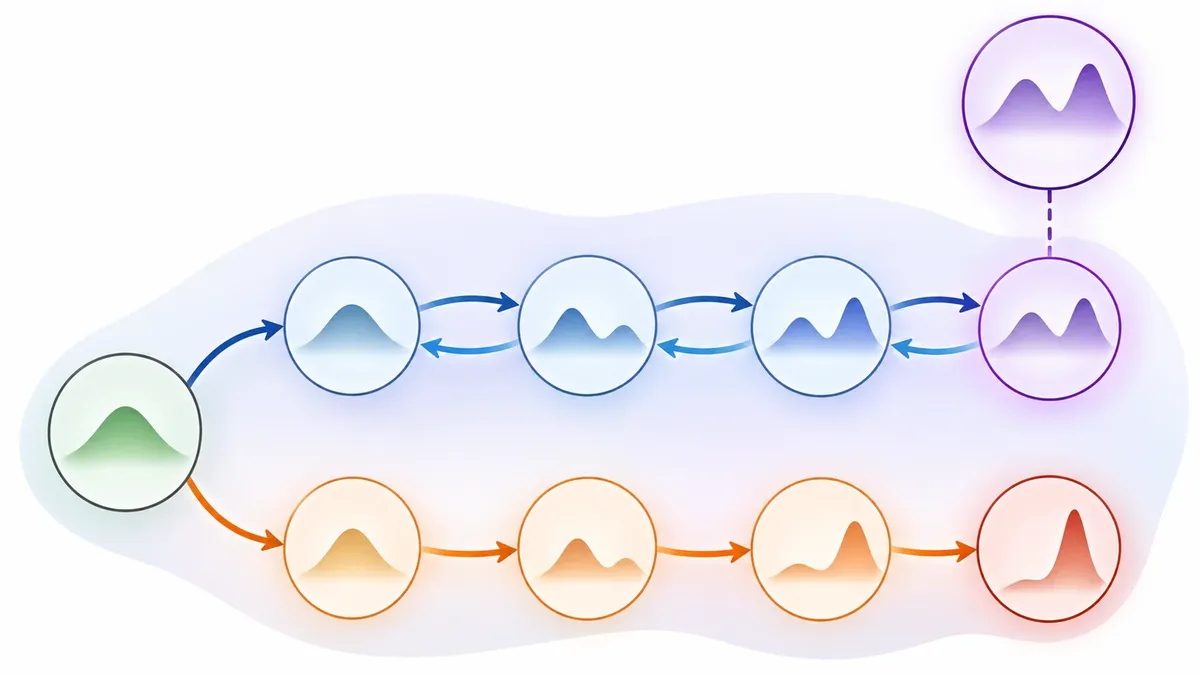
Finite ergodic Markov chains have stationary distributions, but a quantum algorithm may need more than a classical draw: it may need the distribution encoded as a coherent quantum state, and may need to move between such states as the chain changes. Wael Drif’s preprint develops two approaches and explains why their guarantees depend on spectral conditions, state overlaps and the cost of transition oracles.
A Markov chain describes movement among possible states according to transition probabilities. For a finite ergodic chain—one that is irreducible and aperiodic—the distribution of states converges to a unique stationary distribution. In quantum algorithms, the goal can be to encode that distribution as amplitudes in a quantum state, so it can be used coherently in later computation rather than measured immediately.
Wael Drif’s preprint asks how to prepare and transport such coherent samples when a chain is nonreversible, meaning its transitions do not obey detailed balance. The work presents a theoretical framework, not a practical quantum-sampler demonstration or a claim of general quantum advantage.
Two routes, with different targets
The framework combines spectral filtering with fixed-point amplitude amplification. A spectral filter uses an operator’s spectral properties to distinguish a desired state. This can support a selective phase operation, which amplification uses to increase a target component already present in a starting state. The filter does not itself provide an initializer: the starting state and its overlap with the target remain part of the preparation problem. The paper’s transport results address a sequence of related chains, with assumptions about those overlaps and the implementation of each stage.
Drif studies two constructions with different oracle requirements and targets.
The curved route requires coherent access to both the forward chain and its time-reversed chain. It targets the stationary quantum sample: the state whose amplitudes are the square roots of the stationary probabilities. Its filtering cost depends on a gap associated with multiplicative reversibilization, a method for obtaining useful spectral information about nonreversible dynamics.
The flat route uses forward transitions alone, but selects the leading eigenstate of a symmetric operator called the flat discriminant. That state need not equal the stationary quantum sample. The paper bounds their mismatch only under stated hypotheses: these include primitivity of the flat discriminant, a leading-eigenvalue separation condition, and a bound involving the reversibility-on-the-stationary-distribution-average deficit relative to a geometric-reversibilization gap. Forward-only access therefore brings a possible target bias, not simply the same target at lower cost.
For the flat route, Drif gives a generalized quantum signal-processing implementation using one signal qubit for the spectral-filtering layer. This does not count all qubits: transition registers, oracle workspace and other resources are additional. The paper also presents an explicit implementation for the curved route, with its own workspace requirements.
What sets the cost?
The analysis derives error and resource bounds for transport across multiple stages. Up to logarithmic factors, spectral-filter degree scales inversely with the square root of the relevant gap. Transport adds an inverse-square-root dependence on certified positive lower bounds for squared overlaps between consecutive selected states. This distinction matters: in the curved route, selected states are stationary samples; in the flat route, they are leading eigenstates that may be biased relative to those samples. A schedule’s stationary-state overlaps alone do not automatically certify the overlaps needed for flat-route transport.
The bounds also depend on coherent transition-state oracles, which encode transition probabilities in quantum operations. Some constructions require oracles for powered chains. A clean oracle for a multi-step transition is not automatically as cheap as repeatedly applying a one-step transition, so the paper keeps these implementation costs explicit unless a more efficient construction is justified.
Spectral and overlap bounds must be supplied or certified; the preprint does not give a general black-box procedure for efficiently finding them. For the flat route, accuracy relative to the stationary sample must additionally account for target bias. Improving filter accuracy cannot remove a mismatch between the selected eigenstate and the desired stationary state.
Evidence and limits
The preprint includes finite-dimensional checks, including a small nonreversible Gibbs-family example, to examine spectral selection and overlaps. It also studies a constructed chain to illustrate differences between spectral measures and worst-start classical mixing times. These are mathematical or numerical diagnostics, not large-scale quantum experiments or fault-tolerant circuit demonstrations. They do not establish an end-to-end speedup; the paper notes that a direct preparation route is available in one benchmark.
The contribution is a transport and error-accounting framework that connects existing nonreversible spectral filters to multistage fixed-point amplification. It does not claim universal quantum advantage or show that its alternative filter implementation is cheaper than earlier methods. Practical performance depends on the chain, initialization, oracle construction and the ability to certify the required parameters.
This article is based on an arXiv preprint, which may not have undergone peer review. Its guarantees are conditional on the paper’s assumptions, and its finite examples do not establish how useful the approach would be for large problems.
- quantum algorithms
- Markov chains
- nonreversible dynamics
- spectral filtering
- quantum state preparation
- amplitude amplification
Related reading
Automatically matched by shared topic keywords. These links do not imply that the sources agree or establish a consensus.
Dicke states from every qubit, with no extras
Source published
Shared keywords: amplitude amplification, quantum state preparation
Repeated measurements enable rational quantum spectral filters
Source published
Shared keywords: spectral filtering
Quantum search sharpens theoretical bounds for hard graph problems
Source published
Shared keywords: quantum algorithms
How noise changes the best stopping point for quantum search
Source published
Shared keywords: amplitude amplification
A small memory makes quantum measurement records predictable
Source published
Shared keywords: markov chains