TRANSMISSION // 2611.31374v1
Can Cosmic Structure Help Explain Acceleration?
Source published
A preprint compares distance-based density estimates with ΛCDM, but does not directly measure the mass contribution it proposes could drive acceleration.
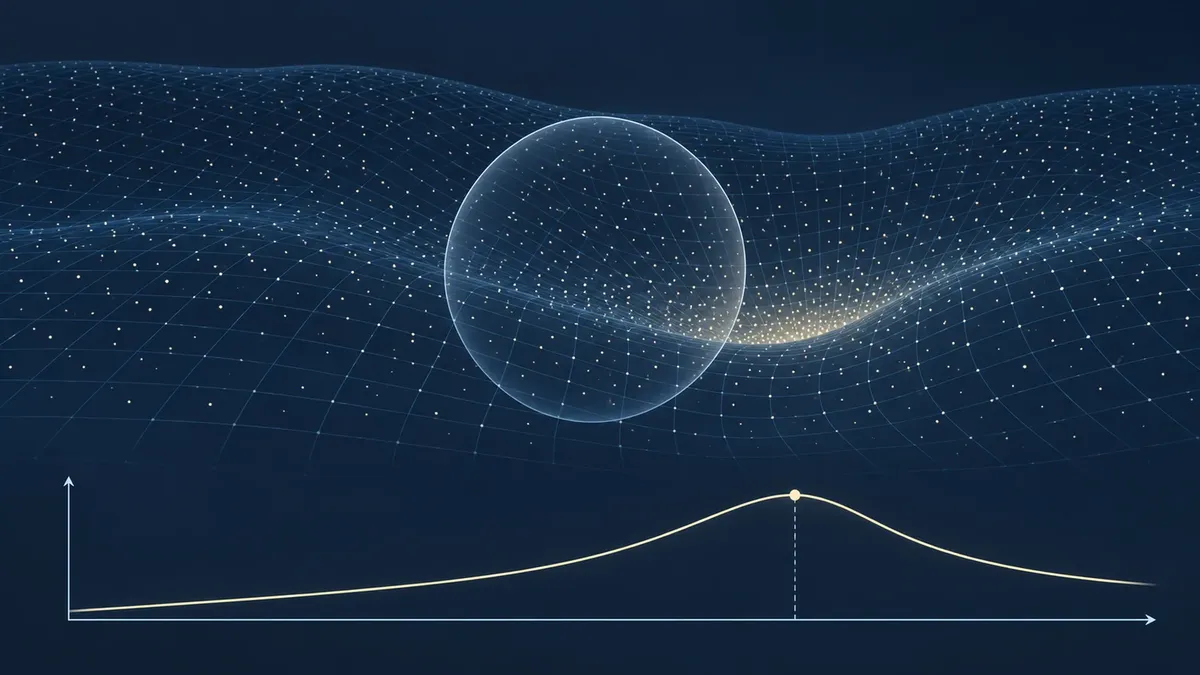
Could the uneven distribution of matter help explain why the universe’s expansion is accelerating? A preprint tests one part of that idea using cosmic distance measurements. Its comparison is an initial check—not a direct measurement of the proposed mass contribution or evidence that inhomogeneities cause acceleration.
The universe’s expansion is accelerating. In the standard cosmological model, ΛCDM, that behavior is described by a cosmological constant. Mariano Cadoni and colleagues explore a different possibility in a preprint: that nonlinear matter structures could be connected to late-time acceleration within general relativity. They call their framework Anisotropic Fluid Inhomogeneous Cosmology, or AFIC. The proposed connection is a model claim, not an established explanation of the acceleration.
AFIC is based on an exact solution to Einstein’s equations. The authors say it approaches the familiar homogeneous, isotropic cosmology at early times and on sufficiently large scales, while allowing departures associated with nonlinear structure at late times. In their proposal, the large-scale behavior of a quantity describing the matter distribution contributes an effective dark-energy-like term. The present paper asks whether distance observations provide an initial check of this framework.
What the observations constrain
The quantity at the center of the paper is the Misner–Sharp (MS) mass. It is a covariant geometric quantity. In a spatially flat universe, it can be interpreted as the total mass enclosed within a sphere of a given areal radius. The authors use a relation that connects this mass to the radius at the maximum of angular-diameter distance along our past light path.
They estimate that distance maximum using baryon acoustic oscillation (BAO) measurements from the Dark Energy Spectroscopic Instrument’s Data Release 2 (DESI DR2) and Type Ia supernova distances from the Pantheon+ sample. BAO provide distance information from a characteristic scale imprinted by sound waves in the early universe; supernovae provide another way to map distances across cosmic history.
The researchers reconstruct the distance-redshift relation with a Gaussian process, a statistical method for estimating a smooth curve from measurements. For the BAO reconstruction, they assume spatial flatness. Their main reconstruction uses a flexible dark-energy model as its mean, marginalizing over matter density and the parameters describing the dark-energy history; the mean neglects radiation. To convert BAO distances into physical units, they adopt a sound-horizon calibration of 147.09 ± 0.26 megaparsecs, based on Planck 2018 data, and propagate its uncertainty.
The crucial distinction is what the analysis does—and does not—measure. From the distance maximum, the authors infer the total density there and compare it with the ΛCDM prediction. They do not directly determine the MS mass from its separate components, nor isolate the homogeneous and inhomogeneous contributions. The inferred total density is reported as consistent with the ΛCDM value. That agreement is a comparison between density estimates; it does not demonstrate that AFIC’s proposed inhomogeneity-related contribution causes acceleration, or establish that AFIC is as well supported as ΛCDM.
An initial check, not a full test
The authors describe their comparison as a necessary first check. Testing the broader proposal requires evidence beyond background distances, including observations of structure growth and weak gravitational lensing, as well as cosmic microwave background measurements. They identify CMB lensing and the late Integrated Sachs–Wolfe effect—an imprint on the CMB associated with evolving gravitational fields—as possible future probes.
The framework also makes simplifying assumptions. Its metric ansatz uses spherical symmetry and radial density profiles, which the authors suggest may be useful particularly for describing voids. One implication is that these assumptions may limit how directly the setup represents the complexity of the cosmic matter distribution; the paper does not claim to model every structure. The analysis also relies on a companion paper for AFIC’s mathematical foundation.
These results should therefore be read as a limited observational check of one aspect of a proposed framework, not as a resolution of the dark-energy puzzle. The study is an arXiv preprint and may not have undergone peer review. Further tests with multiple kinds of observations will be needed to assess whether AFIC can account for the expansion history and other cosmological evidence.
- cosmic acceleration
- dark energy
- DESI DR2
- baryon acoustic oscillations
- Type Ia supernovae
- Misner–Sharp mass
- cosmology
Related reading
Automatically matched by shared topic keywords. These links do not imply that the sources agree or establish a consensus.
Could Cosmic Structure Help Explain Acceleration?
Source published
Shared keywords: cosmic acceleration, dark energy, misner sharp mass
Dark energy’s apparent evolution survives a test of uncertain error bars
Source published
Shared keywords: dark energy, type ia supernovae
Does cosmic shear support evolving dark energy?
Source published
Shared keywords: dark energy
DES Year 6 tests the cosmic picture
Source published
Shared keywords: dark energy
Cosmic rulers constrain low-density shells, but do not reveal a unique one
Source published
Shared keywords: baryon acoustic oscillations, type ia supernovae