TRANSMISSION // 2611.31370v1
A quantum cluster that carries its own current
Source published
An exactly solvable model suggests how an equilibrium bound cluster can carry a persistent current, with motion revealed in its correlations rather than its average density.
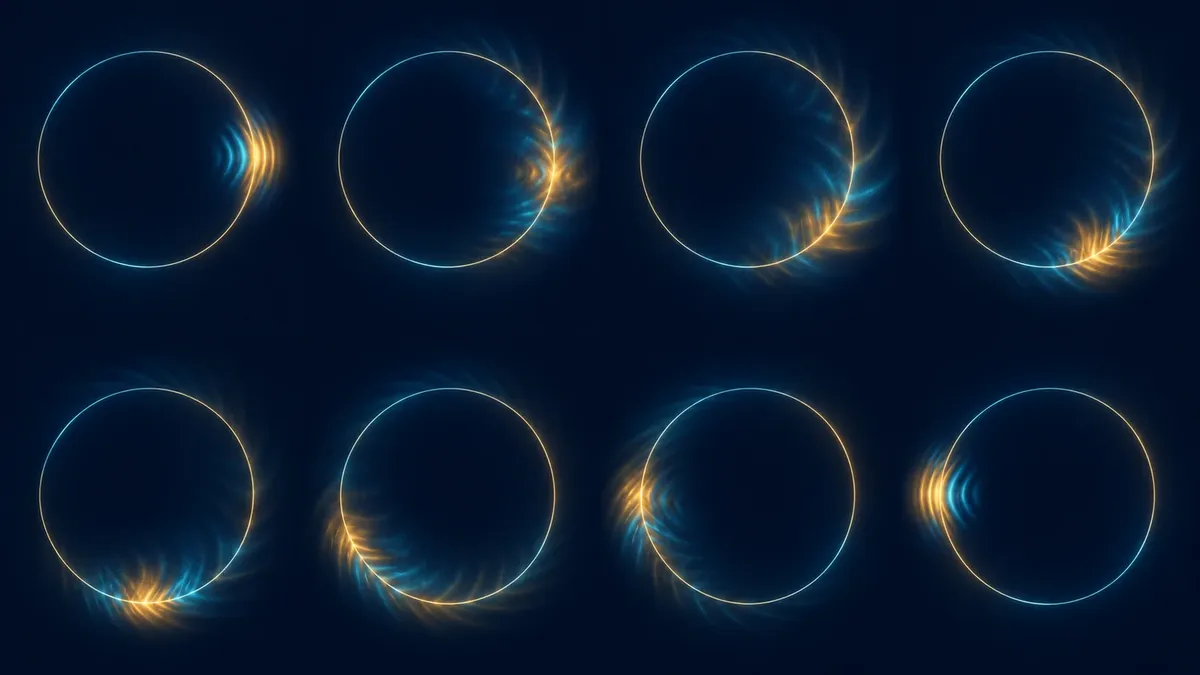
Can a many-particle quantum object keep moving in its lowest-energy state without being driven? A theoretical study explores a qualified possibility: in a model of attractive one-dimensional anyons on a ring, the ground state forms a bound cluster with a persistent current. Its recurring motion appears in density correlations, not as a visible orbit in the average density.
The idea of a time crystal is striking: a system’s state changes in time even though it is in equilibrium. But established no-go results rule out persistent time-dependent long-range order in equilibrium states of generic systems with short-range interactions. That does not rule out every equilibrium current or changing correlation. It makes the details of a proposed example important.
In an arXiv preprint, Matteo Massaro and Adolfo del Campo propose a ground-state chiral quantum cluster: particles bound into a self-contained many-body object that carries a persistent current with a preferred direction. Their claim is specific to a model with attraction and anyonic statistics. It is not a claim that a generic uniform equilibrium system becomes a time crystal.
From a field theory to an exact model
The researchers first introduce a minimal field theory for particles on a ring. Attractive interactions favor concentrated density, while a density-dependent gauge potential links local density to phase and current. In the mean-field description, these ingredients can produce a localized, soliton-like profile carrying a persistent current. In this theory, the current’s direction is tied to the sign of the coupling that sets the handedness.
They then analyze an exactly solvable microscopic example: the attractive anyonic Lieb–Liniger model on a ring. Its statistical parameter has bosonic and fermionic endpoints, and affects the allowed momentum states. Attraction binds the particles; the anyonic phase shifts their momentum. Using the Bethe ansatz—a method for solving certain one-dimensional quantum models—the authors identify the ground state and calculate its density correlations and dynamical structure factor.
The microscopic current direction is not captured by a simple rule based on statistics alone. The ground-state momentum depends on the statistical parameter and particle number through a nearest-integer choice in the model’s quantization condition. The paper reports that this momentum is generally nonzero, but its value and sign depend on those parameters.
There is also an important distinction between average density and correlations. The ground state has definite momentum, so its center of mass is delocalized around the ring and the average density is uniform. Correlations between density measurements at different positions and times can nevertheless reveal the cluster’s internal structure.
A pattern that spreads, returns and drifts
In the calculation, the contribution from states in which the bound cluster remains intact produces a localized bump in the density-density correlator. Over time, the pattern disperses. Because momenta on the ring are quantized, its components realign at regular revival times and the bump reforms. The authors identify this recurrence with the Talbot effect: a wave pattern can reappear after spreading because its components interfere.
At successive revivals, the reconstructed bump shifts around the ring. The drift is set by the cluster’s string center, denoted q in the paper; its direction reflects the chirality of the ground state. Thus, the reported motion is a feature of the correlation pattern, not a localized cluster visibly circling in the average density. The authors describe the recurring, drifting correlations as a mesoscopic quantum time crystal.
That terminology should be read in the context of the model and observable. The paper’s discussion of no-go results concerns persistent time-dependent long-range order under specified short-range-interaction conditions. Its result does not show that such constraints fail generally, nor does it rule on all forms of equilibrium motion or correlations.
Proposed probes and open questions
The authors point to the dynamical structure factor as a possible diagnostic. It describes density response across momenta and frequencies, and the paper notes that it can be measured using Bragg spectroscopy in ultracold atomic gases. It also discusses weak density measurements as a possible way to access real-space correlations. These are proposed probes, not reports of an experimental observation of the predicted cluster or its revivals.
The analysis considers finite measurement resolution. Resolving the predicted profile requires a momentum cutoff larger than the inverse cluster width. Under an additional condition on that cutoff, the paper estimates the self-correlation contribution to be smaller than the intact-cluster signal by a factor of order one over particle number. This estimate is theoretical and conditional on the model’s assumptions. The work does not establish preparation in a real platform or the signatures’ robustness at finite temperature.
The results combine a mean-field field theory with an analytical treatment of the anyonic Lieb–Liniger model. They therefore describe a theoretical proposal rather than an experimental demonstration. The source is an arXiv preprint; its presence there alone does not establish whether it has undergone peer review. The central proposal is narrower than a general equilibrium time crystal: a bound cluster in a particular model carries a persistent current, while its spreading, reviving and drifting correlations provide a way to characterize that current.
- quantum time crystals
- anyons
- quantum clusters
- persistent current
- Lieb–Liniger model
- Talbot effect
- ultracold atoms
Reviewed cross-references
These connections were reviewed by a model, not independently fact-checked by a human. Similarity does not imply agreement; consult the original papers and the evidence below.
A special line makes a Bose–Fermi quantum mixture easier to solve
Shared method: Both papers use Bethe-ansatz methods to obtain exact results in one-dimensional contact-interaction models. The cluster paper treats an attractive anyonic gas on a ring, whereas the mixture paper studies repulsive Bose–Fermi interactions along a special parameter line; the shared method does not imply shared physical findings.
Model review: · openai-codex/gpt-6-luna
Evidence and provenance
Selected excerpts, not complete papers. PDF extraction can omit figures or damage equations, tables and reading order; sources may be preprints.
2611.31370v1 — Original paper
Excerpt reference:
static/papers/2611.31370v1.md:230-405
Basis: Paper text
Source SHA-256:894df9ba1b8e6fa7658e42a2f2ae8368a7e34a7798d8a19f478e10f98a97fd5e2611.32804v1 — Original paper
Excerpt reference:
static/papers/2611.32804v1.md:12-72
Basis: Paper text
Source SHA-256:d3950c7b06cc706b129f1d511f41dc1974f0c15eea65eefad17860338108657f
Related reading
Automatically matched by shared topic keywords. These links do not imply that the sources agree or establish a consensus.
A Raman route to anyon-like behavior in a one-dimensional lattice
Source published
Shared keywords: ultracold atoms
A special line makes a Bose–Fermi quantum mixture easier to solve
Source published
Shared keywords: lieb liniger model
A Cold-Atom Bath Helps a Trapped Ion Reveal Its Spectrum
Source published
Shared keywords: ultracold atoms
How ultracold atoms reveal an unusual insulating state
Source published
Shared keywords: ultracold atoms
When two atoms scatter light as a pair
Source published
Shared keywords: ultracold atoms