TRANSMISSION // 2611.31366v1
Can a nonlocal symmetry lead to local gauge physics?
Source published
A theoretical preprint argues that selected nonlocal symmetries of lattice Dirac fermions can be rewritten to allow local or approximately local gauging. The results depend on the model, lattice structure, topology and anomalies.
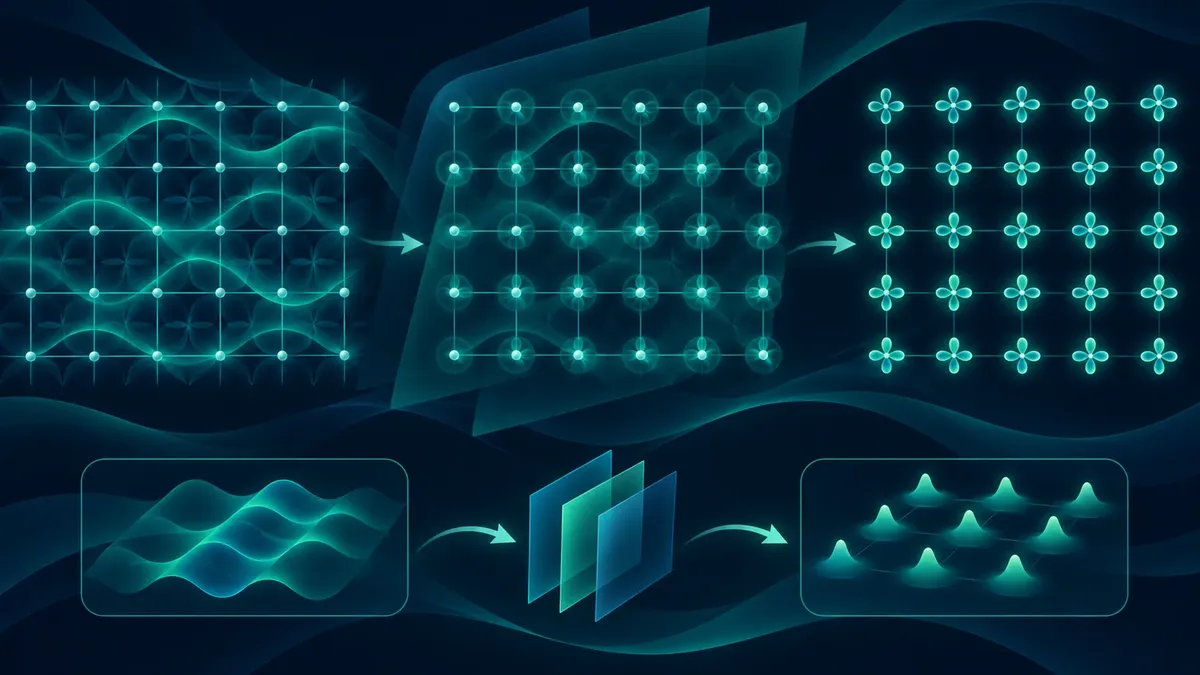
A symmetry may act across distant parts of a lattice, while local dynamics concerns interactions that remain local. Lei Su’s theoretical preprint asks whether changing how lattice fermions are represented can make certain nonlocal symmetries compatible with local gauge dynamics—and where that approach fails.
The locality puzzle
In this preprint, the key question is whether a symmetry that begins in a spatially nonlocal form can be made suitable for gauging without making the Hamiltonian—the operator governing the system’s dynamics—equally nonlocal. The proposed answer is conditional: a nonlocal canonical transformation can make certain exact, compact symmetries onsite while retaining enough Hamiltonian locality for gauging. The abstract describes this approach as symmetry relocalization; it does not claim that every nonlocal symmetry can be handled this way.
Different dimensions, different results
This is a theoretical study of lattice models, not an experimental report. Its abstract summarizes distinct results in one, two and three dimensions, rather than a single construction that works identically in every setting.
In one dimension, a Hamiltonian-preserving transformation exchanges an onsite vector charge with a nonlocal spectral axial charge. The abstract reports that each can be gauged locally and that their relationship exposes a mixed anomaly. It also reports a nonperturbative norm-resolvent bound proving emergent dynamical gauge locality at finite chemical potential. The abstract does not provide the bound’s assumptions or proof, so its precise scope cannot be assessed from this summary alone.
The one-dimensional analysis also connects the transformation, through bosonization, to momentum-winding T-duality. It reports that a parity-projected operator flows to a noninvertible topological defect. These are technical claims; the abstract does not provide enough detail to explain the defect’s properties further.
In two dimensions, the paper studies a square π-flux Majorana model. The abstract says it shares two stated features with the Kitaev honeycomb model: a single Dirac fermion and odd Pfaffian parity. It also says the square-lattice model supports sharp and exponentially local compact charges, including one with nontrivial Chern topology. This comparison does not establish that the models are otherwise equivalent.
The abstract further reports that relocalization retains Schwartz locality for asymptotically local gauging. It describes a two-flavor compact U(2) symmetry and asymptotically local non-Abelian gauging. These statements distinguish approximate or asymptotic locality from a claim of exact locality in every case.
The three-dimensional results concern separate models. One yields an exact mixed vector-axial flux response. Another supports an exponentially local vector U(1) charge with strong quaternionic topology—a topological property described in the abstract but not explained there in detail. For that model, a nonlocal map makes the charge and Kramers symmetry onsite while preserving exponential Hamiltonian locality. The abstract also reports a no-go theorem for a compact SU(2) Weyl doublet: a translation-preserving Gaussian transformation cannot make the symmetry onsite while retaining both the Weyl content and Hamiltonian locality.
What the findings establish—and what remains open
Together, these examples suggest that a symmetry’s original spatial form does not by itself determine whether gauging can be local. A change of representation may make a symmetry onsite, but the outcome depends on the model, lattice structure, topology and anomalies. The reported results include exact, emergent and asymptotic forms of locality, as well as a setting where the stated requirements cannot all be met.
These are claims about particular mathematical models and transformations. They do not establish that arbitrary nonlocal symmetries can be gauged locally or that the constructions apply directly to materials or devices. This account is based on the abstract of arXiv preprint 2611.31366v1, not a full examination of its derivations. The abstract reports the author’s results; it cannot by itself establish independent verification, peer review or scientific consensus.
- lattice fermions
- symmetry relocalization
- gauge theory
- quantum locality
- quantum anomalies
- topological physics
Related reading
Automatically matched by shared topic keywords. These links do not imply that the sources agree or establish a consensus.
When Do Fermionic Equilibrium States Stay Local?
Source published
Shared keywords: lattice fermions
Can quantum theory be written without complex numbers?
Source published
Shared keywords: quantum locality
A locality bound for quantum fermions moving in continuous space
Source published
Shared keywords: quantum locality
Two Ways to Simulate a Small Gauge Theory
Source published
Shared keywords: gauge theory
A framework for tracking grid errors in quantum field simulations
Source published
Shared keywords: gauge theory