TRANSMISSION // 2611.31361v1
A Black Hole Encounter Could Set Off Two Flares
Source published
Simulations suggest a massive black hole can squeeze a black hole–star binary into a sequence of two flares, but predicted rates depend on uncertain stellar populations and simplified debris models.
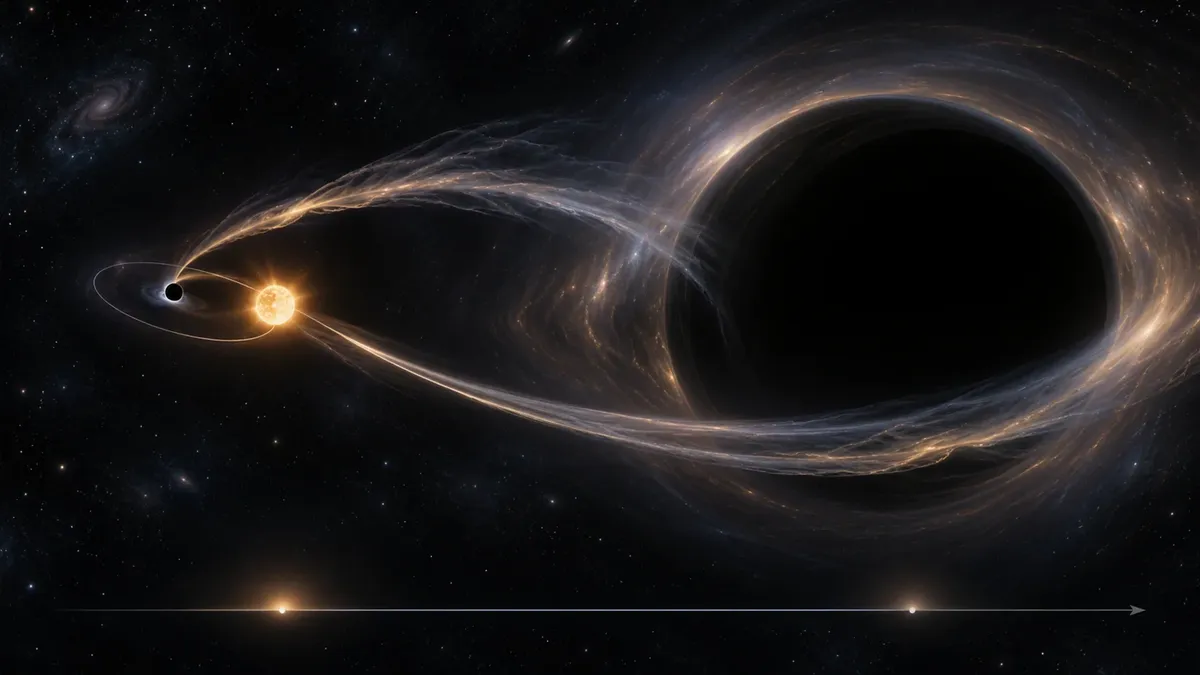
A close pass by a massive black hole may do more than tear apart a star. In simulations, its gravity can distort a smaller black hole–star pair until the star is disrupted by its companion, with some stellar debris later falling onto the massive black hole. The result could be two flares from one location, separated by weeks or longer.
A close encounter, then an encore
A star passing close to a massive black hole can be torn apart, producing a tidal disruption event: a bright flare as stellar material falls inward. Konstantinos Kritos and Rosalba Perna explore a less familiar possibility involving a pair already traveling together: a stellar-mass black hole and a star.
During a close pass by a much heavier black hole, the massive object’s gravity can distort the pair’s internal orbit. The star may be pushed onto a very stretched orbit around its black hole companion and then disrupted by it. The authors call this a micro-tidal disruption event, or μTDE. Some debris may remain gravitationally bound not to the small companion, but to the massive black hole. If that material falls in later, it could power a second flare at the same position in the sky.
The paper’s central question is whether this sequence can occur often enough, and with a distinctive enough delay between flares, to be worth looking for in astronomical surveys.
Simulating the encounter
The researchers used SpaceHub, a computer code for calculating the motion of a small number of interacting bodies, to run direct gravitational-scattering experiments. Their basic binary consisted of a 10-solar-mass black hole and a one-solar-mass, Sun-sized star. They varied the mass of the passing black hole, the binary’s size and eccentricity, and the encounter speed. They also randomized orbital orientations and phases.
The study reports more than 31 million simulated encounters. It tracked outcomes including a surviving flyby, a disrupted binary, an exchange of partners, a direct plunge, or a μTDE. The calculations included corrections to Newtonian gravity that account for effects such as orbital precession and gravitational-wave emission in compact subsystems.
For selected disruptions, the team then modeled the debris as test particles moving under the gravity of the two black holes. This helps estimate when material returns to each object, but it is not a full simulation of the fluid dynamics of the debris.
What the calculations suggest
Most simulated encounters ended as flybys. Across the full set, the authors report that about 3% produced a μTDE, while exchanges occurred in about 9%. These are averages across a broad grid of chosen encounter conditions, not universal probabilities for every real galactic nucleus. The chance of a μTDE depends on the binary’s properties and how closely it passes the massive black hole; in the simulations, the outcome was most common for moderately penetrating encounters.
In the proposed double-flare sequence, the first flare comes from debris falling back onto the stellar-mass black hole. A portion of the debris can later return to the massive black hole, producing a second, potentially slower flare. The paper estimates delays ranging from days to months for intermediate-mass black holes and months to years for some low-mass supermassive black holes. Its abstract gives a delay of a few months for a massive black hole of one million solar masses.
The authors also estimate how often such events might occur across the Universe. Their projected totals range from a few to roughly 100 double flares per year within a luminosity distance of 40 billion parsecs. That wide range reflects assumptions about how many black hole–star binaries exist and how centrally concentrated they are in nuclear star clusters. The calculation adopts a fiducial binary fraction that is not observationally established, and predicted rates scale with it.
A promising signature, not a detection
A fast flare followed by another flare from the same sky position could be a useful clue to this channel. But the paper presents a theoretical prediction, not an observed double flare. Identifying such a pattern would not, by itself, prove that a μTDE caused it; the flares’ properties and possible alternative explanations would matter.
There are further modeling limits. In a representative debris calculation, the authors neglect the debris stream’s self-gravity and its gravitational effect on the black holes. They note that self-gravity can affect μTDE debris. Their frozen-in estimate of the delay also gives a longer wait than a direct particle calculation in the example they compare, so the reported fitted delays should be treated as approximate and potentially overestimated. Some extreme encounter regions are incompletely sampled, and the μTDE branching fraction has not converged for the most massive perturbers.
The work is a November 2026 arXiv preprint, so its claims should be regarded as provisional rather than as settled, peer-reviewed conclusions. Its value is in mapping out a possible route from a gravitational encounter to two linked flashes—and spelling out what astronomers might test as time-domain surveys find more transient events.
- black holes
- tidal disruption events
- stellar dynamics
- astronomical transients
- galactic nuclei
- computer simulations
Related reading
Automatically matched by shared topic keywords. These links do not imply that the sources agree or establish a consensus.
Two cosmic signals could reveal how massive black holes grow
Source published
Shared keywords: tidal disruption events
A carbon glow offers clues to the gas around a star-shredding black hole
Source published
Shared keywords: black holes, tidal disruption events
How a black hole inside a star could make an eccentric pair
Source published
Shared keywords: stellar dynamics
Gas disks could steer stars into growing black holes
Source published
Shared keywords: tidal disruption events
How stars may spiral into the tight orbits behind repeating black-hole flares
Source published
Shared keywords: tidal disruption events