TRANSMISSION // 2611.31320v1
Why EEG AI’s middle layers can be easier to read
Source published
A study of five EEG foundation models finds that layer scores depend on how features are read out. Intermediate layers often help when models are frozen, and some selected interfaces transfer across datasets—but the advantage has important limits.
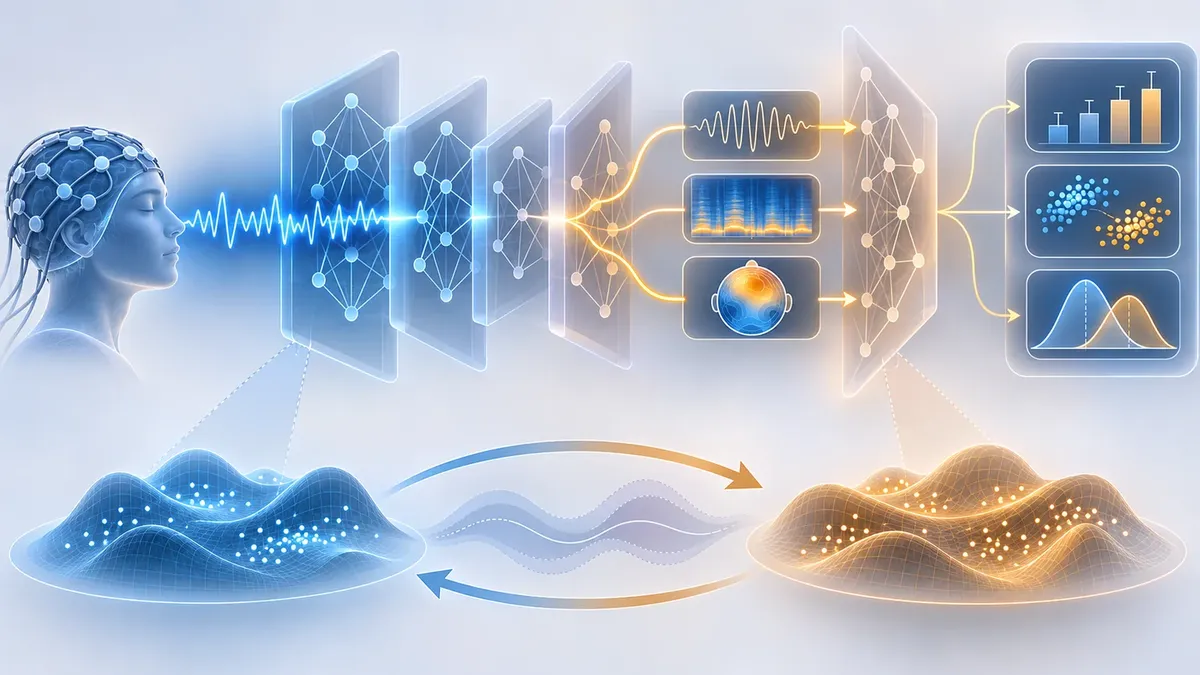
A model’s final layer is not automatically its most useful feature source. In a preprint study, researchers tested how readout choices, network depth and cross-dataset transfer shape the predictive value of frozen EEG foundation models.
When an EEG foundation model processes a brain-signal recording, it produces internal representations at successive layers. Researchers can take features from one layer, keep the model fixed and train a classifier to predict a task. Intermediate layers sometimes score better than the final layer. But is that because they offer more useful predictive information—or because the features are summarized in a way that better suits the classifier?
Yanlin Fu, Wei Liu and Liming Zhao investigate this question by examining readout choices, layer depth and transfer between datasets. Their results suggest that a layer’s measured usefulness depends both on its features and on how those features are presented to a classifier.
Comparing layers more carefully
The researchers evaluated five EEG foundation models—CBraMod, REVE, LaBraM, LUNA and CSBrain—on motor imagery, two event-related-potential tasks and emotion recognition. In the main experiments, the encoders remained frozen while classifiers used summaries of their internal features.
These summaries, called readouts, included simple averages as well as options that preserve more structure, such as keeping channels distinct, measuring variation over time or dividing recordings into temporal bins. The team first selected a readout for each model’s final layer, then compared layers using that same readout. This helps separate the effect of layer depth from the effect of how features are summarized.
The study also tested whether layers selected on one dataset could be used on another. In these transfer tests, the source-selected layer and readout were carried over, while a classifier was fitted using target-dataset training data. A separate analysis tested whether task-related feature directions transferred in sleep staging. Evaluation used participant-disjoint splits and participant-level bootstrap intervals, which help limit leakage and characterize uncertainty in these experiments.
Readout changes the picture
Selecting a better readout improved final-layer predictions in all 15 model-and-task conditions in the primary analysis, compared with global mean pooling. In 12 of those conditions, selecting an intermediate layer then brought an additional improvement with the readout held fixed. The size of that benefit varied: some conditions showed little extra gain, and depth results for emotion recognition were inconclusive under the study’s evaluation approach.
The practical lesson is not simply “use an intermediate layer.” A weak score from basic averaging may reflect a mismatch between the summary and the model’s features. Once the researchers addressed that mismatch, intermediate layers still often offered predictive advantages in frozen-feature tests, but not in every model or task.
Residual analyses add a further qualification. With features compressed to 200 dimensions, intermediate-layer residuals often improved predictions beyond final-layer features. But gains shrank as the final-layer representation retained more dimensions; with both representations at their native dimensions, there was no consistent improvement. This does not establish that the final layer contains every useful pattern. It shows that the measured benefit depended on the tested feature dimensions and analysis methods.
Some selected layers transferred
Across five dataset pairs and four task families, source-selected layers outperformed final layers in all ten CBraMod and REVE comparisons. They outperformed an average of non-final layers in eight comparisons. These results suggest that a layer-readout choice made on one dataset can sometimes be reused on another, rather than searched for anew. They do not show that one layer is best for every model, dataset or task.
In sleep staging, four task-related directions identified from source-dataset features also retained predictive value after transfer. Adding them to final-layer features improved target predictions compared with several matched controls. Removing them harmed performance, although refitting the target classifier recovered much of the loss. This supports reusable predictive structure in that particular transfer setting, not a general claim about other tasks.
The authors also tested parameter-efficient adaptation—adding trainable components while keeping the original model weights fixed—in one model on one event-related-potential task. In that experiment, the final layer improved enough that the intermediate-layer advantage seen with frozen features did not persist. Layer rankings therefore depend in part on whether a model is used as-is or adapted.
What remains uncertain
The study covers selected models, datasets, readouts and probing methods. The authors note that residual-analysis conclusions depend on feature dimensionality and analytical choices. The adaptation experiment covers only CBraMod on N170, and confidence intervals in the supplement are not adjusted for multiple comparisons. The findings should therefore be read as evidence about the tested evaluation settings, not as a general rule for EEG systems.
The paper is identified as a preprint, so its findings should be considered provisional rather than peer-reviewed conclusions. Its methodological takeaway is that evaluations of frozen EEG models should report not only which layer performs best, but also how features were summarized, how choices were selected, and whether results hold under transfer or adaptation.
- EEG
- foundation models
- machine learning
- neural representations
- transfer learning
Reviewed cross-references
These connections were reviewed by a model, not independently fact-checked by a human. Similarity does not imply agreement; consult the original papers and the evidence below.
EEG Models May Separate People Better Than the Tasks They Perform
Shared method: Both studies use linear probes on EEG representations to assess downstream classification: Fu et al. describe probes trained on fixed feature summaries, while Madapura et al. compare baseline and subject-mean-normalized embeddings for state classification. The shared method is limited to probing representations; the tasks and normalization and layer-selection questions differ.
Model review: · openai-codex/gpt-6-luna
Evidence and provenance
Selected excerpts, not complete papers. PDF extraction can omit figures or damage equations, tables and reading order; sources may be preprints.
2611.31320v1 — Original paper
Excerpt reference:
static/papers/2611.31320v1.md:175-252
Basis: Paper text
Source SHA-256:c0bc1405759eaa53862a9a27875f77d444f8599f80baaebea470867bd5a3bccb2611.05652v1 — Original paper
Excerpt reference:
static/papers/2611.05652v1.md:658-872
Basis: Paper text
Source SHA-256:36ecdda8bed63b8729d92a552d2b7333f5067bdcb4a6295130cf079750966d56
Related reading
Automatically matched by shared topic keywords. These links do not imply that the sources agree or establish a consensus.
Do AI Models of Brain Signals Find the Same Patterns?
Source published
Shared keywords: foundation models
EEG Models May Separate People Better Than the Tasks They Perform
Source published
Shared keywords: foundation models
Why a dexterous robot hand needs more than a powerful AI model
Source published
Shared keywords: foundation models
Can EEG Help Generate fMRI Signals?
Source published
Shared keywords: machine learning
One EEG Model, Three Kinds of Decisions
Source published
Shared keywords: machine learning