TRANSMISSION // 2611.31301v1
A benchmark asks AI to say what part of a deepfake is fake
Source published
MOZAIC tests whether AI can distinguish fake video, fake audio and identity changes—not just label a clip real or fake. Its results reveal limits in generalization and explanation.
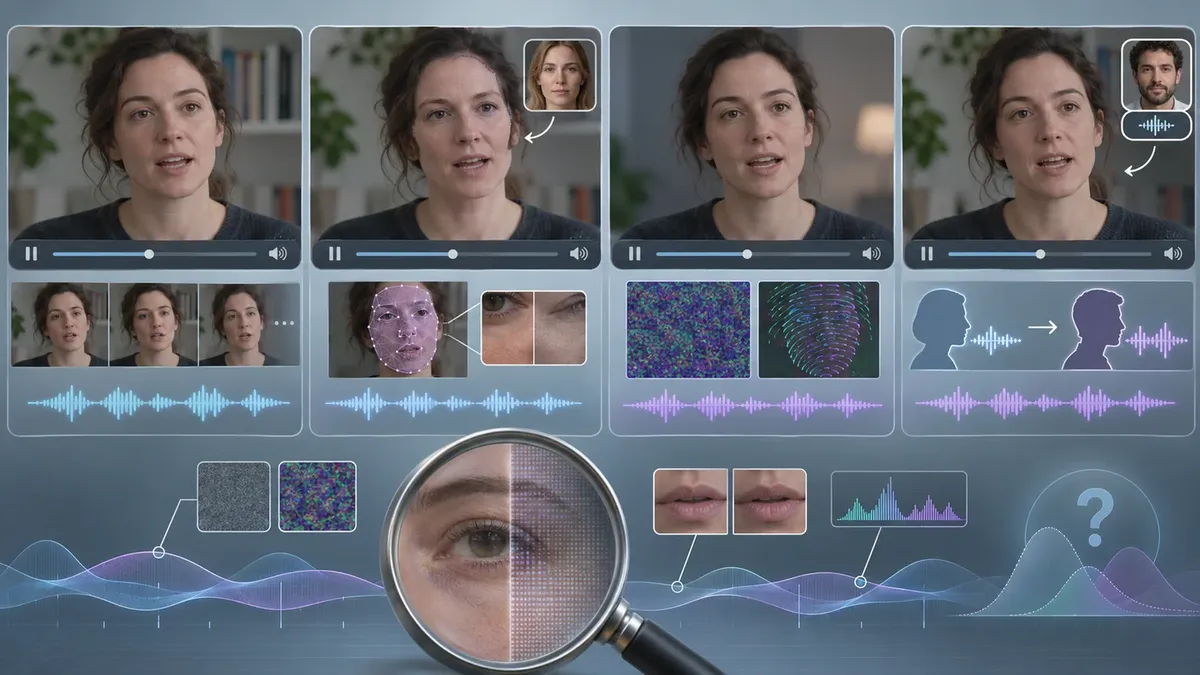
A clip can show a real person with a converted voice, a swapped face with genuine audio, or fabricated picture and sound together. MOZAIC gives researchers a way to test whether AI can tell those cases apart—and whether it can explain what changed.
A deepfake detector that says only “fake” leaves an important question unanswered: was the picture manipulated, the voice, or both? That distinction matters when a clip combines authentic and generated material. A model might make the right overall call for the wrong reason, such as noticing a visual artifact while ignoring a fake voice.
MOZAIC, a benchmark introduced by researchers at the Vector Institute and Ontario Tech University, is designed to examine that problem. Rather than testing only a yes-or-no judgment, it asks systems to identify which part of an audio-video clip has been altered, what kind of video manipulation occurred, whether a person matches a reference clip, and what evidence supports an explanation.
The same source, different combinations
The researchers built MOZAIC from short talking-head recordings associated with 1,000 identities in the VoxCeleb2 development set. For each source pair, they prepared versions combining real or manipulated video with real or manipulated audio. This paired design makes it possible to compare closely related clips while changing which modality is fake. A vocoded version of the original voice serves as a control, intended to help prevent detectors from treating vocoder traces alone as proof of a fake.
The video manipulations include FaceFusion, which swaps the inner face, and two Wan2.2 methods that generate the whole frame. Seed-VC converts a speaker’s voice to another person’s while preserving the words and timing. After quality checks and exclusions, the dataset contains 137,745 clips from 15,014 source pairs. The authors also provide a smaller 16,995-clip split for some evaluations. The data is research-only, in part because the fakes depict real people.
The benchmark has four tasks. T1 asks which combination of real and fake audio and video a clip represents. T2 classifies the video manipulation. T3 tests whether a face or voice is authentic and matches a supplied reference identity. T4 asks for separate explanations of the audio and video, including the manipulated region. The researchers tested 12 multimodal large language models (MLLMs), trained four detector systems, and fine-tuned some language models using LoRA, a method that adapts selected parts of a model rather than retraining everything.
Strong benchmark scores, uneven skills
On the four-way authenticity task, the best off-the-shelf MLLM achieved 35.6% accuracy; chance performance was 25%. That result came from Gemini 3.1 Pro. Its performance was uneven: it identified 43.6% of video-only fakes, but just 7.5% of voice-only fakes. Some models frequently chose one answer regardless of the clip, so an accuracy score on its own can hide a weak ability to distinguish the categories.
Specialist detectors trained on MOZAIC did much better on the same benchmark distribution: the best reported T1 result was 98.4%. But this is not evidence that detectors can reliably handle any deepfake they encounter. When the strongest T1 detector was tested with the FaceFusion generator held out from training, its accuracy fell to 78.3%. The paper also reports a similar warning in macro-F1, a measure that accounts for performance across classes: for one detector, it dropped from 98.6 to 76.9. The authors interpret this as a sign that strong in-distribution results can depend on cues associated with generators seen during training.
Fine-tuning improved explanation scores for several MLLMs. For example, OmniVinci’s score rose from 4.17 to 7.40 on a 10-point judging scale. But improvement did not mean consistently accurate forensic reasoning: the paper says no evaluated model reliably localized the manipulation. Explanations were scored by an AI judge against reference descriptions, rather than through a fully independent human evaluation of all outputs.
What the results do—and don’t—show
MOZAIC’s paired construction helps researchers ask more precise questions than a single real-or-fake label allows. Its results suggest that current general-purpose multimodal models can struggle especially with altered voices, while detectors trained on a particular benchmark can perform very well without necessarily transferring to an unseen generator.
The study is bounded by its materials. It uses short, low-resolution talking-head clips from one source dataset, one voice converter and three video-generation methods. The authors note that compression and voice-conversion artifacts remain despite efforts to normalize the files. The benchmark therefore does not establish how systems would perform across longer clips, different sources, or the full range of real-world editing and sharing conditions.
MOZAIC is an arXiv preprint, so its claims should be read as research findings that may change with review or further testing. Its contribution is a controlled way to measure what a detector identifies—not proof that any evaluated system can verify authenticity reliably in everyday use. The dataset, code and evaluation prompts are listed on the project page: https://vectorinstitute.github.io/mozaic/.
- deepfake detection
- MOZAIC benchmark
- audio-video AI
- multimodal models
- AI forensics
- generalization
Related reading
Automatically matched by shared topic keywords. These links do not imply that the sources agree or establish a consensus.
When Are Model Predictions Enough—and When Do Features Help?
Source published
Shared keywords: deepfake detection
Can real videos help deepfake detectors stay reliable?
Source published
Shared keywords: deepfake detection
Training Video AI to Notice the Impossible
Source published
Shared keywords: multimodal models
A two-stream detector targets multiple kinds of video forgery
Source published
Shared keywords: deepfake detection
Can edited images reveal what a deepfake detector uses?
Source published
Shared keywords: deepfake detection