TRANSMISSION // 2611.31272v1
Why the In-In Turning Point Adds No Boundary Term
Source published
A path-integral analysis finds that total time derivatives do not add a contribution at the observation point in the studied in-in calculations, provided the relevant boundary conditions hold and contact terms are included.
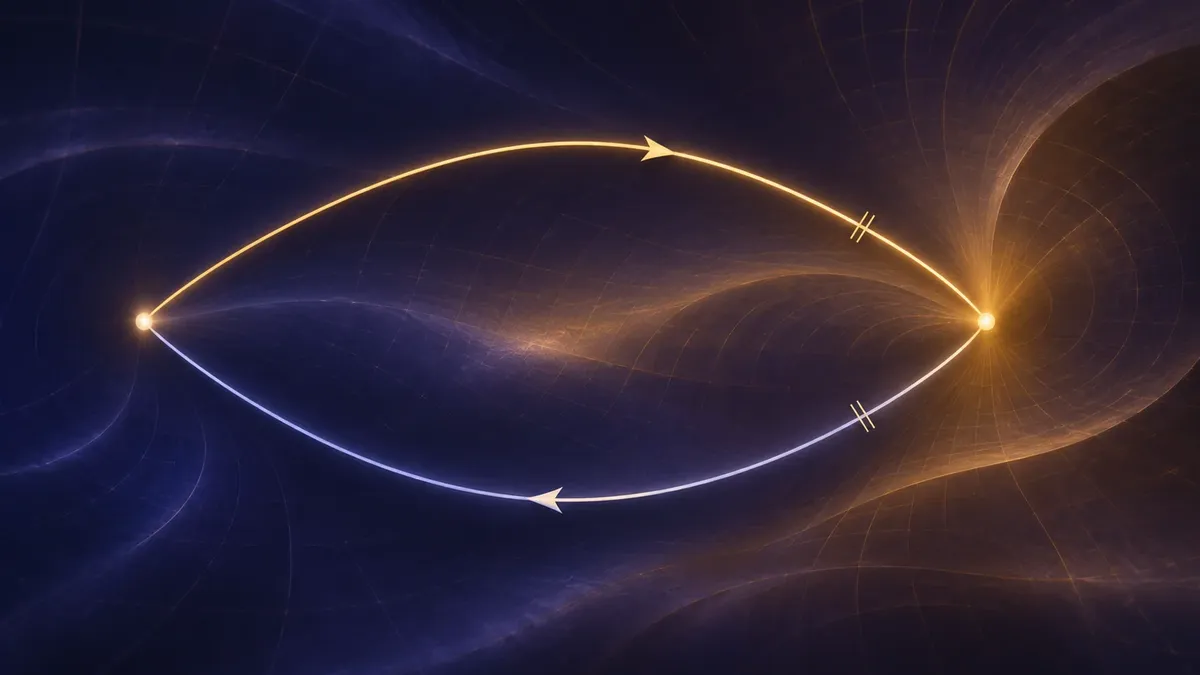
When physicists rewrite an action by integration by parts, they may create a total time derivative. In inflationary calculations, some researchers have argued that such terms can affect correlations at the observation time. Yohei Ema and colleagues say the apparent effect cancels when the closed time contour is treated with the appropriate operator ordering.
Is the observation time an endpoint?
Physicists often rewrite an action by integration by parts, shifting derivatives between terms. This can add a total time derivative: a term whose integral is determined by the values at the ends of the time interval. If the relevant boundary conditions are fixed, adding such a term is generally expected not to change physical predictions.
Inflationary calculations of quantum correlations often use the in-in formalism. It follows a system forward in time and then back along a second branch, allowing researchers to calculate expectation values at a finite observation time. The two branches meet at that time. Earlier studies have argued that total time derivatives—particularly ones involving time derivatives of fields—can leave a contribution there.
Yohei Ema, Muzi Hong, Ryusuke Jinno and Kyohei Mukaida examine this claim. Their central argument is that the observation time is a turning point on one closed contour, not an endpoint of the full path. Splitting the contour into forward and backward branches can make the turning point look like an endpoint of each branch, but that split should not create a new physical boundary contribution.
Building the ordering rule
The authors begin with a quantum-mechanical system whose Lagrangian includes a total time derivative. If the quantity being differentiated depends on the field’s velocity, the Lagrangian appears to contain higher time derivatives. The authors use canonical quantization and constraint analysis to show that constraints remove the apparent extra degrees of freedom, leaving the dynamics equivalent to those without the total derivative, under the assumptions used in their construction.
Next, they build a regulated, discretized path integral, representing time evolution as a sequence of finite steps. In this formulation, the total derivative is represented by differences between neighboring steps. With the stated boundary assumptions, including that the function inside the derivative vanishes near the relevant endpoints in the quantum-mechanical construction, these differences sum to zero. The authors extend the method to the closed contour used in in-in calculations.
This leads to the T_C-star ordering, a prescription for ordering operators along that contour when time derivatives are present. In this prescription, derivatives act not only on fields but also on the functions that encode contour ordering. Differentiating those functions produces localized contact terms. The turning point requires care in this ordering; it is not an endpoint where an independent boundary term remains.
What the examples show
The authors conclude that, under their boundary assumptions, total time derivatives do not contribute at the in-in observation point once the appropriate ordering and contact terms are included. Contributions that appear when the two branches are treated separately cancel in the full-contour calculation.
To illustrate the result, the paper reanalyzes examples from earlier work, including three-point and four-point scalar-field correlation functions. In these examples, branch contributions considered on their own can be nonzero. The authors show that contact terms omitted in those calculations cancel those contributions when the full ordering prescription is applied. The paper also distinguishes total derivatives from equation-of-motion terms: in one example, an equation-of-motion term contributes to the final bispectrum, while the total derivative does not.
The practical lesson is not to ignore terms that look like boundary terms. Rather, calculations involving time derivatives must use an ordering prescription that includes the associated contact terms, and equation-of-motion terms need separate treatment. The result concerns contributions from total time derivatives at the observation point in the setup analyzed; it is not a claim that every boundary-related effect vanishes in every cosmological calculation.
Scope and uncertainty
This is a formal theoretical study, not an observational test. Its worked examples demonstrate the cancellation in the systems and correlation functions examined, but do not establish the result for every possible choice of boundary conditions or cosmological setup. Applying the prescription in a particular calculation requires specifying the contour and boundary conditions and accounting for the relevant contact terms.
The work is an arXiv preprint, version 1 (2611.31272v1), and may not have undergone peer review. The supplied paper text presents the authors’ derivation and examples; the available retrieval material does not provide an independent evaluation or establish community consensus. The findings are therefore best read as a specific methodological argument about how to handle total time derivatives in in-in calculations.
- in-in formalism
- inflation
- quantum field theory
- path integrals
- total time derivatives
- cosmological correlators
Related reading
Automatically matched by shared topic keywords. These links do not imply that the sources agree or establish a consensus.
A New Route to Inflation-Era Particle Signatures
Source published
Shared keywords: cosmological correlators, quantum field theory
Keeping spacetime continuous in quantum path integrals
Source published
Shared keywords: path integrals, quantum field theory
Quantum memory may reshape a field in an expanding universe
Source published
Shared keywords: quantum field theory
A Formula for Three Massive Fields in Inflation
Source published
Shared keywords: cosmological correlators
How a quantum system might keep its own time
Source published
Shared keywords: path integrals