TRANSMISSION // 2611.31260v1
How Transformers Handle Multiple Recurrence Rules
Source published
In controlled recurrence tasks, the authors report that switching specified rules is simpler for Transformers than identifying latent rules.
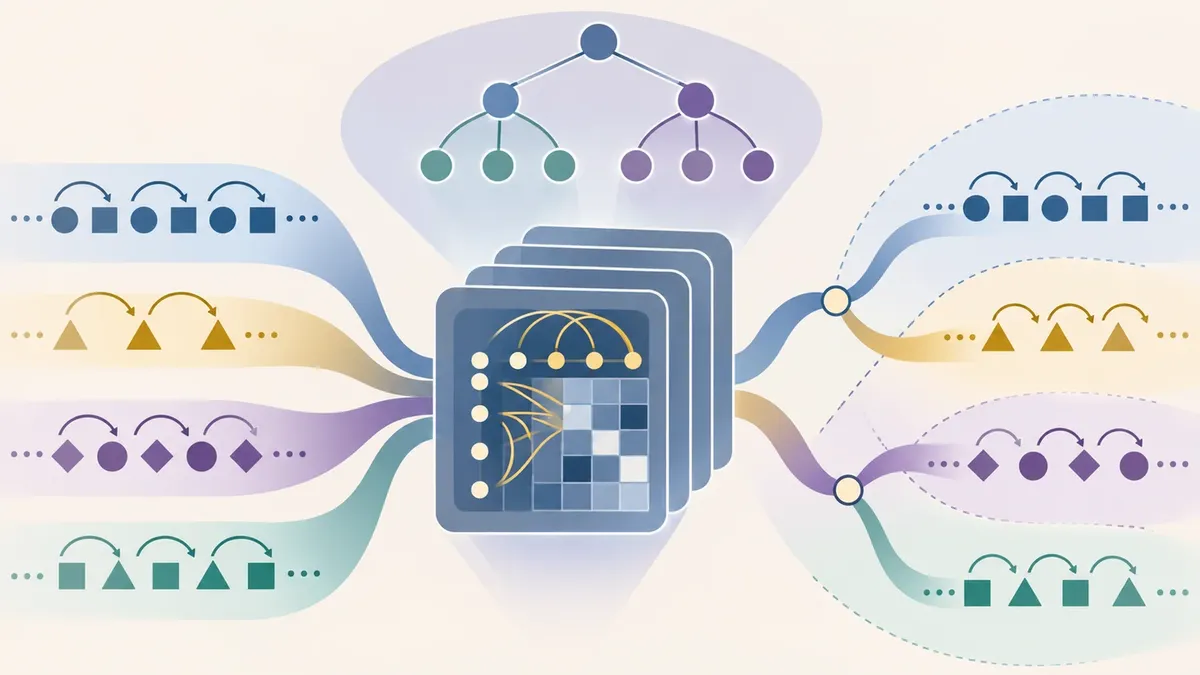
Can a Transformer apply different rules, and what changes when the rule is not specified in advance? A study of simplified mathematical tasks compares these abilities and examines how model design and training relate to generalization.
A Transformer can be tested on more than whether it follows a single rule. It can also be asked to switch between specified rules or to identify a rule that is latent in context. These are distinct task categories, and a new arXiv preprint by Xiamin Chen, Linyu Liu, Jiachen Hu and Pinyan Lu compares them in a controlled setting.
The researchers study linear recurrence tasks over finite cyclic groups. In broad terms, recurrence means that values in a sequence are related through repeated updates; a finite cyclic group is a mathematical system with a fixed set of values and a wraparound structure. A clock-face analogy might offer one intuition for wraparound, but the abstract does not provide the recurrence equations or specify a particular update rule.
The task family ranges from executing a single fixed rule to identifying a latent rule from context and switching between rules that are explicitly specified. The authors also examine versions with input masking. The abstract does not describe the exact inputs, outputs or masking procedure, so the details of how each task is presented remain unclear from the available evidence.
A reported difference between tasks
The authors report that switching specified rules is simpler for Transformers in general than identifying latent rules. This finding concerns the particular tasks and experimental configurations they studied; it does not establish that switching is easier in every setting or for every kind of rule. The abstract does not provide scores or enough procedural detail to assess exactly how the comparison was measured.
The study also reports that generalization is affected by model depth and width, as well as by the algebraic structure of the recurrence. The abstract does not spell out the direction or size of each effect. When the number of rules is large, the authors describe curriculum training—organizing training in a progression—as extremely useful, though the supplied summary does not give the curriculum design or quantitative results.
To investigate internal representations, the researchers use linear probing and input patching, described in the abstract as standard interpretability tools. Their analysis, they report, sheds light on how Transformers represent, identify and execute multiple rules. The abstract does not specify how these tools were implemented or provide enough detail to determine precisely which internal processes they revealed.
Scope and uncertainty
The simplified mathematical tasks let researchers examine rule-related capabilities under controlled conditions. They are not direct tests of language understanding, conversation or open-ended reasoning; this is a limitation of what the task setting can establish, not a reported comparison in the study. How far the findings extend beyond these recurrences is therefore an open question.
This account is based on the paper’s abstract rather than its full text. Sample sizes, exact measurements, experimental configurations and detailed qualifications are not available here, limiting independent assessment of the findings’ strength and scope. The abstract supports the authors’ reported conclusions, but not more specific claims about the experiments.
The work is identified as an arXiv preprint. The supplied evidence does not establish whether it has been peer reviewed. For now, its central contribution is a focused comparison: in the reported experiments, switching among specified recurrence rules was simpler than identifying latent rules, while model dimensions, recurrence structure and training approach also mattered.
- Transformers
- recurrence tasks
- rule learning
- machine learning
- interpretability
Reviewed cross-references
These connections were reviewed by a model, not independently fact-checked by a human. Similarity does not imply agreement; consult the original papers and the evidence below.
Why Recurrent AI Models Still Struggle With Longer Tasks
Supporting evidence: Both controlled synthetic-task studies report that generalization depends on task structure as well as model capacity. Chen et al. find effects from rule organization and recurrence algebra in recurrence prediction; Jung et al. find effects from operation representation and positional encoding on state-tracking length extrapolation. These are compatible but distinct factors and outcomes, not a direct replication or evidence that the same factor drives both results.
Model review: · openai-codex/gpt-6-luna
Evidence and provenance
Selected excerpts, not complete papers. PDF extraction can omit figures or damage equations, tables and reading order; sources may be preprints.
2611.31260v1 — Original paper
Excerpt reference:
static/papers/2611.31260v1.md:1195-1253
Basis: Paper text
Source SHA-256:ec36c00a6d2a843de290af47e589c709a8cd9a9c2190690f0f7280231a0c313e2611.29171v1 — Original paper
Excerpt reference:
static/papers/2611.29171v1.md:200-278
Basis: Paper text
Source SHA-256:67e3cd3f59892e4e587f7cb1b8e08b0c319e0a33dea5633814725cb49eacd5b7
Related reading
Automatically matched by shared topic keywords. These links do not imply that the sources agree or establish a consensus.
When Do Looped Transformers Retrieve Stored Facts?
Source published
Shared keywords: machine learning
Can the geometry of a program’s execution reveal the program itself?
Source published
Shared keywords: machine learning
Can Transformers learn a smaller structure?
Source published
Shared keywords: machine learning
A transformer aims to make AI-agent permissions more consistent
Source published
Shared keywords: machine learning
Why AI explanations can look convincing and still be wrong
Source published
Shared keywords: machine learning