TRANSMISSION // 2611.31252v1
DAGGER estimates AI workflow quality from sparse tests
Source published
A graph-based method estimates multi-stage language-model workflow quality from sparse measurements, aiming to reduce the profiling needed to compare configurations.
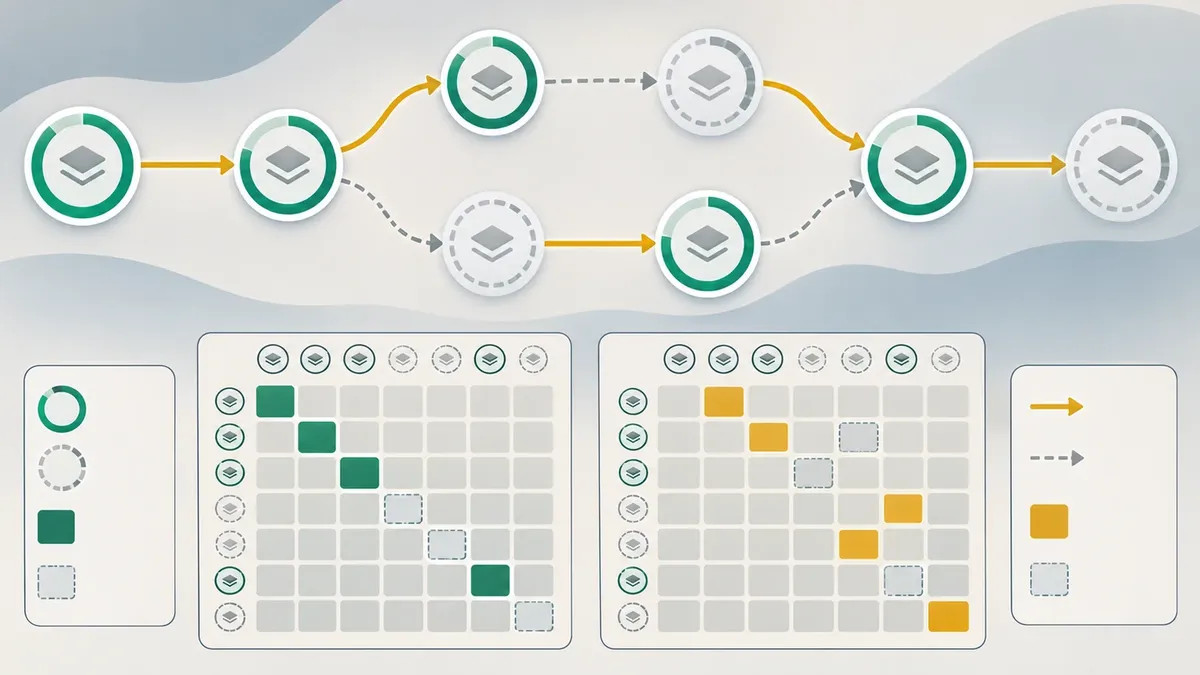
A generative AI workflow can fail not only because one model makes a mistake, but because that mistake shapes what a later model receives. Testing every combination of models across every stage can be costly. DAGGER aims to estimate workflow quality from a limited set of component measurements.
Why estimate a workflow before running it?
Many AI applications link several model-powered steps. A question-answering system, for example, might retrieve passages, reason over them, then write a response. Each step can use different models, and the best model for one step may not produce the best overall system. An upstream error can also affect later stages.
The direct way to compare configurations is to run each complete workflow on a test set. But the number of combinations grows quickly as stages and candidate models are added. Dimitrios Liakopoulos and Neeraja J. Yadwadkar introduce DAGGER, a framework designed to estimate end-to-end quality without exhaustively profiling every configuration.
A graph of stages and their connections
DAGGER represents a workflow as a directed graph: nodes are stages, and edges show how one stage’s output feeds another. It uses two kinds of quantities. A node accuracy term describes how well a model performs at its stage when given a correct input. An edge dependency term captures how the output of one model affects the next model’s performance. For branching workflows, the method also accounts for the relative contribution of different paths.
Analytical formulas combine these quantities to estimate workflow quality. To avoid measuring every model-stage and model-pair combination, DAGGER uses singular value decomposition (SVD)-based matrix completion. It observes some entries in tables of node accuracies and edge dependencies, then estimates missing entries by exploiting patterns in the measurements.
The authors evaluated the method on three multi-hop question-answering workflows: a sequential chain, a branching workflow, and a more complex arrangement. The tests used three language models and three datasets—HotpotQA, MuSiQue, and 2WikiMultiHopQA. An LLM judge assigned a binary correctness label to outputs; workflow quality was the average score over a dataset. The researchers compared estimates with quality measured by running complete workflows, and assessed profiling time and GPU-hours against several baselines.
What the evaluation found
The paper reports a 6.79 percentage-point median error for end-to-end workflow quality estimates (rounded to 6.8 points in the abstract). This is the paper’s cumulative reported statistic; it should not be read as a guarantee for each workflow or dataset. The detailed cost comparison says BenchPress required 10.20 times as much profiling time and GPU-hours as DAGGER in the tested setup. These are two reported profiling measures, not a single combined cost figure. DAGGER still ran complete workflows to establish ground-truth quality for evaluation; its savings came from reducing the profiling of component accuracies and dependencies.
Estimating quality is not the same as reliably picking the best configuration. In a separate selection test for a sequential workflow, DAGGER chose the best configuration on 2WikiMultiHopQA, the second-best on HotpotQA, and a configuration ranked 14th out of 27 on MuSiQue. On MuSiQue, that choice was 6.5 percentage points below the best. The authors note that leading candidates there had closely clustered scores, making them harder to distinguish when estimates contain error. So a useful overall estimation result does not ensure the right choice in every setting.
What remains uncertain
The evaluation covers three workflows, three datasets, and three models, all for multi-hop question answering. It does not establish that the same estimation accuracy or profiling savings will hold for other tasks, larger model pools, or different workflow structures. DAGGER’s analytical approach also relies on assumptions about how quality propagates through the graph. In particular, its Markov assumption treats the effective quality at a node as depending on local edge relationships, with separate formulations for sequential, branching, and more general workflows.
The evaluation uses an LLM judge rather than human assessment, so the measured quality depends on that evaluator’s judgments. Matrix completion adds uncertainty: the paper reports median relative errors of 19.1% for node-accuracy estimates and 16.4% for edge-dependency estimates. It also notes that completion performance depends on which entries are observed and how many are available, and identifies principled initialization as future work.
DAGGER is therefore a method for estimating and narrowing options in the tested settings, not a substitute for checking candidate systems directly. Its selection result on MuSiQue illustrates why estimates may need follow-up evaluation. This article is based on the first arXiv version of the paper, a preprint; the evidence provided here does not establish its peer-review status.
- DAGGER
- generative AI workflows
- language models
- matrix completion
- AI evaluation
- multi-hop question answering
Reviewed cross-references
These connections were reviewed by a model, not independently fact-checked by a human. Similarity does not imply agreement; consult the original papers and the evidence below.
How local mistakes travel through AI teams
Shared method: Both papers compose local measurements through workflow structure to estimate system-level outcomes: DAGGER combines per-node accuracy and per-edge dependency terms over a workflow DAG, while REPA composes locally estimated agent responses along an executed workflow. The methods and targets differ—workflow quality estimation versus error-propagation prediction—so this is a structural methodological parallel, not evidence that either validates the other.
Model review: · openai-codex/gpt-6-luna
Evidence and provenance
Selected excerpts, not complete papers. PDF extraction can omit figures or damage equations, tables and reading order; sources may be preprints.
2611.31252v1 — Original paper
Excerpt reference:
static/papers/2611.31252v1.md:136-194
Basis: Paper text
Source SHA-256:c819ebbe262b2cce307c833b741a8bf69b4e194bcc6fb98052e3b11535308c072611.31063v1 — Original paper
Excerpt reference:
static/papers/2611.31063v1.md:89-125
Basis: Paper text
Source SHA-256:71ec9bac414ebed8a7ed529f5949a0e01680ba2a37fe3fc0f3f9b9b5187d3fe6
Related reading
Automatically matched by shared topic keywords. These links do not imply that the sources agree or establish a consensus.
FondueQA tests how AI fills gaps in retrieved evidence
Source published
Shared keywords: ai evaluation, multi hop question answering
How local mistakes travel through AI teams
Source published
Shared keywords: ai evaluation
Can One AI Model Fill in Missing Data Across Many Fields?
Source published
Shared keywords: matrix completion
PRISMA organizes AI searches into evidence-checking steps
Source published
Shared keywords: language models, multi hop question answering
When Sudoku cells contain quantum states
Source published
Shared keywords: matrix completion