TRANSMISSION // 2611.31249v1
A benchmark asks when waveform AI choices matter
Source published
Actionwave compares waveform-prediction models across care settings, testing how timing, signal duration and available inputs shape evaluation.
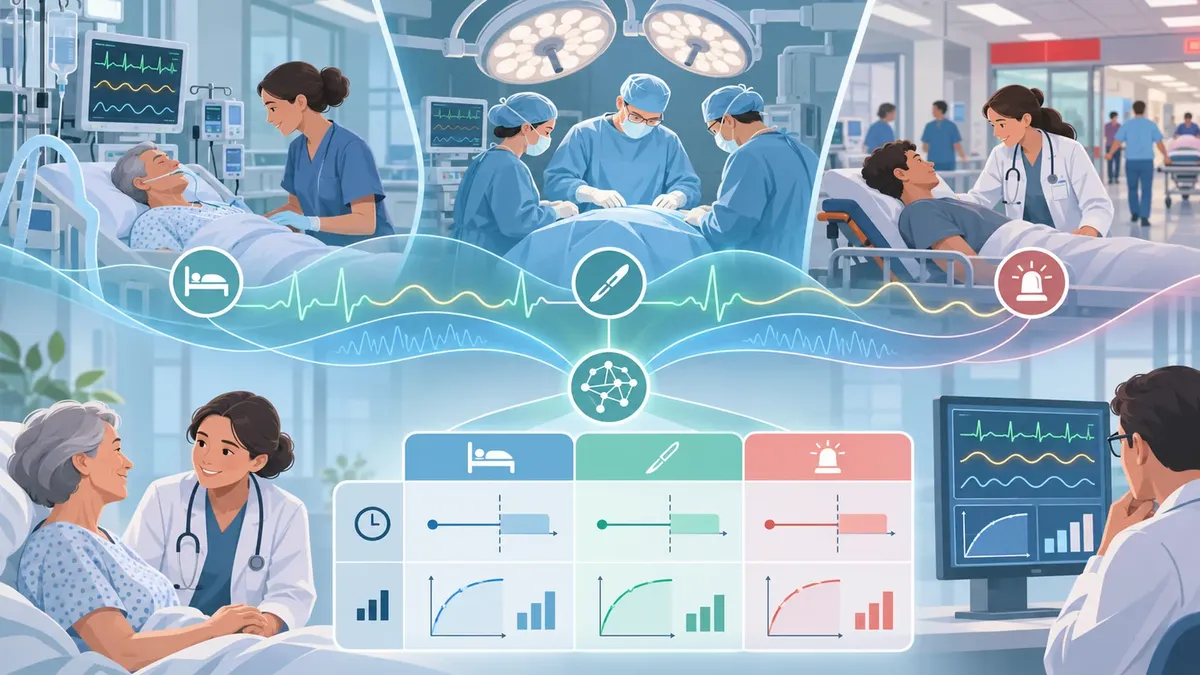
Bedside monitors capture changing physiology, but a model’s apparent performance can depend on when it is asked to predict, how much signal it sees and what other inputs are available. Actionwave is a benchmark designed to make such comparisons more systematic across intensive care, operating rooms and emergency departments.
Why compare models across scenarios?
Bedside monitors produce continuous traces of physiology. These waveforms may help forecast clinical events, but a model score alone can be hard to interpret. A forecast made well before an intervention answers a different question from one made moments beforehand. Likewise, a model using a long stretch of data or several input types may not be directly comparable to one using a short signal alone.
The authors of Actionwave set out to organize these questions in a common evaluation framework. Rather than treating waveform prediction as one generic task, they group clinically grounded tasks by what a model is asked to infer and when it must do so. The benchmark spans three care settings: intensive care, the operating room and the emergency department.
How the benchmark is designed
According to the paper’s abstract, Actionwave applies a shared decision-time prediction interface across tasks. It varies conditions intended to matter in clinical use, including the warning time required before an intervention. The researchers compare diverse model architectures and pretrained biosignal encoders, with specified model-size and compute budgets.
The protocol also sets rules for data handling and comparisons. It requires patient-level splits, so data from a patient are not divided between training and evaluation. It imposes strict information cutoffs, intended to ensure predictions use only information available by the decision point. And it calls for comparisons that isolate individual modeling factors, helping researchers examine choices without changing several factors at once.
The abstract reports that the experiments covered 20 tasks and 1.4 million task-labelled windows drawn from source datasets. The experimental grids involved more than 87,000 model fits. These figures describe the scale of the benchmark exercise; they do not, by themselves, tell us which model is best or whether any model is ready for clinical use.
What the authors report
The paper’s main reported conclusion is that model choices are task-specific. The abstract does not present a single architecture or encoder as a universal winner across the settings and prediction conditions considered. Instead, it highlights why comparisons need to account for the cohort being tested, the inputs given to a model and the timing of its prediction.
The authors particularly emphasize matched cohorts, unimodal controls and explicit timing. These are presented as necessary elements for interpreting waveform-model performance. The abstract does not specify the results of individual control comparisons, so it does not support a more detailed claim about what any particular control reveals.
These are methodological lessons, not evidence that waveform-based systems improve patient outcomes. The abstract does not provide task-by-task scores, identify specific winning models or describe clinical trials. It therefore supports a conclusion about how to evaluate models, not a claim that using one would improve care.
What remains uncertain
A benchmark is only as informative as its tasks, datasets and evaluation rules. The abstract says Actionwave draws on source datasets but does not identify them or give details about patient populations, task definitions, data quality, model results or statistical uncertainty. Without those details, readers cannot assess how representative the evaluations are or judge the size and practical significance of performance differences.
Nor does the abstract establish that predictions will work prospectively in a hospital, transfer to other institutions or help clinicians make better decisions. The emphasis on warning time matters, but the abstract does not say how much warning any system achieved or whether that warning would be useful in practice.
This account is based on the arXiv abstract, not a full-text review. The work is a preprint, and the supplied source record does not establish whether it has undergone peer review. Its reported numbers and conclusions should be read as the authors’ abstract-level summary, not as independently verified clinical evidence. Actionwave’s proposed contribution is a more disciplined framework for comparing waveform models; whether such comparisons lead to reliable bedside tools remains an open question.
- Actionwave
- clinical AI
- waveform prediction
- biosignal models
- benchmarking
- clinical prediction
Reviewed cross-references
These connections were reviewed by a model, not independently fact-checked by a human. Similarity does not imply agreement; consult the original papers and the evidence below.
Heart failure prediction models need stronger validation, review finds
Supporting evidence: Both papers illustrate why prediction results need clearly characterized cohorts and evaluation conditions: Actionwave specifies patient-level splits, strict information cutoffs, and matched comparisons, while the heart-failure review reports heterogeneous cohort definitions and external validation in 23% of included studies. The review concerns heart-failure mortality models, not waveform benchmarks, so this supports only the bounded case for transparent cohort and validation practices—not Actionwave’s findings or generalizability.
Model review: · openai-codex/gpt-6-luna
Evidence and provenance
Selected excerpts, not complete papers. PDF extraction can omit figures or damage equations, tables and reading order; sources may be preprints.
2611.31249v1 — Original paper
Excerpt reference:
static/papers/2611.31249v1.md:16-41
Basis: Paper text
Source SHA-256:b833e0df9817e64e193de21f0371e82d63a1db72159905b8b514794f5dbf10a42611.03665v1 — Original paper
Excerpt reference:
static/papers/2611.03665v1.md:71-150
Basis: Paper text
Source SHA-256:fa4d4cb18fa5961af518e036e0852ad205dea2f75db1b9e36f778bf47c25428b2611.03665v1 — Original paper
Excerpt reference:
static/papers/2611.03665v1.md:764-864
Basis: Paper text
Source SHA-256:fa4d4cb18fa5961af518e036e0852ad205dea2f75db1b9e36f778bf47c25428b
Related reading
Automatically matched by shared topic keywords. These links do not imply that the sources agree or establish a consensus.
MedUIGym tests whether AI can navigate clinical software
Source published
Shared keywords: clinical ai
Teaching EHR models to reason in time
Source published
Shared keywords: clinical prediction
A medical-language AI that explains predictions through concepts
Source published
Shared keywords: clinical prediction
Can language models learn to rank medical risk when follow-up is incomplete?
Source published
Shared keywords: clinical prediction
Can fairness constraints reduce gender gaps in emergency-care AI?
Source published
Shared keywords: clinical prediction