TRANSMISSION // 2611.31235v2
How Simons Observatory Telescopes Can Cross-Calibrate
Source published
Simulations test ways for Simons Observatory instruments to share polarization calibration, showing when transfer may help and what limits remain.
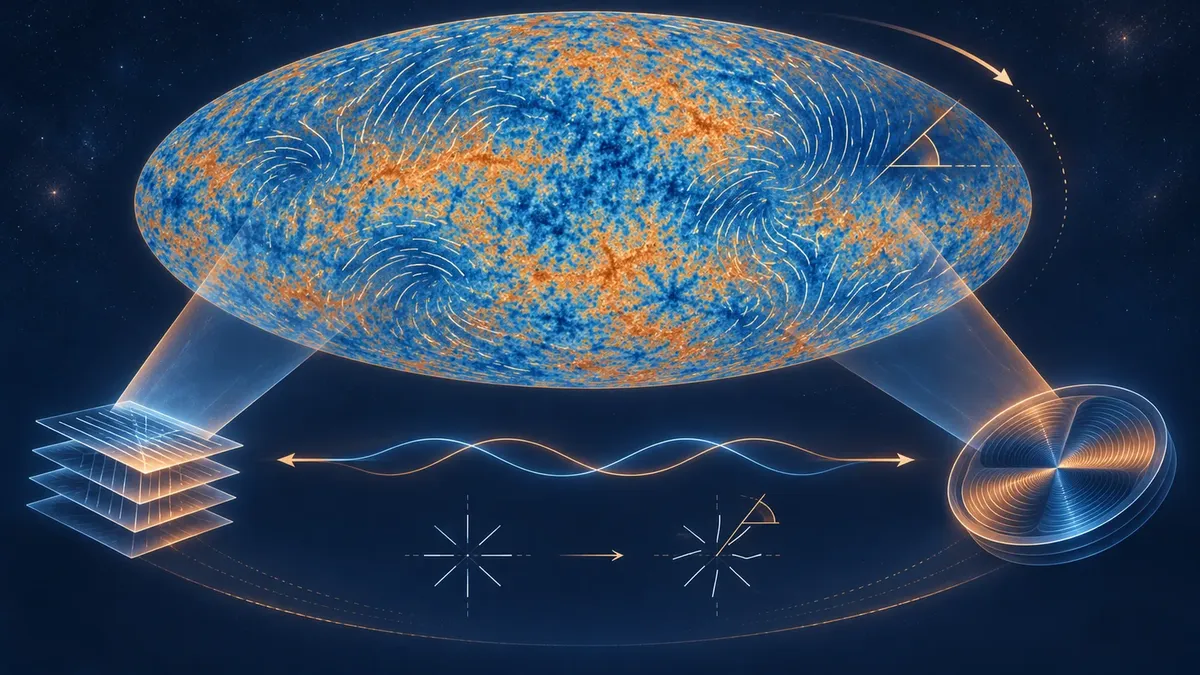
A small rotation of the cosmic microwave background’s polarization could offer a way to test parity-violating physics. But an instrument’s angle error can imitate such a rotation. A simulation study examines whether Simons Observatory telescopes can calibrate one another—and where that approach reaches its limits.
The cosmic microwave background (CMB) carries linear polarization, whose orientation can be measured by telescopes. Cosmic birefringence is a possible rotation of that orientation across the Universe and is a test of parity-violating physics beyond the Standard Model. Yet an error in a telescope’s absolute polarization angle can produce a similar signal, complicating searches for a uniform, or isotropic, rotation.
The study asks whether calibration can be transferred between the Simons Observatory’s Large Aperture Telescope (LAT) and Small Aperture Telescopes (SATs), and what that would mean for measurements of cosmic rotation.
The authors validate two analysis pipelines using map-level simulations. The simulated maps include lensed CMB polarization, polarized Galactic foregrounds, correlated instrumental noise, and polarization-angle miscalibration. One pipeline uses a joint LAT–SAT likelihood to transfer calibration through the instruments’ overlapping sky coverage. The other uses the Minami–Komatsu foreground-based method, which separates cosmic birefringence from instrumental miscalibration using Galactic dust polarization, without an external angle prior.
The main finding is conditional: calibration transfer improves sensitivity only when the combined uncertainties in the reference calibration and the transfer through overlapping observations are smaller than the receiving instrument’s calibration uncertainty. Comparing instruments alone does not guarantee a better calibration.
In the simulated cases, the relative-angle uncertainty is about 0.1 degrees for a SAT maximum multipole of 300, and about 0.04 degrees for a maximum multipole of 600. These are simulation-based results, not measurements of on-sky performance. The abstract notes that they are subject to control of the SAT beam and transfer function.
The authors also identify a limit: transferring calibration does not lower the absolute-angle floor for isotropic rotation. Instead, it anchors the receiving instrument’s multipole range. Thus, improving agreement between instruments does not remove the uncertainty in the absolute angle that limits a uniform-rotation measurement.
Finally, for an assumed rotation of 0.3 degrees, the paper shows how the LAT’s multipole range can distinguish a scale-independent rotation associated with dark energy from scale-dependent axion dark-matter models using the EB polarization correlation. This is a demonstration in the study, not a detection of rotation or evidence that either model describes the Universe.
The evidence available here is the paper’s abstract, rather than its full methods, tables, or uncertainty analysis. It supports the reported simulation setup and headline results, but does not allow independent assessment of further technical details. These findings should therefore be understood as a methods study based on simulations, not as a result from observed sky data. The source is an arXiv preprint; the supplied material does not establish whether it has been peer reviewed.
- cosmic microwave background
- cosmic birefringence
- polarization calibration
- Simons Observatory
- CMB polarization
- instrument systematics
Reviewed cross-references
These connections were reviewed by a model, not independently fact-checked by a human. Similarity does not imply agreement; consult the original papers and the evidence below.
A New Way to Compare the Polarisation Angles of CMB Telescopes
Shared method: Both papers describe using cross-correlations of CMB observations from instruments with overlapping sky coverage to estimate relative polarization-angle misalignment. Rigouzzo et al. forecast using the SO SATs as a calibrated reference, while Lonappan et al. describe a joint LAT–SAT likelihood and calibration transfer in simulations. The excerpts support a shared cross-correlation approach, not an identical estimator; they do not establish that both approaches avoid assumptions about cosmic birefringence or primordial EB.
Model review: · openai-codex/gpt-6-luna
Evidence and provenance
Selected excerpts, not complete papers. PDF extraction can omit figures or damage equations, tables and reading order; sources may be preprints.
2611.31235v2 — Original paper
Excerpt reference:
static/papers/2611.31235v2.md:63-126
Basis: Paper text
Source SHA-256:37f7e6a8bfb9fbb48db907f9da88a6adc422d528dd0322716c383d9574f148122606.11300v2 — Original paper
Excerpt reference:
static/papers/2606.11300v2.md:65-129
Basis: Paper text
Source SHA-256:3038a919f2844b35a909732a93c642e5515a5ae1806da274480104e6d28f7234
Related reading
Automatically matched by shared topic keywords. These links do not imply that the sources agree or establish a consensus.
A New Way to Compare the Polarisation Angles of CMB Telescopes
Source published
Shared keywords: cosmic birefringence, cosmic microwave background, simons observatory
Radio galaxies offer an independent test of cosmic birefringence
Source published
Shared keywords: cmb polarization, cosmic birefringence
Testing a joint method for CMB lensing and polarization rotation
Source published
Shared keywords: cosmic birefringence, cosmic microwave background
What Could Northern CMB Surveys Tell Us About Primordial Gravitational Waves?
Source published
Shared keywords: cosmic microwave background
Lensing Ratios Could Add a New View of Dark Energy
Source published
Shared keywords: simons observatory