TRANSMISSION // 2611.31224v1
How rewiring helps quantum circuits build error-correcting codes
Source published
Simulations suggest that adding long-range links to monitored quantum circuits can produce robust quantum codes in less circuit depth, while also changing how measurements erase stored information.
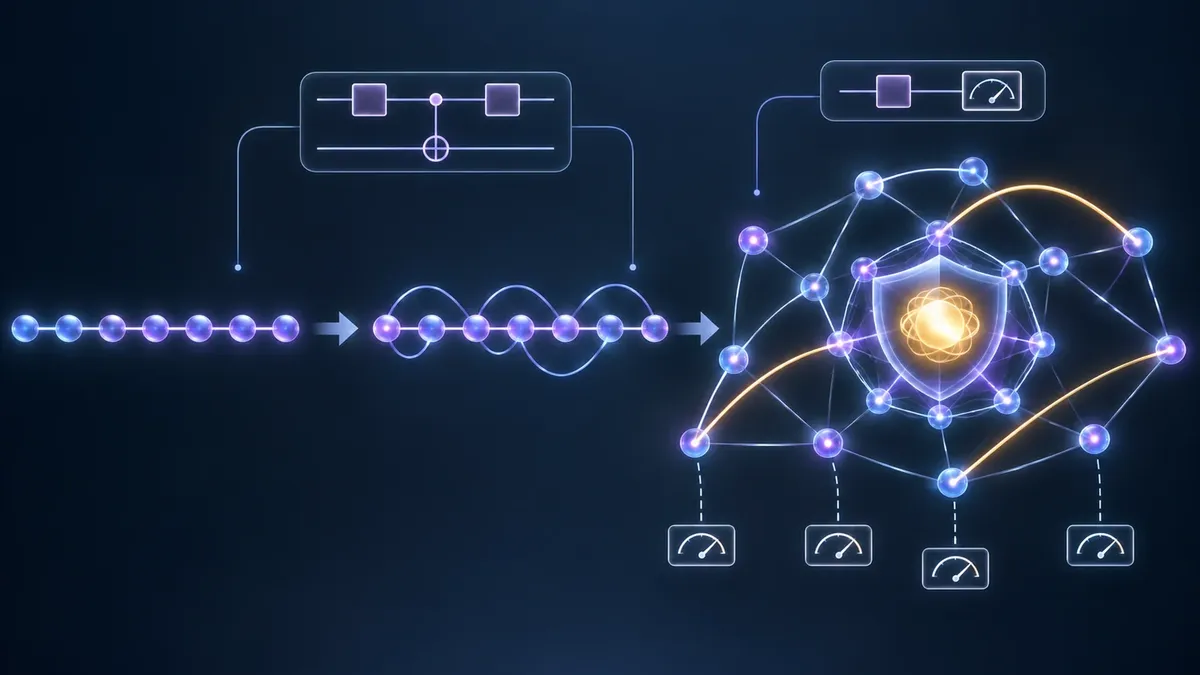
Quantum error-correcting codes protect information by spreading it across many qubits, but building useful codes can demand deep circuits. Samuel Bevins and Gregory Bentsen investigate whether changing the network connections in a monitored random circuit can make code formation faster and tune how much information survives.
Quantum computers are error-prone, so useful computations will need ways to protect quantum information. Error-correcting codes do this by encoding information across multiple physical qubits. A challenge is producing codes that protect information well without requiring long, difficult-to-run circuits.
Samuel Bevins and Gregory Bentsen, in a preprint, study whether the network connecting qubits can help. Their work asks how code properties change when random quantum circuits include measurements and when some of their otherwise local connections are rewired into long-range links.
A circuit with adjustable connections
The researchers simulated monitored random Clifford circuits. Clifford gates are a restricted family of quantum operations that make these circuits especially tractable to simulate. In each circuit layer, random two-qubit gates act on connected pairs, then each qubit is independently measured with a chosen probability. Gates spread quantum information; measurements can remove some of it. Together, the operations determine how many logical qubits survive and how well they are protected.
The allowed connections came from Watts–Strogatz networks: graphs that can be adjusted from a local ring to a network with many rewired links. The researchers varied three controls: the rewiring probability, the measurement rate and the circuit depth. They compared code properties across ensembles of simulated circuits, using several measures of protection. These included a “contiguous distance,” which asks how long an arc of neighboring qubits must be before it exposes logical information, and the probability of losing information under random erasure of qubits.
Shorter depths, with important caveats
On fully rewired networks, the authors report that typical circuits can form codes at depths that grow logarithmically with the number of qubits. On the local ring, the corresponding encoding depth grows polynomially in their simulations. They also find that, at logarithmic depth, the fully rewired circuits produce codes with a finite rate and an extensive mean contiguous distance: as the system grows, this particular distance measure grows in proportion to system size. Their rate–distance results are ensemble averages, however, and the authors note that individual circuits can still produce codes with very small distance.
The qualification about “contiguous” matters. It measures exposed regions that form arcs on the original ring; it is not the full code distance, which considers every possible subset of qubits. The authors also test arbitrary erasures and report fewer failures for the fully rewired ensemble than for the local-ring ensemble in the conditions they studied. They find that many codes in both ensembles have an exposed single qubit, a vulnerability that can dominate failure under low erasure rates. Selecting only codes with distance at least two improves the reported erasure behavior, but also excludes many candidates—especially from the local-ring ensemble.
Rewiring also changes the measurement-induced purification transition: the point at which measurements eliminate the circuit’s capacity to retain quantum information. The fitted critical measurement rate rises with rewiring. The authors’ finite-size analysis also finds different critical exponents for the local ring and fully rewired network. They caution that it remains open whether the change in exponents is continuous as rewiring increases or marks a sharper change in critical behavior.
What the results do—and do not—show
The authors propose a physical interpretation in terms of domain walls, mathematical objects used to describe how information is protected in these circuits. They suggest that long-range links make it more costly, in an information-theoretic sense, to pin a boundary between protected and exposed regions. This mechanism is supported by a phenomenological model, but it is a proposed explanation rather than a direct hardware demonstration.
The study is numerical, using ideal gates and measurements in the simulations. It does not establish that the resulting codes can already be implemented efficiently on a particular device. The paper itself identifies stabilizer-check weights, decoding algorithms and hardware-specific constraints as important next steps. Its scaling claims are inferred from finite system sizes and fits, so they should not be read as guarantees for arbitrarily large systems. In particular, the authors describe code formation as a crossover, not a sharp transition.
The work is available as an arXiv preprint, which may not have undergone peer review. The paper provides simulation code and says its data can be reproduced using recorded random seeds. Those resources support scrutiny, but do not replace independent validation. For now, the main contribution is a design idea: network connectivity, alongside measurement rate and depth, can be treated as a control for exploring the trade-offs in randomly generated quantum codes.
- quantum error correction
- monitored quantum circuits
- small-world networks
- Clifford circuits
- quantum codes
- quantum measurements
Related reading
Automatically matched by shared topic keywords. These links do not imply that the sources agree or establish a consensus.
A hardware-aware route to logical quantum gates
Source published
Shared keywords: quantum error correction
How Impurity Arises in Quantum Code Constructions
Source published
Shared keywords: quantum error correction
When the Most Likely Error Is Not the Best Correction
Source published
Shared keywords: quantum codes, quantum error correction
How quantum-code symmetries fit finite lattices
Source published
Shared keywords: quantum codes, quantum error correction
When Higher-Dimensional Quantum Codes Can Be Decoupled
Source published
Shared keywords: quantum error correction