TRANSMISSION // 2611.31198v1
ToolSmith lets multimodal search agents build new tools
Source published
ToolSmith adds a pipeline for generating and checking reusable tools when a multimodal search agent’s existing toolkit falls short. Tests across 13 benchmarks found higher average accuracy than the base toolkit, though generated tools sometimes introduced errors.
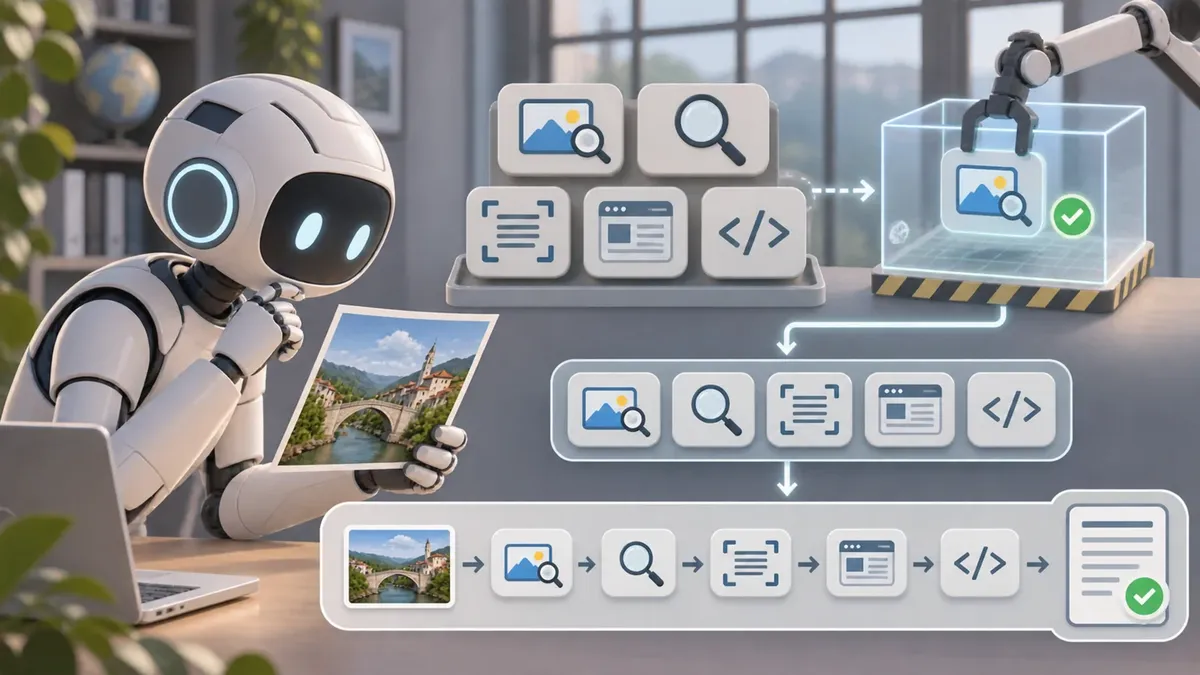
A search agent may need to recognize something in a picture before it can look up the right fact. ToolSmith aims to help agents handle such gaps by generating and checking new software tools from a small set of existing capabilities.
Multimodal search agents combine language, image understanding and web searches to answer questions that may require several steps. Their toolkits can include image search, optical character recognition (OCR), webpage reading and code execution. But a fixed toolkit may not have a ready-made way to solve every new kind of query. Could an agent create a reusable tool when it gets stuck—and check that tool before using it?
That is the question behind ToolSmith, a framework described in a preprint by Rui Sun and colleagues. Rather than give an agent an unlimited set of tools, the researchers start with eight basic ones and add a process for identifying missing capabilities, generating candidate tools and screening them.
From failed attempts to new tools
ToolSmith first examines an agent’s past attempts on training questions. An automated judge flags incorrect answers, and a model then critiques the associated attempts, sorting failures into categories such as needing a new tool, making a reasoning mistake or encountering noisy search results. The framework uses only failures labelled as needing a new tool to identify capability gaps.
Next, it checks whether an existing tool already appears to cover each gap. If not, a language model writes a candidate tool in Python, along with a typed interface and description. The tool can combine existing capabilities—for example, using image search to identify an entity and then searching for information about it.
Candidates must pass two checks before joining the library. One runs the code in a restricted sandbox on a basic test input and checks for certain unsafe patterns. A second uses a language model to review qualities such as whether the tool uses its inputs, handles edge cases and matches its stated purpose. The authors stress that these checks do not guarantee correctness: some flawed tools passed the screening process. At test time, the agent is shown only generated tools judged relevant to the current query, rather than the entire expanded library.
What the tests found
The researchers evaluated ToolSmith on three in-domain benchmarks—FVQA, InfoSeek and EncyclopedicVQA—and ten out-of-domain benchmarks not used to generate the tools. They compared agents using the original eight-tool library with agents given that library plus tools generated by ToolSmith. Final answers were assessed using a vision-language model as a judge, and reported results were averages across three independent runs.
For the Qwen3-VL-8B-Instruct agent, adding tools generated by GPT-5 raised average accuracy by 2.20 percentage points on the in-domain benchmarks and 1.33 points on the out-of-domain benchmarks, relative to the base-tool agent. On the ten out-of-domain benchmarks, the reported average improvement was 2.98 points for Qwen3-VL-32B-Instruct. The paper reports improvements for the tested inference models overall, but the size of the gains varied by model and benchmark; some individual results were flat or slightly lower.
Generated tools were used more often on in-domain than out-of-domain tasks: they accounted for 27% of tool calls in-domain and 15% out-of-domain. The authors interpret the continued, though lower, out-of-domain use as evidence that some tools transferred beyond the tasks used to create them. In examples, tools helped by making the agent identify an image’s subject before searching for related facts. They also sometimes hurt: failures included tools returning incorrect information, visual misidentification and agents trusting a bad tool result over a correct result from a basic tool.
How much confidence is warranted?
These results support a limited conclusion: in this particular setup, adding automatically generated tools improved average benchmark accuracy over the same agents’ base toolkits. They do not show that tool generation will improve every search system or every type of query. The evaluation uses a specific set of models, tools, benchmarks and a model-based answer judge, and the authors note that live search services and proprietary models can change, making exact reproduction difficult.
The reported safety checks are also not a proof that generated code is safe or reliable. The paper gives examples of flawed candidates that passed checks or produced incorrect information. ToolSmith does not generate tools that create images, which the authors list as outside the work’s scope. In addition, the authors describe code and data as available through a project site, but access to materials alone would not independently confirm the reported results.
ToolSmith is presented in an arXiv preprint, a publicly shared research paper that may not have undergone peer review. Its findings are therefore best treated as a reported benchmark result and a proposal for further testing—not as evidence that autonomous tool-building is ready for unsupervised use.
- ToolSmith
- multimodal search
- AI agents
- automatic tool generation
- vision-language models
- benchmark evaluation
Reviewed cross-references
These connections were reviewed by a model, not independently fact-checked by a human. Similarity does not imply agreement; consult the original papers and the evidence below.
Teaching an AI search agent when to look for images
Supporting evidence: Both papers report benchmark gains in multimodal search settings associated with tool capability: ToolSmith reports improvements after admitting generated tools, while ModalSearcher reports accuracy decreases when visual-search tools are removed. These are separate experiments with different systems, benchmarks, and interventions; they support only the bounded point that tool capabilities can contribute to performance, not a direct comparison of methods or effect sizes.
Model review: · openai-codex/gpt-6-luna
Evidence and provenance
Selected excerpts, not complete papers. PDF extraction can omit figures or damage equations, tables and reading order; sources may be preprints.
2611.31198v1 — Original paper
Excerpt reference:
static/papers/2611.31198v1.md:194-266
Basis: Paper text
Source SHA-256:a9b7ab5c509386bbe3bd13427b0e5d791b1679e6d2047363ac3c77b5d6345f9c2611.06131v1 — Original paper
Excerpt reference:
static/papers/2611.06131v1.md:1053-1096
Basis: Paper text
Source SHA-256:cdd43387fc30cb09553940327b0e6f85b77144dd0819fa333040629da7e651cd
Related reading
Automatically matched by shared topic keywords. These links do not imply that the sources agree or establish a consensus.
When an AI search agent finds nothing, the problem may be the search world
Source published
Shared keywords: ai agents, benchmark evaluation, multimodal search
Do AI models really combine evidence across images?
Source published
Shared keywords: benchmark evaluation, vision language models
ScopeAct divides smartphone tasks between AI models
Source published
Shared keywords: vision language models
Giving AI Agents the Right Roles in Program Evolution
Source published
Shared keywords: ai agents, benchmark evaluation
TASTE builds tougher, broader tool-use tests for AI agents
Source published
Shared keywords: ai agents, benchmark evaluation